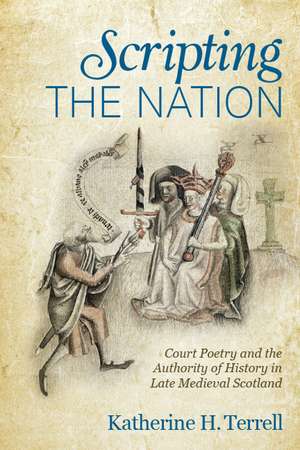
Scripting the Nation: Court Poetry and the Authority of History in Late Medieval Scotland: Interventions: New Studies in Medieval Culture
Autor Katherine H. Terrellen Limba Engleză Hardback – apr 2021
Evoluția studiilor medievale recente indică o reevaluare profundă a modului în care identitățile naționale au fost construite prin text, dincolo de simplele cronici politice. Descoperim aici, în lucrarea semnată de Katherine H. Terrell, o analiză riguroasă a modului în care poezia de curte din Scoția medievală târzie a servit drept instrument de legitimare istorică și culturală. Scripting the Nation nu se limitează la o critică literară estetică, ci plasează operele lui William Dunbar, Walter Kennedy și Gavin Douglas într-un dialog direct cu istoriografia latină a unor cronicari precum John of Fordun.
Notăm cu interes modul în care autoarea demonstrează că acești poeți nu au fost simpli imitatori ai tradiției engleze. Cititorii familiarizați cu The Trojan Legend in Medieval Scottish Literature de Emily Wingfield vor aprecia modul în care Katherine H. Terrell extinde discuția de la mitul troian la o strategie mai amplă de subvertire a autorității literare a lui Geoffrey Chaucer. În timp ce Emily Wingfield se concentrează pe o singură legendă, Scripting the Nation analizează cum poezia vernaculară a preluat ștafeta de la cronicile latine pentru a combate pretențiile de hegemonie ale Angliei.
Structura volumului reflectă o progresie logică de la mecanismele diplomației și genealogiei, în primele capitole, către studii de caz aplicate pe textele fundamentale ale epocii. Un punct central al lucrării îl reprezintă analiza traducerii Eneados de către Gavin Douglas, interpretată nu doar ca un act literar, ci ca o afirmație politică a suveranității limbii scoțiene. Prin această abordare, volumul publicat de Ohio State University Press devine o piesă esențială pentru înțelegerea modului în care autoritatea istorică a fost „scrisă” pentru a defini o națiune.
Din seria Interventions: New Studies in Medieval Culture
-
 Preț: 270.86 lei
 -
 Preț: 248.35 lei
 -
 Preț: 248.35 lei
 -
 Preț: 246.01 lei
 -
 Preț: 282.89 lei
 -
 Preț: 306.33 lei
 -
 Preț: 316.07 lei
 -
 Preț: 314.92 lei
 -
 Preț: 273.94 lei
 -
 Preț: 314.92 lei
 -
 Preț: 314.92 lei
 -
 Preț: 297.08 lei
 -
 Preț: 249.85 lei
 -
 Preț: 254.88 lei
 -
 Preț: 288.69 lei
 -
 Preț: 157.76 lei
 -
 Preț: 236.86 lei
 -
 Preț: 240.41 lei
 -
 Preț: 254.88 lei
 -
 Preț: 300.13 lei
 -
 Preț: 300.13 lei
 -
 Preț: 274.08 lei
 -
 Preț: 273.03 lei
 -
 Preț: 286.07 lei
 - 23%
 Preț: 609.89 lei
 - 19%
 Preț: 589.22 lei
 - 23%
 Preț: 670.32 lei
 - 19%
 Preț: 657.64 lei
Preț: 717.14 lei
Preț vechi: 833.88 lei
-14%
Carte disponibilă
Livrare economică 11-25 noiembrie
Livrare express 27-31 octombrie pentru 30.100 lei
Specificații
ISBN-10: 0814214622
Pagini: 234
Ilustrații: 1 b&w
Dimensiuni: 152 x 229 x 23 mm
Greutate: 0.45 kg
Ediția:1
Editura: Ohio State University Press
Colecția Ohio State University Press
Seria Interventions: New Studies in Medieval Culture
De ce să citești această carte
Această lucrare este esențială pentru cercetătorii interesați de formarea identităților naționale în Evul Mediu. Cititorul câștigă o perspectivă nouă asupra modului în care poezia poate funcționa ca instrument diplomatic și politic. Este o recomandare certă pentru cei care doresc să înțeleagă relația complexă dintre literatura scoțiană și cea engleză, oferind argumente solide despre cum cultura poate subverti puterea politică prin redefinirea trecutului.
Despre autor
Katherine H. Terrell este o specialistă recunoscută în literatura medievală, cu un interes academic profund pentru intersecția dintre istoriografie, identitate națională și tradiții poetice. Prin activitatea sa în cadrul seriei Interventions: New Studies in Medieval Culture, ea contribuie la redefinirea canonului literar scoțian. Expertiza sa se concentrează pe modul în care autorii medievali din spațiul britanic au utilizat textele vernaculare pentru a negocia poziții de autoritate în raport cu tradiția latină și cu marile figuri literare ale epocii, precum Chaucer, oferind perspective critice noi asupra perioadei de tranziție către Renaștere.
Descriere scurtă
Recenzii
“Terrell’s persuasive and deeply scholarly study weaves together literary and historiographical scholarship to offer substantial new insights into the poetry associated with the court of James IV, a period crucial for both the development of Older Scots literature and for Scotland’s transformed sense of itself as a nation.” —Rhiannon Purdie, editorial secretary of the Scottish Text Society
“Scripting the Nation is impressively rigorous in its analysis and based on an intimate knowledge of the texts discussed and the contexts in which they were written. It has strong interdisciplinary credentials and contributes substantially to ongoing research in the fields of Scottish and English literature as well as engaging with issues of cultural and national identity.” —Roger A. Mason, editor of Scots and Britons: Scottish Political Thought and the Union of 1603
“This book is a very timely intervention in a medieval studies that is currently looking long and hard at its historical allegiances to nationalisms past and present.” —Antony J. Hasler, author of Court Poetry in Late Medieval England and Scotland: Allegories of Authority
Notă biografică
Extras
As the period during which Scottish culture first began to coalesce around the royal court, James IV’s reign provides a focal point for the poetic texts under consideration in this book. Accordingly, two of the poems most obviously and intimately concerned with Scottish nationalism—John Barbour’s Bruce and Blind Hary’s Wallace—fall outside the scope of this study. Their perspectives on nationalism and their links to the chronicle tradition have already been well explored, most notably by James Goldstein. In choosing to focus, instead, on the court poetry of Kennedy, Douglas, and Dunbar, I address a site of nationalist discourse that is at once more subtle and more complex than Barbour’s and Hary’s poems dealing directly with the Scottish Wars of Independence. While Barbour sought to celebrate and strengthen a nascent monarchy, and Hary to further bolster Scottish nationalism in response to James III’s pro-English policies, the poets of James IV’s reign were concerned with a different set of questions. As Sally Mapstone has argued, “It would be quite wrong to suggest that court life and courtly literature, even the court poet, had the same character before the 1490s as they were to have after them.” James IV’s mature rule opened up a brief space in which Scottish poets could ask not what it was to become a nation but what it was to inhabit one. I contend that this court poetry, written more than a century after Scotland’s reestablishment as an independent nation, seeks to consolidate Scottish national identity through its focus on the court as a site of Scottish self-definition and its persistent concern with marking out a distinct realm of Scottish cultural and poetic achievement.
Cuprins
Chapter 1 On the Uses of the Past: Diplomacy, Genealogy, and Historiography
Chapter 2 Subversive Histories: Strategies of Identity in Scottish Historiography
Chapter 3 “Ane worthier genology”: Translatio Imperii and the Divine Imperative of History
Chapter 4 Legacies of Nationalist Historiography and the Founding of Scottish Poetry
Chapter 5 Literary Genealogy and National Identity in Dunbar and Kennedy
Chapter 6 From Courtly Love to Court Poetics: Dunbar’s Petitions and the Scottish Transformation of Tradition
Chapter 7 “Writtin in the Langage of Scottis Natioun”: The Political Poetry of Douglas’s Eneados
Epilogue
Bibliography
Index