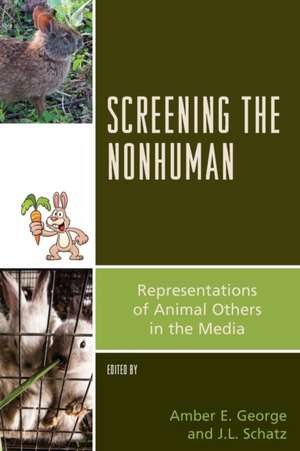
Screening the Nonhuman: Representations of Animal Others in the Media: Critical Animal Studies and Theory
Editat de Amber E. George, J.L. Schatz Contribuţii de Joseph Anderton, Michael Atkinson, Fernando Pagnoni Berns, Christina Victoria Cedillo, Stella Hockenhull, Anja Höing, am Husemann, Fiona Yuk-wa Law, Matthew Lerberg, César Marino, Guilherme Nothen, Sean Parson, Jennifer Polish, Carter Solesen Limba Engleză Paperback – 6 noi 2018



Preț: 285.17 lei
Preț vechi: 388.44 lei
-27%
Puncte Express: 428
Carte tipărită la comandă
Livrare economică 05-19 decembrie
Livrare prin curier în România Termenul estimat este afișat lângă disponibilitate.
Transport gratuit de la 400.00 lei Plată online sau ramburs, în funcție de opțiunile comenzii.
Retur gratuit în 14 zile Comandă securizată și suport în română.
Specificații
ISBN-13: 9781498513760
ISBN-10: 149851376X
Pagini: 240
Dimensiuni: 151 x 219 x 18 mm
Greutate: 0.35 kg
Editura: Bloomsbury Publishing
Colecția Lexington Books
Seria Critical Animal Studies and Theory
Locul publicării:New York, United States
ISBN-10: 149851376X
Pagini: 240
Dimensiuni: 151 x 219 x 18 mm
Greutate: 0.35 kg
Editura: Bloomsbury Publishing
Colecția Lexington Books
Seria Critical Animal Studies and Theory
Locul publicării:New York, United States
Cuprins
Introduction: Critical Media Studies and Critical Animal Studies at the Crossroads, Amber George and J.L. Schatz
Part I
Chapter One: The Brown Wizard's Unexpected Politics: Speciesist Fiction and the Ethics of The Hobbit, J.L. Schatz
Chapter Two: The Passing Faerie and the Transforming Raven: Animalized Compulsory Re-covery, Endurance, and Dis/ability in Maleficent, Jennifer Polish
Chapter Three: Jabbering Jaws: Reimagining Representations of Sharks Post-Jaws, Matthew Lerberg
Chapter Four: Horseplay: Beastly Cinematic Performances in Steven Spielberg's War Horse, Stella Hockenhull
Chapter Five: Would Bugs Bunny Have Diabetes?: The Realistic Consequences of Cartoons for Non/Human Animals, Amber E. George
Part II
Chapter Six: I Am Legend (2007), U.S. Imperialism, and the Liminal Animality of "The Last Man, Carter Soles
Chapter Seven: Ape Anxiety: Intelligence, Human Supremacy, and Rise and Dawn of the Planet of the Apes, Sean Parson
Chapter Eight: The Vicious Cycle of Disnification and Audience De
Part I
Chapter One: The Brown Wizard's Unexpected Politics: Speciesist Fiction and the Ethics of The Hobbit, J.L. Schatz
Chapter Two: The Passing Faerie and the Transforming Raven: Animalized Compulsory Re-covery, Endurance, and Dis/ability in Maleficent, Jennifer Polish
Chapter Three: Jabbering Jaws: Reimagining Representations of Sharks Post-Jaws, Matthew Lerberg
Chapter Four: Horseplay: Beastly Cinematic Performances in Steven Spielberg's War Horse, Stella Hockenhull
Chapter Five: Would Bugs Bunny Have Diabetes?: The Realistic Consequences of Cartoons for Non/Human Animals, Amber E. George
Part II
Chapter Six: I Am Legend (2007), U.S. Imperialism, and the Liminal Animality of "The Last Man, Carter Soles
Chapter Seven: Ape Anxiety: Intelligence, Human Supremacy, and Rise and Dawn of the Planet of the Apes, Sean Parson
Chapter Eight: The Vicious Cycle of Disnification and Audience De
Recenzii
Our fellow animals have had rough treatment on film-like many of our fellow humans. But they cannot organize and protest like we can. The book you have before you gives us tools and evidence to make the case on their behalf. Freedom from harm is a basic animal right, and that applies to issues of representation as well as physical treatment. Their cause must be our cause.
Finally, analyses of animal representations in popular culture from an explicitly Critical Animal Studies point of view. I enthusiastically recommend Screening the Nonhuman: Representations of Animal Others to those who want to enhance visual literacy while opening their minds to the revolutionary perspective of total liberation.
A wonderfully insightful, provocative, and much needed book that combines critical theory, media analysis, and cultural studies with the ethics and urgency of animal liberation politics. This crossover work builds bridges between activism, academia, and the general public, and will surely inspire discussion and debate about the role of nonhuman animals in both film and society.
Finally, analyses of animal representations in popular culture from an explicitly Critical Animal Studies point of view. I enthusiastically recommend Screening the Nonhuman: Representations of Animal Others to those who want to enhance visual literacy while opening their minds to the revolutionary perspective of total liberation.
A wonderfully insightful, provocative, and much needed book that combines critical theory, media analysis, and cultural studies with the ethics and urgency of animal liberation politics. This crossover work builds bridges between activism, academia, and the general public, and will surely inspire discussion and debate about the role of nonhuman animals in both film and society.