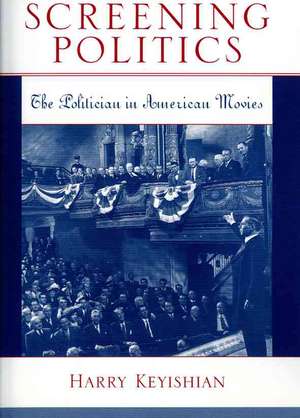
Screening Politics: The Politician in American Movies
Autor Harry Keyishianen Limba Engleză Paperback – 14 sep 2006
Preț: 361.88 lei
Preț vechi: 483.54 lei
-25%
Puncte Express: 543
Carte tipărită la comandă
Livrare economică 08-22 decembrie
Livrare prin curier în România Termenul estimat este afișat lângă disponibilitate.
Transport gratuit de la 400.00 lei Plată online sau ramburs, în funcție de opțiunile comenzii.
Retur gratuit în 14 zile Comandă securizată și suport în română.
Specificații
ISBN-13: 9780810858824
ISBN-10: 0810858827
Pagini: 199
Dimensiuni: 139 x 217 x 16 mm
Greutate: 0.31 kg
Editura: Bloomsbury Publishing
Colecția Scarecrow Press
Locul publicării:New York, United States
ISBN-10: 0810858827
Pagini: 199
Dimensiuni: 139 x 217 x 16 mm
Greutate: 0.31 kg
Editura: Bloomsbury Publishing
Colecția Scarecrow Press
Locul publicării:New York, United States
V-ar putea interesa
-
 -35%Preț: 745.61 lei1150.86 lei
 -
 -31%Preț: 631.98 lei913.29 lei
 -
 The Epic in Film: From Myth to BlockbusterConstantine Santas-20%Preț: 311.99 lei389.85 lei
 -
 The Essential Guide to Mummy LiteratureBrian J. Frost-33%Preț: 582.96 lei863.86 lei
 -
 Film Culture ReaderAdams P. SitneyPreț: 132.48 lei
 -
 Son of the 100 Best Movies You've Never SeenRichard Crouse-30%Preț: 95.66 lei135.78 lei
Recenzii
Keyishian (English, Fairleigh Dickinson U.) describes and analyzes more than 50 films dealing with politicians and the political process in the U.S. He provides an overview of the development of the genre in the introduction, while the main part of the volume consists of alphabetically arranged entries discussing individual films. This is the first paperback edition of a work previously published in 2003.
This book is an eclectic anthology about fifty-eight feature films released over a neat seven-decade period....interesting...
Harry Keyishian discusses how films help to shape our understanding of the American political process. He shows how the populist films of the Depression era, with their endorsement of the progressive ideals of Roosevelt's New Deal, gave way to a generally more ambiguous view of politics and politicians after World War II. . . Keyishian points out that despite the cynicism of the post-Watergate era, or perhaps precisely because of it, the reedemer hero of the 1930s has returned.
This book is an eclectic anthology about fifty-eight feature films released over a neat seven-decade period....interesting...
Harry Keyishian discusses how films help to shape our understanding of the American political process. He shows how the populist films of the Depression era, with their endorsement of the progressive ideals of Roosevelt's New Deal, gave way to a generally more ambiguous view of politics and politicians after World War II. . . Keyishian points out that despite the cynicism of the post-Watergate era, or perhaps precisely because of it, the reedemer hero of the 1930s has returned.