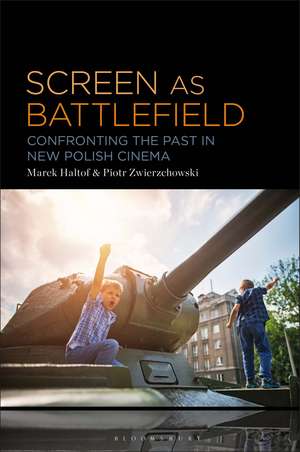
Screen as Battlefield: Confronting the Past in New Polish Cinema
Autor Marek Haltof, Piotr Zwierzchowskien Limba Engleză Hardback – 12 oct 2026
It analyzes not only how local filmmakers have represented the last century's complex history, but also how various government institutions have tried to influence the cinematic vision of the past through funding (or the lack of it) and by using political pressure.
The year 1989 was as a turning point in Polish history, marking the peaceful transition from a totalitarian system to democracy. After years of mythologizing history, Polish past was finally present on Polish screens. Previously banned or available only in censored versions, historical subjects became prominent in cinema theatres and on television. These topics have included, among others, the Soviet-Nazi pact and aggression on Poland in 1939, the Soviet occupation of the entire region after 1945, the brutal imposition of communist rule, and the Stalinist legacy. Since the founding of the Polish Film Institute (PISF) in 2005, more than one hundred theatrically released films have dealt with Polish history. Several of them received international acclaim and festival awards; they were also popular at the box office. Screen as Battlefield discusses several internationally known films, among them The Pianist (2002), Katyn (2007), Rose (2011), Ida (2013), Warsaw '44 (2014), Volhynia (aka Hatred, 2016), and Cold War (2018).
Preț: 628.48 lei
Preț vechi: 926.65 lei
-32% Precomandă
Puncte Express: 943
Carte nepublicată încă
Livrare prin curier în România Precomanda se expediază când titlul devine disponibil.
Transport gratuit pentru acest produs Plată online sau ramburs, în funcție de opțiunile comenzii.
Retur gratuit în 14 zile Comandă securizată și suport în română.
Doresc să fiu notificat când acest titlu va fi disponibil:
Se trimite...
Specificații
ISBN-13: 9781501382772
ISBN-10: 1501382772
Pagini: 256
Ilustrații: 30 bw illus
Dimensiuni: 152 x 229 x 25 mm
Greutate: 0.45 kg
Editura: Bloomsbury Publishing
Colecția Bloomsbury Academic
Locul publicării:New York, United States
ISBN-10: 1501382772
Pagini: 256
Ilustrații: 30 bw illus
Dimensiuni: 152 x 229 x 25 mm
Greutate: 0.45 kg
Editura: Bloomsbury Publishing
Colecția Bloomsbury Academic
Locul publicării:New York, United States
Cuprins
Acknowledgments
Abbreviations
1. Introduction: History, Memory, and Politics in Polish Cinema
2. Józef Pilsudski and the 100th Anniversary of Polish Independence: Between the "Pedagogy of Pride" and the Revision of History
3. Double Memory: New Films about the Holocaust
4. Between Hitler and Stalin: Cinematic Representations of Polish "Bloodlands" and the Aftermath
5. The Polish Communist Apparatus on the Screen
6. The Return of the Communist Past as a Genre Film
Select Filmography
Select Bibliography
Index
Abbreviations
1. Introduction: History, Memory, and Politics in Polish Cinema
2. Józef Pilsudski and the 100th Anniversary of Polish Independence: Between the "Pedagogy of Pride" and the Revision of History
3. Double Memory: New Films about the Holocaust
4. Between Hitler and Stalin: Cinematic Representations of Polish "Bloodlands" and the Aftermath
5. The Polish Communist Apparatus on the Screen
6. The Return of the Communist Past as a Genre Film
Select Filmography
Select Bibliography
Index
Recenzii
Marek Haltof and Piotr Zwierzchowski discuss an impressive corpus of films which, with few exceptions, is little known outside Poland. Many of these films have often been the source of heated debate due to the subject matter, deemed sensitive for historical or political reasons. In this way, the book, authored by two authorities in the field of Polish cinema, provides a major contribution to our knowledge of the last 30 years of Polish cinema, including the industrial, political, and historical sources that have shaped it and will resonate with audiences in both the English-speaking world and in Poland.
This impeccably researched book covers a vast range of motion pictures that grapple with the tensions of postwar - and especially post-Communist - Poland. Having carefully watched over 100 films, the authors illuminate the intersections of political history and cinematic representation. This timely study reminds us that in Poland, movies matter.
History did not end with the collapse of communism, and neither did Polish cinema's intricate engagement with the past, which has continued to be shaped-just as before-by the politics of the present. Zwierzchowski and Haltof offer a sweeping panorama of post-1989 films that grapple with the regions and the country's tumultuous twentieth-century history, from the interwar years, through the Second World War and the Holocaust, to the communist era. The breadth of their coverage is matched by the depth of their insights, resulting in an account that is both comprehensive and consistently engaging.
This impeccably researched book covers a vast range of motion pictures that grapple with the tensions of postwar - and especially post-Communist - Poland. Having carefully watched over 100 films, the authors illuminate the intersections of political history and cinematic representation. This timely study reminds us that in Poland, movies matter.
History did not end with the collapse of communism, and neither did Polish cinema's intricate engagement with the past, which has continued to be shaped-just as before-by the politics of the present. Zwierzchowski and Haltof offer a sweeping panorama of post-1989 films that grapple with the regions and the country's tumultuous twentieth-century history, from the interwar years, through the Second World War and the Holocaust, to the communist era. The breadth of their coverage is matched by the depth of their insights, resulting in an account that is both comprehensive and consistently engaging.