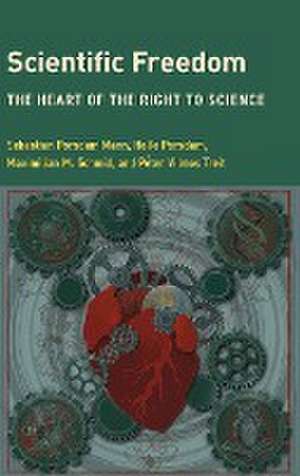
Scientific Freedom: The Heart of the Right to Science: Global Epistemics
Autor Sebastian Porsdam Mann, Helle Porsdam, Maximilian M. Schmid, Péter Vilmos Treiten Limba Engleză Hardback – 16 ian 2024
Drawing on rigorous interdisciplinary methods, this book defines the concept of scientific freedom, tells its story, and asks on what basis scientific freedom is best justified. Based on international human rights law and philosophy, the authors develop a model of scientific freedom as a constitutive element of the human right to enjoy the benefits of the progress of science and its applications. To illustrate its usefulness, they then test and apply this model to a real-life and real-time case study, as well as to two highly important international human rights instruments.


Preț: 491.24 lei
Preț vechi: 721.23 lei
-32%
Puncte Express: 737
Carte disponibilă
Livrare economică 09-23 noiembrie
Livrare prin curier în România Termenul estimat este afișat lângă disponibilitate.
Transport gratuit pentru acest produs Plată online sau ramburs, în funcție de opțiunile comenzii.
Retur gratuit în 14 zile Comandă securizată și suport în română.
Specificații
ISBN-13: 9781538178379
ISBN-10: 1538178370
Pagini: 222
Ilustrații: 2 BW Photos, 2 Tables
Dimensiuni: 150 x 232 x 18 mm
Greutate: 0.49 kg
Editura: Bloomsbury Publishing
Colecția Rowman & Littlefield
Seria Global Epistemics
Locul publicării:New York, United States
ISBN-10: 1538178370
Pagini: 222
Ilustrații: 2 BW Photos, 2 Tables
Dimensiuni: 150 x 232 x 18 mm
Greutate: 0.49 kg
Editura: Bloomsbury Publishing
Colecția Rowman & Littlefield
Seria Global Epistemics
Locul publicării:New York, United States
Cuprins
Opening Vignette: Artificial Intelligence and Introduction
PART ONE: Setting the Scene and Providing the Necessary Historical Background
Chapter 1: Historical Background and Key Concepts And Definitions
Chapter 2: A Systematic Review of The Scholarly Literature On Scientific Freedom: Methods And Results
Chapter 3: Taking Human Right to the Next Level: The Right to Science, History and Content
Chapter 4: Scientific Freedom: How Does It Relate to Scientific Dissemination and International Co-Operation?
PART TWO: SAFIRES: A Conceptual Model of Scientific Freedom Obligations under International Human Rights Law
Chapter 5: The SAFIRES (Scientific and Academic Freedom as Integral elements of the Right to Enjoy the benefits of Science) Model
Chapter 6: The Scope of 'Science' and 'Scientific Freedom' in Three Human Rights Instruments
PART THREE: Working with Scientific Freedom And The Right To Science In Practice
Chapter 7: On Drafting the General Comment on Science (2013-2020): A Personal Account, Mikel Mancisidor
Chapter 8: Litigating the Right to Science before the CESCR: the View from the Trenches, Cesare P.R. Romano
Chapter 9: Defending Science, Knowledge and Facts: The UN And Scientific Freedom Of Expression, Malene Nielsen and Carsten Staur
Appendices
Index
PART ONE: Setting the Scene and Providing the Necessary Historical Background
Chapter 1: Historical Background and Key Concepts And Definitions
Chapter 2: A Systematic Review of The Scholarly Literature On Scientific Freedom: Methods And Results
Chapter 3: Taking Human Right to the Next Level: The Right to Science, History and Content
Chapter 4: Scientific Freedom: How Does It Relate to Scientific Dissemination and International Co-Operation?
PART TWO: SAFIRES: A Conceptual Model of Scientific Freedom Obligations under International Human Rights Law
Chapter 5: The SAFIRES (Scientific and Academic Freedom as Integral elements of the Right to Enjoy the benefits of Science) Model
Chapter 6: The Scope of 'Science' and 'Scientific Freedom' in Three Human Rights Instruments
PART THREE: Working with Scientific Freedom And The Right To Science In Practice
Chapter 7: On Drafting the General Comment on Science (2013-2020): A Personal Account, Mikel Mancisidor
Chapter 8: Litigating the Right to Science before the CESCR: the View from the Trenches, Cesare P.R. Romano
Chapter 9: Defending Science, Knowledge and Facts: The UN And Scientific Freedom Of Expression, Malene Nielsen and Carsten Staur
Appendices
Index
Recenzii
Although scientific freedom is clearly at the heart of the right to science as a human right, it is less clear what this freedom entails and how it interacts with other rights and freedoms. This book is the first to provide a very comprehensive and accessible analysis of the historical, theoretical and practical dimensions of scientific freedom. A must-read for professionals and policymakers in this field!
This book adds remarkably to the still-young debate on the right to science by highlighting that scientific freedom is the centrepiece of the right to science-as it best guarantees scientific progress. Those who believe that the right to science might usefully be appropriated for purely goal- and priority-based research should read this book to find a better understanding.
This nuanced, comprehensive and in-depth reassessment of scientific freedom as a constitutive element of the human right to science comes at the right moment. With a fresh perspective, the authors compellingly frame scientific freedom as a universal cultural human right and highlight its importance for democratic societies.
What is scientific freedom, why does it matter, and just as importantly, when must it be limited? These questions are both perennial and utterly timely, and this book dives into them with flair, focus, and a profound commitment to the future of human rights.
This book adds remarkably to the still-young debate on the right to science by highlighting that scientific freedom is the centrepiece of the right to science-as it best guarantees scientific progress. Those who believe that the right to science might usefully be appropriated for purely goal- and priority-based research should read this book to find a better understanding.
This nuanced, comprehensive and in-depth reassessment of scientific freedom as a constitutive element of the human right to science comes at the right moment. With a fresh perspective, the authors compellingly frame scientific freedom as a universal cultural human right and highlight its importance for democratic societies.
What is scientific freedom, why does it matter, and just as importantly, when must it be limited? These questions are both perennial and utterly timely, and this book dives into them with flair, focus, and a profound commitment to the future of human rights.