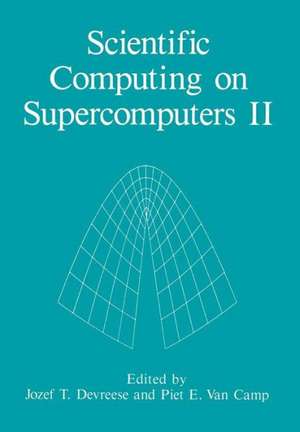
Scientific Computing on Supercomputers II
Editat de J. T. Devreeseen Limba Engleză Paperback – 4 oct 2011
Preț: 376.69 lei
Puncte Express: 565
Carte tipărită la comandă
Livrare economică 28 noiembrie-12 decembrie
Livrare prin curier în România Termenul estimat este afișat lângă disponibilitate.
Transport gratuit de la 400.00 lei Plată online sau ramburs, în funcție de opțiunile comenzii.
Retur gratuit în 14 zile Comandă securizată și suport în română.
Specificații
ISBN-13: 9781461279143
ISBN-10: 1461279143
Pagini: 264
Ilustrații: 260 p.
Dimensiuni: 170 x 244 x 15 mm
Greutate: 0.46 kg
Ediția:Softcover reprint of the original 1st ed. 1990
Editura: Springer
Locul publicării:New York, NY, United States
ISBN-10: 1461279143
Pagini: 264
Ilustrații: 260 p.
Dimensiuni: 170 x 244 x 15 mm
Greutate: 0.46 kg
Ediția:Softcover reprint of the original 1st ed. 1990
Editura: Springer
Locul publicării:New York, NY, United States
V-ar putea interesa
-
 Scientific Computing on Supercomputers IIIP. E. van Camp-20%Preț: 1024.29 lei1280.36 lei
 -
 Numerical Methods for Experimental MechanicsDonald Berghaus-18%Preț: 981.00 lei1196.34 lei
 -
 An Introduction to Engineering MathematicsD. McmullinPreț: 434.72 lei
 -
 An Introduction to Applied MechanicsEwart S. AndrewsPreț: 417.34 lei
 -
 Scientific Computing on SupercomputersJ. T. DevreesePreț: 378.84 lei
 -
 AB Initio Calculation of Phonon SpectraJ.T. Devreese-15%Preț: 618.64 lei727.80 lei
 -
 The Application of Mathematics to the Sciences of NatureClaudio Pellegrini-18%Preț: 953.91 lei1163.30 lei
 -
 -15%Preț: 636.05 lei748.30 lei
 -
 Symmetries in Science VBruno GruberPreț: 421.22 lei
 -
 -15%Preț: 623.52 lei733.55 lei
 -
 Inverse Problems, Tomography, and Image ProcessingAlexander G. Ramm-15%Preț: 642.38 lei755.74 lei
 -
 Scientific Computing on Supercomputers IIIJ.T. Devreese-20%Preț: 945.50 lei1181.87 lei
 -
 Numerical Methods and Modelling for EngineeringRichard Khoury-15%Preț: 555.60 lei653.65 lei
 -
 Advances in Discretization MethodsGiulio Ventura-15%Preț: 668.72 lei786.73 lei
 -
 Design and Analysis of Control Systems: Case StudiesHumberto Stein ShiromotoPreț: 362.88 lei
 -
 Informed ArchitectureMarco Hemmerling-18%Preț: 976.39 lei1190.72 lei
 -
 Preț: 348.18 lei
 -
 Preț: 355.19 lei
 -
 Interkulturelles User Interface DesignRüdiger Heimgärtner-13%Preț: 678.51 lei779.90 lei
 -
 Finite ElementeKlaus Knothe-11%Preț: 609.15 lei684.44 lei
 -
 MATHEMATICA kompaktHans BenkerPreț: 348.66 lei
 -
 -15%Preț: 478.79 lei563.28 lei
Public țintă
ResearchCuprins
Vectorization, Optimization and Supercomputer Architecture.- Abstract.- 1. The architecture of vector computers.- 2. Arithmetic operations, memory bandwidth and memory access.- 3. Data structures and the design of algorithms.- 4. Matrix multiplication and related problems.- 5. Red-black SOR and diagonal storing of matrices.- 6. The linear first order recurrence.- 7. Generation of random numbers.- 8. Supercomputer software independent of a special architecture.- 9. Concluding remarks.- 10. References.- Vectorization of Some General Purpose Algorithms.- Abstract.- I. Introduction.- II. The vector concept in Fortran-200.- III. Main vector extensions in Fortran-200.- IV. Intrinsic functions.- Conclusion.- References.- ASTRID: a Programming Environment for Scientific Applications on Parallel Vector Computers.- Abstract.- 1. Introduction.- 2. Organization of ASTRID.- 3. ASTRID command language.- 4. MiniM: mini-modeller to define the geometry.- 5. CASE: interface to define physical quantities.- 6. Mesh: numerical mesh.- 7. Solve: solves the problem.- 8. BASPL: graphics system.- 9. Application: distribution of electrical contacts.- Acknowledgments.- References.- Large Scale Computations in Solid State Physics.- I. Introduction.- II. Numerical procedures.- III. Summary of the results.- IV. Acknowledgment.- Appendix A: the density functional theory.- Appendix B: the pseudopotential theory and plane wave expansion.- References.- Could User-friendly Supercomputers be Designed?.- Abstract.- 1. Introduction.- 2. The requirements for a supercomputer in engineering sciences.- 3. Parallel architectures.- 4. The continuous pipe vector computer (CPVC).- 5. Concluding remarks.- 6. Weak points of present supercomputer architectures.- 7. References.- The Use of Transputers in Quantum Chemistry.- Quantum chemistry and computer.- Parallel computer architectures or why we use transputers.- Programming environment for transputer systems.- Developing programs for transputer systems.- A direct SCF-program.- Testing the direct SCF-program.- Improving the performance.- First experience with Helios.- Conclusion.- References.- Domain Decomposition Methods for Partial Differential Equations and Parallel Computing.- Abstract.- 1. Introduction.- 2. The Schwarz alternative principle.- 3. The Schur complement method.- 4. The hybrid element method.- 5. Implementation of the hybrid method for solving a three-dimensional structural analysis problem.- 6. Conclusions.- References.- TERPSICHORE: A Three-Dimensional Ideal Magnetohydrodynamic Stability Program.- Abstract.- 1. Introduction.- 2. The physics problem.- 3. The organization of TERPSICHORE.- 4. The test case.- 5. Performance measurements.- Acknowledgments.- References.- The Bridge from Present (Sequential) Systems to Future (Parallel) Systems: the Parallel Programming Environments Express and CSTools.- Abstract.- Requirements of a good parallel programming environment.- An overview of parallel programming environments and languages.- The CSTools cross-development toolset.- The Express portable parallel programming environment.- Some features of Express.- An example: transputer implementation of the Kohonen feature map.- A comparison of Express and CSTools.- Conclusion.- Monte Carlo Methods in Classical Statistical Mechanics.- I. Introduction.- II. Monte Carlo calculations.- III. The scheme in practice: Monte Carlo in the canonical ensemble.- IV. Monte Carlo calculations in the grand canonical ensemble.- V. Final remarks.- Acknowledgement.- References.- The Usefulness of Vector Computers for Performing Simultaneous Experiments.- 1. Basic principles.- 2. Example: throwing a dice.- 3. Example: path integrals.- Conclusions.- Acknowledgments.- References.