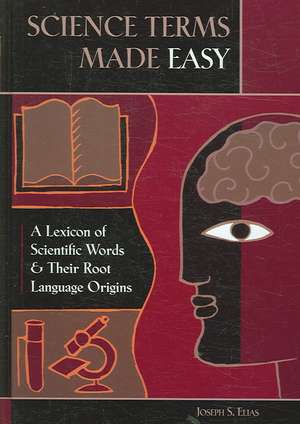
Science Terms Made Easy: A Lexicon of Scientific Words and Their Root Language Origins
Autor Joseph S. Eliasen Limba Engleză Hardback – 30 noi 2006
Science Terms Made Easy both saves time by avoiding rote memorization and encourages students to use their analytical skills to figure out meanings.
Preț: 259.20 lei
Preț vechi: 458.33 lei
-43%
Puncte Express: 389
Carte tipărită la comandă
Livrare economică 02-16 decembrie
Livrare prin curier în România Termenul estimat este afișat lângă disponibilitate.
Transport gratuit de la 400.00 lei Plată online sau ramburs, în funcție de opțiunile comenzii.
Retur gratuit în 14 zile Comandă securizată și suport în română.
Specificații
ISBN-13: 9780313338960
ISBN-10: 0313338965
Pagini: 236
Dimensiuni: 178 x 254 x 20 mm
Greutate: 0.66 kg
Editura: Bloomsbury Publishing
Colecția Greenwood
Locul publicării:New York, United States
ISBN-10: 0313338965
Pagini: 236
Dimensiuni: 178 x 254 x 20 mm
Greutate: 0.66 kg
Editura: Bloomsbury Publishing
Colecția Greenwood
Locul publicării:New York, United States
V-ar putea interesa
-
 The Age of EarthquakesDouglas CouplandPreț: 106.59 lei
 -
 -11%Preț: 346.43 lei388.09 lei
 -
 The Perfect Theory: A Century of Geniuses and the Battle over General RelativityProfessor Pedro G. FerreiraPreț: 94.57 lei
 -
 -26%Preț: 69.28 lei93.66 lei
 -
 -18%Preț: 58.69 lei71.98 lei
 -
 NumbersAlfred S PosamentierPreț: 115.86 lei
 -
 InfinitesimalAmir Alexander-5%Preț: 88.56 lei92.84 lei
 -
 In Our Own ImageGeorge ZarkadakisPreț: 117.58 lei
 -
 -25%Preț: 71.21 lei94.83 lei
 -
 Das geheime Leben der BäumePeter WohllebenPreț: 138.01 lei
Recenzii
Science Terms Made Easy contains a wealth of accurate information not found in most dictionaries and encyclopedias. The book would be a helpful resource for improving students' science vocabularies.
Elias believes that an etymological exploration of common scientific vocabulary can help middle and high school students understand and retain their meanings better than simple memorization. This book, intended for those students and their instructors, offers such an exploration in alphabetical format, describing the root language origins and current definitions of secondary-level terms. Sidebars throughout the volume place major concepts and people in historical concepts, and the appendices list common roots and prefixes. This book is not intended as an exhaustive reference but as a supplementary tool for connecting scientific vocabulary to its ancient origins.
Elias believes that an etymological exploration of common scientific vocabulary can help middle and high school students understand and retain their meanings better than simple memorization. This book, intended for those students and their instructors, offers such an exploration in alphabetical format, describing the root language origins and current definitions of secondary-level terms. Sidebars throughout the volume place major concepts and people in historical concepts, and the appendices list common roots and prefixes. This book is not intended as an exhaustive reference but as a supplementary tool for connecting scientific vocabulary to its ancient origins.