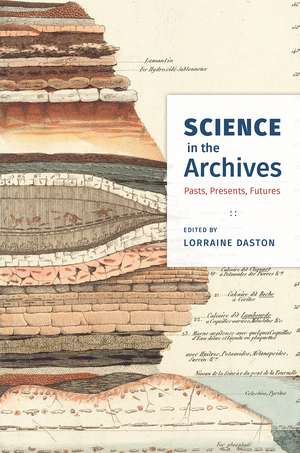
Science in the Archives: Pasts, Presents, Futures
Editat de Lorraine Dastonen Limba Engleză Paperback – 4 apr 2017
Evoluția istoriei științei a migrat în ultimul deceniu de la analiza marilor descoperiri către studiul infrastructurilor care fac aceste descoperiri posibile. Ne-a atras atenția Science in the Archives, o lucrare colectivă coordonată de Lorraine Daston, care propune o reevaluare fundamentală a „științelor arhivelor”. Departe de a fi simple depozite prăfuite, arhivele sunt prezentate aici ca entități dinamice care definesc traiectoria cercetării în astronomie, geologie sau genetică.
Apreciem modul în care volumul extinde cadrul propus de Osiris, Volume 32 de Aronova Elena cu date noi din istoria profundă a practicilor de colectare, de la doxologia antichității până la algoritmii moderni de data mining. Dacă în lucrarea sa anterioară, Objectivity, scrisă împreună cu Peter Galison, Daston analiza modul în care s-a format privirea cercetătorului, în acest nou volum ea se concentrează pe materialitatea dovezilor. Structura cărții este riguros organizată în patru părți: prima explorează arhivele „naturale” (fosilele și pământul), a doua urmărește continuitatea ideilor din antichitate în modernitate, a treia abordează controversele politice ale datelor publice versus private, iar ultima secțiune privește spre viitorul mileniului trei.
Această lucrare demonstrează că știința nu este doar un proces de acumulare liniară, ci unul de recontextualizare permanentă a datelor vechi. Prin integrarea studiilor de caz despre programele climatice ale SUA sau supravegherea digitală, Science in the Archives oferă o perspectivă istorică esențială pentru dezbaterile contemporane despre Big Data, oferind profunzime unui domeniu adesea privit doar prin prisma prezentului tehnologic.
Preț: 353.00 lei
Carte tipărită la comandă
Livrare economică 20 noiembrie-04 decembrie
Specificații
ISBN-10: 022643236X
Pagini: 392
Ilustrații: 25 halftones, 11 line drawings, 1 table
Dimensiuni: 152 x 229 x 13 mm
Greutate: 0.57 kg
Ediția:1
Editura: University of Chicago Press
Colecția University of Chicago Press
V-ar putea interesa
-
 Empire of ChanceGerd GigerenzerPreț: 206.74 lei
 -
 Classical Probability in the EnlightenmentLorraine DastonPreț: 516.11 lei
 -
 Classical Probability in the Enlightenment, New EditionLorraine DastonPreț: 256.30 lei
 -
 Preț: 49.88 lei
 -
 Morris William Travers- A Lifetime of AchievementKeith KosteckaPreț: 129.73 lei
 -
 A History of the Northeast Algal Society (Neas)Dr Peter M. BradleyPreț: 38.92 lei
 -
 Sankofa?David R. ZimmermanPreț: 109.91 lei
 -
 AlchemySteven SchoolPreț: 54.57 lei
 -
 What Is Science?Michael J. FindleyPreț: 130.45 lei
 -
 Biografie Di GalileoGuglielmo LibriPreț: 54.82 lei
 -
 In Beaver WorldEnos MillsPreț: 91.04 lei
 -
 The Spell of the RockiesEnos MillsPreț: 99.31 lei
 -
 RegelnLorraine DastonPreț: 230.01 lei
 -
 RivalsLorraine DastonPreț: 89.40 lei
De ce să citești această carte
Recomandăm această carte cercetătorilor și studenților interesați de istoria ideilor și de filosofia științei. Cititorul va câștiga o înțelegere profundă a modului în care datele brute devin dovezi științifice și cum politicile de conservare de astăzi modelează descoperirile de mâine. Este un instrument teoretic esențial pentru a naviga între provocările etice și tehnice ale erei informației, oferind un context istoric rar pentru fenomenul Big Data.
Despre autor
Lorraine Daston, editorul acestui volum și figură centrală la Institutul Max Planck pentru Istoria Științei din Berlin, este recunoscută pentru studiile sale asupra epistemologiei istorice. Deși datele furnizate o menționează pe Katharine Park ca autor principal în bio, contribuția centrală la acest volum aparține lui Lorraine Daston, cunoscută pentru lucrări fundamentale precum Objectivity și Wonders and the Order of Nature 1150-1750. Opera sa explorează modul în care categorii precum „obiectivitatea” sau „ordinea naturală” au fost construite istoric. În Science in the Archives, Daston continuă această tradiție, analizând modul în care instituția arhivei fundamentează autoritatea științifică modernă.
Descriere scurtă
With Science in the Archives, Lorraine Daston and her co-authors offer the first study of the important role that these archives play in the natural and human sciences. Reaching across disciplines and centuries, contributors cover episodes in the history of astronomy, geology, genetics, philology, climatology, medicine, and more—as well as fundamental practices such as collecting, retrieval, and data mining. Chapters cover topics ranging from doxology in Greco-Roman Antiquity to NSA surveillance techniques of the twenty-first century. Thoroughly exploring the practices, politics, economics, and potential of the sciences of the archives, this volume reveals the essential historical dimension of the sciences, while also adding a much-needed long-term perspective to contemporary debates over the uses of Big Data in science.
Notă biografică
Cuprins
Introduction: Third Nature
Lorraine Daston
I. Nature's Own Canon: Archives of the Historical Sciences
1. Astronomy after the Deluge
Florence Hsia
2. The Earth as Archive: Contingency, Narrative, and the History of Life
David Sepkoski
3. Empiricism in the Library: Medicine’s Case Histories
Andrew Mendelsohn
II. Spanning the Centuries: Archives from Ancient to Modern
4. Archiving Scientific Ideas in Greco-Roman Antiquity
Liba Taub
5. Ancient History in the Age of Archival Research
Suzanne Marchand
6. The Immortal Archive: Nineteenth-Century Science Imagines the Future
Lorraine Daston
III. Problems and Politics: Controversies in the Global Archive
7. The “Data Deluge”: Turning Private Data into Public Archives
Bruno J. Strasser
8. Evolutionary Genetics and the Politics of the Human Archive
Cathy Gere
9. Montage and Metamorphosis: Climatological Data Archiving and the U.S. National Climate Program
Vladimir Janković
IV. The Future of Data: Archives of the New Millennium
10. Archives-of-Self: The Vicissitudes of Time and Self in a Technologically Determinist Future
Rebecca Lemov
11. An Archive of Words
Daniel Rosenberg
12. Querying the Archive: Data Mining from Apriori to PageRank
Matthew L. Jones
Epilogue: The Time of the Archive
Lorraine Daston
Contributors
Bibliography
Index