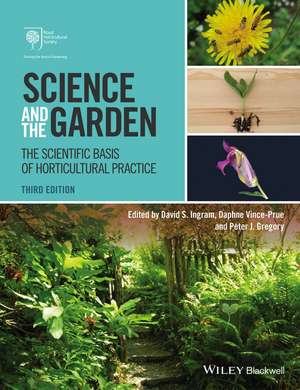
Science and the Garden - The Scientific Basis of Hoticultural Practice 3e
Editat de Daphne Vince-Prue, David S. Ingram, Peter J. Gregoryen Limba Engleză Paperback – 18 dec 2015
Descoperim aici o resursă tehnică riguroasă care depășește instrucțiunile convenționale de tip „când și cum”, concentrându-se pe fundamentul fiziologic al horticulturii. Notăm cu interes felul în care lucrarea Science and the Garden răspunde la întrebări esențiale pentru orice specialist: de ce tăierea mugurelui terminal stimulează creșterea laterală sau cum influențează variabilitatea climatică succesul culturilor protejate. Dacă Principles of Horticulture de Charles Adams v-a oferit cadrul teoretic general, această ediție publicată în colaborare cu Royal Horticultural Society oferă instrumentele practice și argumentele științifice necesare pentru a valida sau ajusta tehnicile de lucru în teren. Remarcăm integrarea unor capitole noi, esențiale în contextul actual, despre schimbările de mediu și impactul grădinăritului asupra sănătății umane. Textul acoperă sistematic nomenclatura, genetica, managementul solului și controlul dăunătorilor, transformând observația empirică în date aplicabile. Această abordare amintește de rigoarea din Photoperiodism in Plants, o altă lucrare de referință a editoarei Daphne Vince-Prue, unde studiul reacției plantelor la durata zilei este tratat ca un factor critic de control al dezvoltării. În Science and the Garden, această expertiză este extinsă la nivelul întregului ecosistem al grădinii, de la biochimia culorii și a mirosului până la ecologia conservării și sustenabilitate. Ritmul este unul dens, specific unui manual universitar, însă claritatea expunerii îl face accesibil și profesioniștilor care doresc să își fundamenteze deciziile de management horticol pe baze științifice actualizate.
Preț: 449.00 lei
Preț vechi: 583.11 lei
-23%
Carte tipărită la comandă
Livrare economică 10-24 noiembrie
Livrare express 03-09 octombrie pentru 76.96 lei
Specificații
ISBN-10: 111877843X
Pagini: 400
Dimensiuni: 190 x 246 x 35 mm
Greutate: 0.84 kg
Ediția:3. Auflage
Editura: John Wiley and Sons Ltd
Locul publicării:Chichester, United Kingdom
V-ar putea interesa
-
 Preț: 170.83 lei
 -
 -13%Preț: 131.11 lei151.43 lei
 -
 -20%Preț: 159.61 lei199.93 lei
 -
 -13%Preț: 357.36 lei412.20 lei
 -
 The Science of Gardening: Discover How Your Garden Really GrowsDr. Stuart FarrimondPreț: 149.53 lei
 -
 -15%Preț: 125.69 lei148.20 lei
 -
 Preț: 285.86 lei
 -
 What's Inside a Garden?: Science and Nature Coloring BookRachel IgnotofskyPreț: 91.32 lei
 -
 What Makes a GardenJinny Blom-17%Preț: 232.33 lei280.83 lei
 -
 Kew Answers for Everyday GardenersPolly Stevens-17%Preț: 95.65 lei115.62 lei
 -
 Garden Practices and Their ScienceGeoff DixonPreț: 318.29 lei
 -
 -29%Preț: 135.96 lei192.57 lei
 -
 -28%Preț: 140.76 lei195.64 lei
 -
 -23%Preț: 113.53 lei147.26 lei
 -
 Gardeners' World: The Flower BookGardeners' World MagazinePreț: 158.70 lei
 -
 RHS Botany for Gardeners: The Art and Science of Gardening Explained & ExploredRoyal Horticultural Society-24%Preț: 110.28 lei145.89 lei
 -
 Gardening in a Changing WorldDarryl Moore-18%Preț: 117.20 lei143.69 lei
 -
 Grow a New GardenBecky SearlePreț: 191.76 lei
 -
 How to Grow a GardenFrances TophillPreț: 110.11 lei
Public țintă
Primary Market:Students studying horticulture (particularly those sitting RHS examinations) agricultural sciences, crop protection, entomology, plant sciences, plant pathology and weed science at introductory level (BTEC, HND, NVQ, HNC and BSc)
As a reference for horticultural scientists, crop and plant scientists, (botanists), plant pathologists, entomologists, agronomists, weed scientists, plant protection specialists; agrochemical company personnel.
Secondary Market:
Plant ecologists, plant physiologists, environmental scientists. Libraries in all universities, agricultural colleges and research establishments where agriculture, horticulture and biological sciences are studied and taught.
De ce să citești această carte
Este manualul de referință pentru studenții care pregătesc examenele RHS sau BSc în horticultură. Cititorul câștigă o înțelegere profundă a proceselor biologice, trecând de la simpla execuție a sarcinilor la capacitatea de a diagnostica și optimiza creșterea plantelor. Este recomandată celor care caută rigoare academică aplicată, oferind soluții concrete pentru adaptarea grădinilor la noile realități climatice.
Despre autor
Echipa editorială este condusă de experți recunoscuți în științele plantelor. Daphne Vince-Prue este o autoritate în fotoperiodism, studiind modul în care lumina reglează dezvoltarea organismelor vegetale. David S. Ingram și Peter J. Gregory aduc decenii de experiență în patologie vegetală și managementul solului. Colaborarea lor, sub egida Royal Horticultural Society, garantează acuratețea datelor și relevanța acestora pentru standardele profesionale din industria horticolă britanică și internațională.
Descriere scurtă
Notă biografică
Professor David Ingram, Formerly Regius Keeper, the Royal Botanic Garden, Edinburgh, RHS Professor of Horticulture and Master, St Catharine's College, Cambridge; now Honorary Professor in the Universities of Edinburgh (Science, Technology & Innovation Studies) and Lancaster (Environment Centre), UK.
Dr Daphne Vince-Prue, Formerly Reader in Botany, University of Reading, Scientific Advisor to the Agricultural Research Council and Head, Physiology and Chemistry Department, Glasshouse Crops Research Institute, UK.
Professor Peter Gregory, Formerly Director and Chief Executive, Scottish Crop Research Institute, Dundee and Chief Executive, East Malling Research; now Professor of Global Food Security, University of Reading, UK.
Cuprins
Preface to third edition xiii
Preface to second edition xiv
Preface to first edition xv
1 Diversity in the plant world 1
2 The plant body: structure and function 14
3 Reproduction: Securing the future 37
4 Naming plants 45
5 Selecting and breeding plants 55
6 Summary 75
7 Soil cultivation and fertility 86
8 The plant environment: Light and water 102
9 Plants and seasons 120
10 Growing plants from seed 139
11 Vegetative propagation 149
12 Size and form 166
13 Colour, scent and sound in the garden 175
14 Climate and weather 191
15 Climate and other environmental changes 206
16 Protected cultivation 214
17 The diversity of the undesirables 234
18 Controlling the undesirables 248
19 Maturation, ripening and storage 262
20 Garden ecology 278
21 Garden wildlife and conservation 292
22 Low-input and low-impact gardening 299
23 Health, well-being and socio-cultural benefits 307
24 Gardens for science 320
Conclusion 328
Further reading 328
Authors and affiliations 328
Glossary 329
Index 355