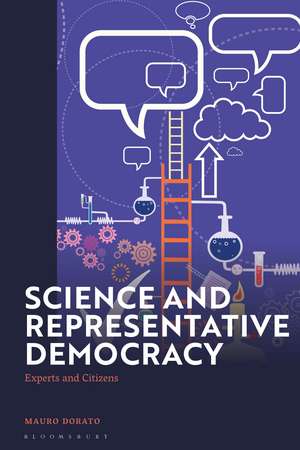
Science and Representative Democracy: Experts and Citizens
Autor Mauro Doratoen Limba Engleză Hardback – 23 mar 2023
This English-language translation of Disinformazione Scientifica e Democrazia argues that the advancement of science depends on an exponential process of specialization, accompanied by the creation of technical languages that are less and less accessible to the general public. Dorato reveals how such a process must align with representative forms of democracies, in which knowledge and decision-making ought to aim at the society's general interest. Given the importance of the principle of competence, however, the role of experts as mediators of knowledge threatens the citizens' autonomy of choice. Consequently, the risk of technocratic regimes calls for new ways to increase literacy about science and its philosophical and probabilistic foundations. Stressing the conceptual conflict between pluralism and conformism, Science and Representative Democracyreveals the obstacles to the functioning of both science and democracy.
| Toate formatele și edițiile | Preț | Express |
|---|---|---|
| Paperback (1) | 197.41 lei 6-8 săpt. | |
| Bloomsbury Publishing – 19 sep 2024 | 197.41 lei 6-8 săpt. | |
| Hardback (1) | 524.52 lei 6-8 săpt. | |
| Bloomsbury Publishing – 23 mar 2023 | 524.52 lei 6-8 săpt. |
Preț: 524.52 lei
Preț vechi: 790.72 lei
-34%
Puncte Express: 787
Preț estimativ în valută:
92.83€ • 108.49$ • 80.59£
92.83€ • 108.49$ • 80.59£
Carte tipărită la comandă
Livrare economică 19 februarie-05 martie
Preluare comenzi: 021 569.72.76
Specificații
ISBN-13: 9781350277724
ISBN-10: 135027772X
Pagini: 200
Dimensiuni: 156 x 234 x 19 mm
Greutate: 0.45 kg
Editura: Bloomsbury Publishing
Colecția Bloomsbury Academic
Locul publicării:London, United Kingdom
ISBN-10: 135027772X
Pagini: 200
Dimensiuni: 156 x 234 x 19 mm
Greutate: 0.45 kg
Editura: Bloomsbury Publishing
Colecția Bloomsbury Academic
Locul publicării:London, United Kingdom
Cuprins
List of Figures
Acknowledgments
Introduction
1. Historical Prologue: The Lippmann-Dewey Debate
2. How Does Science Work? The Evaluation and Controllability of Scientific Hypotheses
3. How Does Democracy Work? The Balance of Powers
4. Representative Democracy, Direct Democracy, and Scientific Specialization
5. Scientific Disinformation and Distrust in the Experts
6. How to Navigate in the Disagreement of Experts: The Need for Greater Scientific Literacy
7. The Role of the History and Philosophy of Science in the Democratic Debate
Conclusion
Notes
References
Index
Acknowledgments
Introduction
1. Historical Prologue: The Lippmann-Dewey Debate
2. How Does Science Work? The Evaluation and Controllability of Scientific Hypotheses
3. How Does Democracy Work? The Balance of Powers
4. Representative Democracy, Direct Democracy, and Scientific Specialization
5. Scientific Disinformation and Distrust in the Experts
6. How to Navigate in the Disagreement of Experts: The Need for Greater Scientific Literacy
7. The Role of the History and Philosophy of Science in the Democratic Debate
Conclusion
Notes
References
Index
Recenzii
In a word, given that the well-functioning and very existence of democracies are no longer a given, this book is truly welcome and is to be regarded as an important academic contribution to a problem that should hopefully also be considered by decision-makers in the political and economic world.
This is a clear and engaging discussion of how science and liberal democracies share a commitment to analogous norms and values, and of how citizens can be empowered by scientific literacy. It is recommended to those interested in finding out what it takes to contribute meaningfully to public debate in contemporary democracies.
Mauro Dorato adopts a fresh approach to analyzing science and democracy from the joint angle of problem-solving. He seeks to resolve the apparent conflict between political values and interests, for one, and scientific knowledge and expertise, for another. As he argues, politics is based on scientific insights, while science proceeds by striving for a consensus in the scientific community. A remarkable explanation of how science and democracy illuminate each other.
In a period in which democracy and science are under threat, questioned, but also
brandished as political rhetoric against enemies, this soft spoken and in depth reflection
on their meaning, their value, and their intimate relation is welcome and important for us all.
This is a clear and engaging discussion of how science and liberal democracies share a commitment to analogous norms and values, and of how citizens can be empowered by scientific literacy. It is recommended to those interested in finding out what it takes to contribute meaningfully to public debate in contemporary democracies.
Mauro Dorato adopts a fresh approach to analyzing science and democracy from the joint angle of problem-solving. He seeks to resolve the apparent conflict between political values and interests, for one, and scientific knowledge and expertise, for another. As he argues, politics is based on scientific insights, while science proceeds by striving for a consensus in the scientific community. A remarkable explanation of how science and democracy illuminate each other.
In a period in which democracy and science are under threat, questioned, but also
brandished as political rhetoric against enemies, this soft spoken and in depth reflection
on their meaning, their value, and their intimate relation is welcome and important for us all.