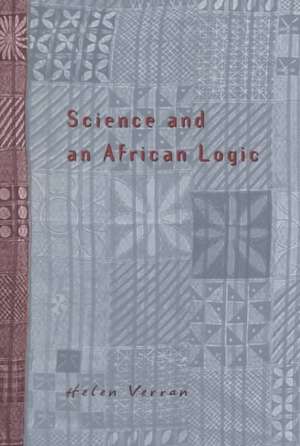
Science and an African Logic
Autor Helen Verranen Limba Engleză Paperback – 15 dec 2001
Does 2 + 2 = 4? Ask almost anyone and they will unequivocally answer yes. A basic equation such as this seems the very definition of certainty, but is it?
In this captivating book, Helen Verran addresses precisely that question by looking at how science, mathematics, and logic come to life in Yoruba primary schools. Drawing on her experience as a teacher in Nigeria, Verran describes how she went from the radical conclusion that logic and math are culturally relative, to determining what Westerners find so disconcerting about Yoruba logic, to a new understanding of all generalizing logic. She reveals that in contrast to the one-to-many model found in Western number systems, Yoruba thinking operates by figuring things as wholes and their parts. Quantity is not absolute but always relational. Certainty is derived not from abstract logic, but from cultural practices and associations.
A powerful story of how one woman's investigation in this everday situation led to extraordinary conclusions about the nature of numbers, generalization, and certainty, this book will be a signal contribution to philosophy, anthropology of science, and education.
In this captivating book, Helen Verran addresses precisely that question by looking at how science, mathematics, and logic come to life in Yoruba primary schools. Drawing on her experience as a teacher in Nigeria, Verran describes how she went from the radical conclusion that logic and math are culturally relative, to determining what Westerners find so disconcerting about Yoruba logic, to a new understanding of all generalizing logic. She reveals that in contrast to the one-to-many model found in Western number systems, Yoruba thinking operates by figuring things as wholes and their parts. Quantity is not absolute but always relational. Certainty is derived not from abstract logic, but from cultural practices and associations.
A powerful story of how one woman's investigation in this everday situation led to extraordinary conclusions about the nature of numbers, generalization, and certainty, this book will be a signal contribution to philosophy, anthropology of science, and education.
Preț: 233.04 lei
Puncte Express: 350
Carte disponibilă
Livrare economică 16-30 mai
Livrare express 02-08 mai pentru 26.60 lei
Specificații
ISBN-13: 9780226853918
ISBN-10: 0226853918
Pagini: 285
Ilustrații: 9 line drawings, 7 tables
Dimensiuni: 152 x 229 x 18 mm
Greutate: 0.4 kg
Ediția:1
Editura: University of Chicago Press
Colecția University of Chicago Press
ISBN-10: 0226853918
Pagini: 285
Ilustrații: 9 line drawings, 7 tables
Dimensiuni: 152 x 229 x 18 mm
Greutate: 0.4 kg
Ediția:1
Editura: University of Chicago Press
Colecția University of Chicago Press
V-ar putea interesa
-
 -8%Preț: 305.62 lei333.18 lei
 -
 On the Heights of DespairE. M. CioranPreț: 203.11 lei
 -
 Preț: 186.18 lei
 -
 The Jealous PotterClaude Lévi-StraussPreț: 225.44 lei
 -
 The Beast and the Sovereign, Volume IIJacques DerridaPreț: 216.75 lei
 -
 Preț: 226.54 lei
 -
 Philosophy In The FleshGeorge Lakoff-13%Preț: 199.23 lei229.07 lei
 -
 Fundamentals of Critical ArgumentationDouglas WaltonPreț: 424.82 lei
 -
 Nietzsche: Thus Spoke ZarathustraRobert PippinPreț: 185.51 lei
 -
 Ideas Of Human Nature 2eTriggPreț: 330.25 lei
 -
 Lives of Eminent Philosophers, Volume IDiogenes LaertiusPreț: 222.90 lei
 -
 Isocrates, Volume IIIIsocratesPreț: 222.87 lei
 -
 Ancient PhilosophyWilliam J. PriorPreț: 75.50 lei
 -
 This Book Will Make You ThinkAlain Stephen-27%Preț: 40.26 lei55.16 lei
 -
 World Mythology in Bite-sized ChunksMark Daniels-27%Preț: 40.26 lei55.13 lei
Notă biografică
Helen Verran taught at Obafemi Awolowo University in Ile-Ife, Nigeria, between 1979 and 1986. She is currently a senior lecturer in the Department of History and Philosophy of Science at the University of Melbourne.
Cuprins
Acknowledgments
Part One: Introduction
1. Disconcertment
2. Toward Generative Critique
Part Two: Numbering
3. A Comparative Study of Yoruba and English Number Systems
4. Decomposing Displays of Numbers
5. Toward Telling the Social Lives of Numbers
Part Three: Generalizing
6. Learning to Apply Numbers to Nature
7. Decomposing Generalizing as "Finding Abstract Objects"
8. Toward Generalization as Transition
Part Four: Certainty
9. Two Consistent Logics of Numbering
10. Decomposing Predicating-Designating as Representing
11. Embodied Certainty and Predicating-Designating
Notes
References
Index