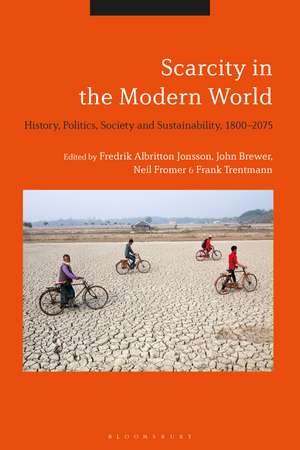
Scarcity in the Modern World: History, Politics, Society and Sustainability, 1800-2075
Editat de John Brewer, Neil Fromer, Fredrik Albritton Jonsson, Professor Frank Trentmannen Limba Engleză Paperback – 20 aug 2020
By bringing together scholars from a variety of academic disciplines, this volume provides an innovative multi-disciplinary perspective that corrects previous scholarship which has discussed scientific and cultural issues separately. In doing so, it recognizes that this challenge is complex and cannot be addressed by a single discipline, but requires a concerted effort to think about its political and social, as well as technical and economic dimensions. This volume is essential for all students and scholars of environmental and economic history.
The ebook editions of this book are available open access under a CC BY-NC-ND 4.0 licence on bloomsburycollection.com. Open access was funded by Knowledge Unlatched.
Preț: 244.30 lei
Preț vechi: 323.15 lei
-24%
Puncte Express: 366
Carte tipărită la comandă
Livrare economică 14-28 noiembrie
Livrare prin curier în România Termenul estimat este afișat lângă disponibilitate.
Transport gratuit de la 400.00 lei Plată online sau ramburs, în funcție de opțiunile comenzii.
Retur gratuit în 14 zile Comandă securizată și suport în română.
Specificații
ISBN-13: 9781350178267
ISBN-10: 1350178268
Pagini: 312
Dimensiuni: 156 x 234 x 21 mm
Greutate: 0.44 kg
Editura: Bloomsbury Publishing
Colecția Bloomsbury Academic
Locul publicării:London, United Kingdom
ISBN-10: 1350178268
Pagini: 312
Dimensiuni: 156 x 234 x 21 mm
Greutate: 0.44 kg
Editura: Bloomsbury Publishing
Colecția Bloomsbury Academic
Locul publicării:London, United Kingdom
Cuprins
List of Illustrations
Notes on Contributors
1. Introduction, Fredrik Albritton Jonsson, John Brewer, Neil Fromer and Frank Trentmann
Part 1 Making Scarcity
2. Scarcity: Language and Politics, Jean-Laurent Rosenthal
3. Untangling Scarcity, Amber Huff and Lyla Mehta
4. Rethinking the Relationships between Scarcity, Poverty and Hunger: An Anthropological Perspective, Richard Wilk
5. Renewable Energy: A Story of Abundance and Scarcity, Neil Fromer
Part 2 The Power of Projection
6. Growth in the Anthropocene, Fredrik Albritton Jonsson
7. The Great Resources Myth, David Rutledge
8. Escapology, or How to Escape Malthusian Traps, Jörg Friedrichs
Part 3 Coping, Managing, Innovating at Different Scales
9. U.S. Mobilization during the Second World War as a Model for Coping with Climate Change, Hugh Rockoff
10. Scarcity and Innovation: Lessons from the British Economy during the U.S. Civil War, W. Walker Hanlon
11. China's Great Leap Famine: Malthus, Marx, Mao and Material Scarcity, Sigrid Schmalzer
12. Encounters with Scarcity at a Micro-Scale: Householders' Responses to Drought as a Continuum of Normal Practice, Heather Chappells
Part 4 Dynamics of Distribution
13. A Climate of Scarcity: Electricity in India, 1899-2016, Elizabeth Chatterjee
14. Lagos 'Scarce-City': Investigating the Roots of Urban Modernity in a Colonial Capital, 1900-1928, David Lamoureux
15. Energy Shortages and the Politics of Time: Resilience, Redistribution and 'Normality' in Japan and East Germany, 1940s-1970s, Hiroki Shin and Frank Trentmann
16. Food Shortages: The Role and Limitations of Markets in Resolving Food Crises during the 2012 Famine in the Sahel, Emma C. Stephens
Acknowledgements
Index
Notes on Contributors
1. Introduction, Fredrik Albritton Jonsson, John Brewer, Neil Fromer and Frank Trentmann
Part 1 Making Scarcity
2. Scarcity: Language and Politics, Jean-Laurent Rosenthal
3. Untangling Scarcity, Amber Huff and Lyla Mehta
4. Rethinking the Relationships between Scarcity, Poverty and Hunger: An Anthropological Perspective, Richard Wilk
5. Renewable Energy: A Story of Abundance and Scarcity, Neil Fromer
Part 2 The Power of Projection
6. Growth in the Anthropocene, Fredrik Albritton Jonsson
7. The Great Resources Myth, David Rutledge
8. Escapology, or How to Escape Malthusian Traps, Jörg Friedrichs
Part 3 Coping, Managing, Innovating at Different Scales
9. U.S. Mobilization during the Second World War as a Model for Coping with Climate Change, Hugh Rockoff
10. Scarcity and Innovation: Lessons from the British Economy during the U.S. Civil War, W. Walker Hanlon
11. China's Great Leap Famine: Malthus, Marx, Mao and Material Scarcity, Sigrid Schmalzer
12. Encounters with Scarcity at a Micro-Scale: Householders' Responses to Drought as a Continuum of Normal Practice, Heather Chappells
Part 4 Dynamics of Distribution
13. A Climate of Scarcity: Electricity in India, 1899-2016, Elizabeth Chatterjee
14. Lagos 'Scarce-City': Investigating the Roots of Urban Modernity in a Colonial Capital, 1900-1928, David Lamoureux
15. Energy Shortages and the Politics of Time: Resilience, Redistribution and 'Normality' in Japan and East Germany, 1940s-1970s, Hiroki Shin and Frank Trentmann
16. Food Shortages: The Role and Limitations of Markets in Resolving Food Crises during the 2012 Famine in the Sahel, Emma C. Stephens
Acknowledgements
Index
Recenzii
Scarcity is no longer just an axiom that governs the narrow world of modern economics; Scarcity in the Modern World reveals a socially, politically, and economically constructed condition in constant tension with the biophysical world. As the mantra of infinite growth in a finite world governs modern capitalism, scarcity threatens to have profound, if not devastating, effects on human life. Spanning cultures, continents, and academic disciplines, this timely anthology richly historicizes climate change and resource exhaustion, as well as proposes creative ways to conceptualize future solutions. This book serves as model for how interdisciplinary scholarship can productively address critical challenges facing humanity.