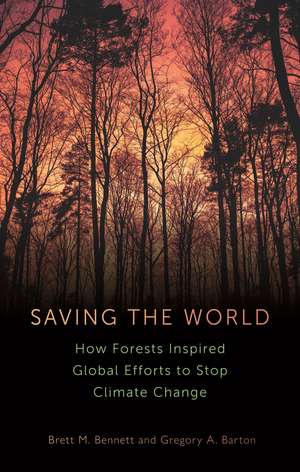
Saving the World: How Forests Inspired Global Efforts to Stop Climate Change
Autor Brett M. Bennett, Gregory A. Bartonen Limba Engleză Hardback – 17 aug 2024
Saving the World tells the forgotten history of climatic botany, the idea that forests are essential for creating and recycling rain. Long before the specter of global warming, societies recognized that deforestation caused drastic climate shifts—as early as 1770, concerns over deforestation spurred legislation to combat human-induced climate change. Across the twentieth century, climatic botany experienced fluctuating fortunes, influenced by technological advancements and evolving meteorological theories. Remarkably, contemporary scientists are rediscovering the crucial role of forests in rainfall recycling, unaware of the long history of climatic botany. This enlightening book is essential reading for anyone passionate about conserving the world’s forests and preserving our climate for future generations.
Preț: 124.72 lei
Puncte Express: 187
Carte disponibilă
Livrare economică 10-17 noiembrie
Livrare express 24-30 octombrie pentru 37.23 lei
Livrare prin curier în România Termenul estimat este afișat lângă disponibilitate.
Transport gratuit de la 400.00 lei Plată online sau ramburs, în funcție de opțiunile comenzii.
Retur gratuit în 14 zile Comandă securizată și suport în română.
Specificații
ISBN-13: 9781789148749
ISBN-10: 178914874X
Pagini: 256
Dimensiuni: 138 x 216 x 30 mm
Greutate: 0.49 kg
Editura: REAKTION BOOKS
Colecția Reaktion Books
ISBN-10: 178914874X
Pagini: 256
Dimensiuni: 138 x 216 x 30 mm
Greutate: 0.49 kg
Editura: REAKTION BOOKS
Colecția Reaktion Books
V-ar putea interesa
-
 How Trees Can Save the WorldPeter WohllebenPreț: 78.21 lei
 -
 Forgotten ForestsJonathan MullardPreț: 158.37 lei
 -
 Preț: 185.70 lei
 -
 The World We Once Lived InWangari Maathai-50%Preț: 28.27 lei56.19 lei
 -
 Forests: A Very Short IntroductionJaboury Ghazoul-20%Preț: 56.65 lei70.82 lei
 -
 JunglePatrick Roberts-51%Preț: 66.52 lei135.93 lei
 -
 The Story of Nature: A Human HistoryJeremy MynottPreț: 225.94 lei
 -
 Foot, D: Woods and PeopleDavid FootPreț: 90.07 lei
 -
 Finding EdenRobin Hanbury-Tenison-41%Preț: 77.33 lei131.66 lei
 -
 Preț: 159.14 lei
 -
 Vanishing Landscapes: The Story of Plants and How We Lost ThemBonnie Lander Johnson-26%Preț: 118.54 lei159.36 lei
 -
 Plants: From Roots to RichesKathy Willis-26%Preț: 69.03 lei93.71 lei
 -
 The Earth Transformed: An Untold HistoryProfessor Peter Frankopan-40%Preț: 75.45 lei125.10 lei
 -
 Wild FictionsAmitav Ghosh-24%Preț: 105.83 lei139.60 lei
 -
 -27%Preț: 98.14 lei133.95 lei
 -
 Trees, Woods and ForestsCharles Watkins-11%Preț: 144.31 lei161.36 lei
 -
 Trees Ancient and Modern: Woodland Cultures and ConservationCharles WatkinsPreț: 192.90 lei
 -
 Chaos in the HeavensJean-Baptiste FressozPreț: 204.98 lei
 -
 -26%Preț: 91.29 lei123.14 lei
 -
 Human NatureKate MarvelPreț: 136.91 lei
Notă biografică
Brett M. Bennett is associate professor of history at Western Sydney University, Australia, and the University of Johannesburg, South Africa. His books include Plantations and Protected Areas: A Global History of Forest Management. Gregory A. Barton is professor of history at Western Sydney University, Australia, and the University of Johannesburg, South Africa. His books include The Global History of Organic Farming.
Cuprins
Introduction The Forgotten History of Climatic Botany
Chapter 1: Redeeming the New World
Chapter 2: Losing the New World: When Climate Change Becomes Bad
Chapter 3: Stopping Climate Change in British India
Chapter 4: The Evaporation of the Forest-Climate Question
Chapter 5: State of Emergency: Saving the World from Deserts
Chapter 6: How Dreams of Reclaiming Deserts Evaporated
Chapter 7: The Revival of the Forest-Rainfall Connection
Conclusion Making Meaning from Climate Change
References
Select Bibliography
Acknowledgements
Index
Chapter 1: Redeeming the New World
Chapter 2: Losing the New World: When Climate Change Becomes Bad
Chapter 3: Stopping Climate Change in British India
Chapter 4: The Evaporation of the Forest-Climate Question
Chapter 5: State of Emergency: Saving the World from Deserts
Chapter 6: How Dreams of Reclaiming Deserts Evaporated
Chapter 7: The Revival of the Forest-Rainfall Connection
Conclusion Making Meaning from Climate Change
References
Select Bibliography
Acknowledgements
Index
Recenzii
Won
"To tell this story, Bennett and Barton ranged far from their disciplinary homes and have produced a credible interdisciplinary account of persistent scientific work on an important question. We owe them a debt of thanks."
“The chapters are very readable, and the main chapters each employ an interesting main story as a prop to a more general coverage of an historical period.”
"Saving the World . . . details the ways in which eighteenth-century initiatives against deforestation, motivated by the belief that forests recycled rain, advanced humanity’s understanding of how human actions affect climate."
“A historical approach to the ideas behind climate change, with a particular focus on the role of trees. . . . If the development of scientific thought interests you, there’s plenty of food for thought here on a subject that couldn’t be more topical.”
"To tell this story, Bennett and Barton ranged far from their disciplinary homes and have produced a credible interdisciplinary account of persistent scientific work on an important question. We owe them a debt of thanks."
"Bennett and Barton present a detailed history of the roots of climatic botany and the underlying scientific philosophies that form our modern understanding of this discipline. In examples that extend over hundreds of years and across cultures and continents, they present a scientific and environmental history of the movement to regulate climate using forests. They argue a ‘supply-side’ perspective of forest hydrology as a key component to climate change policy and mitigation efforts, including supporting reforestation and forest restoration. There is much still to learn about how the water evaporated from plants influences climate at global and regional scales. This history is an ideal text for a seminar or discussion examining global change biology or climate change policy, or as a thought-provoking read for a general audience. Recommended."
“The chapters are very readable, and the main chapters each employ an interesting main story as a prop to a more general coverage of an historical period.”
"You might imagine no one worried much about human impacts on the climate (particularly through deforestation) before the last thirty years. Not so! This elegant and meticulously researched history excavates a fascinating record of investigations into those critical themes, traversing effortlessly from the USA and Europe to India, Africa and South America. In so doing, it provides a timely and significant reflection on contemporary discussions about both the science and the politics of climate change."
"Climate change and environmental crises are now at the centre of global concern. Bennett and Barton vividly demonstrate that the ideas underlying present anxieties have a deep and multi-faceted history. We need to know about these past debates: they are fascinating and they remain influential today. This book, ranging widely from forests to deserts, and from Mauritius, via India, to North America is an excellent place to start."
"This is an extraordinary book, telling the compelling, yet thus far, neglected story of the rise, fall and revival of climatic botany. Bennett and Barton, drawing on extensive archival research, have woven together an enthralling environmental history of climatic botany, stretching from its early modern origins through expansive European empires to present-day scientific frameworks. It is a must-read for those interested in forest, empire and climate change histories."