Cantitate/Preț
Produs

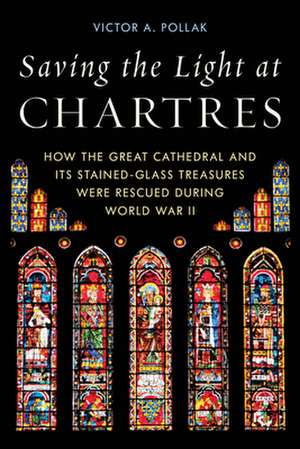
Saving the Light at Chartres

Autor Victor A Pollak
en Limba Engleză Hardback – 16 mar 2020

Autorul Victor A Pollak fundamentează această lucrare pe o cercetare istorică riguroasă a evenimentelor care au dus la supraviețuirea Catedralei din Chartres în timpul celui de-al Doilea Război Mondial, concentrându-se pe figura centrală a colonelului american Welborn Griffith. Spre deosebire de relatările clasice despre unitățile specializate de protecție a patrimoniului, Pollak explorează aici intersecția dintre strategia militară și conștiința individuală în momente de criză extremă.

Apreciem modul în care volumul structurează narațiunea în două etape critice: efortul logistic francez din 1939, când mii de panouri de vitralii medievale au fost evacuate în cariere subterane sub supravegherea viitorilor lideri ai Rezistenței, și momentul tensionat din august 1944. Reținem aici actul de curaj neașteptat al lui Griffith, un ofițer din Armata a Treia a lui Patton, care a ales să riște verificând personal prezența lunetiștilor germani în turnurile catedralei, în loc să execute ordinul de bombardament.

Această lucrare completează perspectiva oferită de Monuments Man de James J Rorimer, adăugând o dimensiune umană specifică: dacă Rorimer descrie eforturile unor specialiști instruiți să recupereze arta, Saving the Light at Chartres urmărește un soldat de carieră fără nicio legătură cu mediul cultural, a cărui decizie spontană a salvat o bijuterie a arhitecturii gotice. Tonul este precis și analitic, evitând idealizarea războiului și oferind în schimb o cronică detaliată a modului în care hazardul și integritatea personală influențează conservarea istoriei. Este o lectură esențială pentru cei interesați de istoria militară și de protecția patrimoniului în zone de conflict.

Citește tot Restrânge

Preț: 19896 lei

Puncte Express: 298

Carte disponibilă

Livrare economică 11-25 mai
Livrare express 25 aprilie-01 mai pentru 4451 lei


Specificații

ISBN-13: 9780811739016
ISBN-10: 0811739015
Pagini: 440
Dimensiuni: 160 x 234 x 30 mm
Greutate: 0.73 kg
Editura: Globe Pequot Publishing

De ce să citești această carte

Recomandăm această carte cititorilor pasionați de istoria celui de-al Doilea Război Mondial care doresc să descopere o perspectivă mai puțin cunoscută asupra eliberării Franței. Veți câștiga o înțelegere profundă a logisticii din spatele salvării patrimoniului cultural și veți descoperi povestea impresionantă a colonelului Welborn Griffith, eroul care a salvat Catedrala din Chartres de la distrugerea totală prin artilerie, plătind cu prețul vieții la scurt timp după aceea.


Despre autor

Victor A Pollak este un cercetător dedicat istoriei militare și conservării patrimoniului cultural, fiind recunoscut pentru capacitatea sa de a extrage biografii remarcabile din arhivele celui de-al Doilea Război Mondial. În această lucrare, el îmbină expertiza în analiza tactică militară cu o apreciere profundă pentru arta medievală, documentând minuțios acțiunile colonelului Welborn Griffith și ale specialiștilor francezi. Pollak reușește să aducă la lumină detalii tehnice despre evacuarea vitraliilor și deciziile de comandă de pe câmpul de luptă, oferind o perspectivă echilibrată între rigoarea istorică și portretul uman al celor care au protejat simbolurile civilizației europene.


Descriere scurtă

Built around 1200 and now a UNESCO World Heritage Site that draws more than a million visitors and pilgrims each year, Chartres Cathedral is one of the crown jewels of world art and architecture. The cathedral avoided looting and destruction during the anti-religion fervor of the French Revolution, and that the cathedral and its prized, priceless stained glass (now the world¿s largest collection of medieval stained glass) survived World War II, which saw the destruction of too many cultural treasures, owes much to the actions of a few individuals who recognized the value of the cathedral and struggled to save it. The story begins half a decade before World War II, when a young French architect developed a plan to save the cathedral¿s precious stained glass. As war engulfed Europe in the fall of 1939, the French were prepared, and a team of architects and future Resistance leaders (such as Jean Moulin) boxed up the panels in a thousand crates. They trained and trucked them to an underground quarry as the German invaders encroached in June 1940, securing the glass¿with the help of refugees fleeing Paris¿not long before the Germans completed their conquest. But this remarkable, close-call effort to save the stained glass is but prologue to the heart of this story: that of American colonel Welborn Griffith. By August 1944, the Americans had broken out of Normandy and were racing across France toward Paris and the Seine. Chartres, sixty miles southwest of Paris, became a key battleground. Allied bombing of Chartres airfield blew out the cathedral¿s temporary window coverings, and when the American reached the town, they believed German artillery spotters or snipers occupied the cathedral¿s spires. When Colonel Griffith¿operations officer of the XX Corps in Patton¿s Third Army¿arrived, the corps¿ artillery had orders to destroy the cathedral to neutralize the German threat. Griffith, a Texan and West Pointer in his early forties, was skeptical. He could have unthinkingly complied with the order from higher up, he could have sent a subordinate to investigate, but in one of those inexplicable moments of war when courage outs, he decided the cathedral should be spared and went himself, entering the old building, inspecting the two steeples, climbing the bell tower, ringing the bell, and hanging an American flag. He found no Germans and ordered his artillery not to destroy the cathedral. Hours later, while patrolling Chartres and its suburbs, Griffith was shot and killed on the back of a tank, while wielding a pistol in one hand and a rifle in the other. Honored by French citizens at his death¿they stood nighttime vigil over his body until U.S. troops could retrieve it¿Griffith received the Distinguished Service Cross, Silver Star, Purple Heart, the Croix de Guerre, the Legion of Merit, and the Legion of Honor for his actions. Fifty-one years later, in August 1995, the great organ of Chartres played the ¿Star Spangled Banner¿ in Griffith¿s honor. In a book in the spirit of The Monuments Men, Victor Pollak describes the efforts to save Chartres Cathedral. But where that story focused on soldiers primed and trained to protect valuable art, this book in large part follows a single soldier, with no background in arts and culture, who decided, on the fly, to risk himself to protect a civilizational landmark.