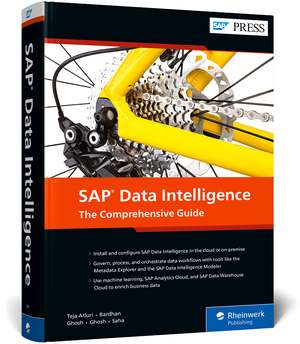
SAP Data Intelligence
Autor Dharma Teja Atluri, Devraj Bardhan, Santanu Ghosh, Snehasish Ghosh, Arindom Sahaen Limba Engleză Hardback – 24 noi 2021
ABORDAREA PRACTICĂ: SAP Data Intelligence prioritizează implementarea tehnică în detrimentul teoriei abstracte, oferind un echilibru solid între arhitectura conceptuală și execuția de cod. Găsim în această carte un parcurs aplicat care începe cu dimensionarea corectă a peisajului IT și continuă cu pași expliciți de instalare, eliminând ambiguitățile procesului de configurare. Reținem că autorii nu se limitează la prezentarea interfețelor, ci pătrund adânc în zona de dezvoltare, oferind detalii despre utilizarea imaginilor Docker și a SDK-ului de Python pentru orchestrarea datelor. Ne-a atras atenția structura logică a volumului, care este organizat pentru a ghida cititorul de la faza de „Getting Started” — unde sunt explicate conceptele de Data Fabric și Business Technology Platform — până la operațiuni complexe de administrare și securitate. Un element distinctiv este accentul pus pe integrare; suntem instruiți cum să conectăm platforma cu sisteme externe și cum să utilizăm SAP Analytics Cloud sau SAP Vora pentru a maximiza valoarea datelor procesate. Cititorul care a aplicat ideile din Data Fabric and Data Mesh Approaches with AI va găsi aici instrumentele specifice ecosistemului SAP pentru a transforma aceste concepte arhitecturale în realitate operațională, beneficiind de detalii despre ML Scenario Manager și integrarea cu Jupyter Notebook. Pe parcursul celor peste 700 de pagini, progresia este naturală: de la infrastructura de bază (Kubernetes și containere) la guvernanța prin Metadata Explorer și crearea de conducte (pipelines) de procesare a datelor. Volumul din seria SAP Press Englisch servește drept manual de referință pentru arhitecții de date care au nevoie de o documentație tehnică riguroasă pentru gestionarea întregului ciclu de viață al aplicațiilor într-un mediu hibrid.
Preț: 812.46 lei
Preț vechi: 1028.19 lei
-20%
Carte indisponibilă temporar
Specificații
ISBN-10: 1493221620
Pagini: 783
Dimensiuni: 184 x 262 x 51 mm
Greutate: 1.75 kg
Ediția:Nouă
Editura: Rheinwerk Publishing Inc.
De ce să citești această carte
Recomandăm această lucrare profesioniștilor IT și arhitecților de sistem care trebuie să implementeze și să gestioneze soluții complexe de date. Cititorul câștigă o înțelegere profundă a modului în care SAP Data Intelligence unifică sursele de date disparate. Este o resursă esențială pentru cei care doresc să stăpânească orchestrarea datelor și integrarea machine learning în procesele de business, oferind soluții concrete pentru guvernanță și securitate într-un format tehnic de înaltă calitate.
Cuprins
... Why Read This Book? ... 21
... Audience ... 22
... Structure of the Book ... 23
... Acknowledgments ... 28
... Conclusion ... 29
PART I ... Getting Started ... 31
1 ... The Data Fabric for the Intelligent Enterprise ... 33
1.1 ... Data Fabric ... 34
1.2 ... Data Orchestration ... 38
1.3 ... SAP Business Technology Platform ... 40
1.4 ... SAP Data Intelligence ... 43
1.5 ... Summary ... 50
2 ... Architecture and Capabilities ... 51
2.1 ... Genesis of SAP Data Intelligence ... 52
2.2 ... SAP Data Intelligence Architecture ... 60
2.3 ... Deployment Options and Bring Your Own License Model ... 63
2.4 ... Kubernetes Cluster and Containers ... 68
2.5 ... SAP Data Intelligence Launchpad ... 86
2.6 ... Summary ... 91
3 ... Setup and Installation ... 93
3.1 ... Landscape Sizing ... 93
3.2 ... SAP Cloud Appliance Library ... 99
3.3 ... On-Demand Cloud Provisioning and Instance Sizing ... 107
3.4 ... Setting Up SAP Data Intelligence on SAP Cloud Appliance Library ... 113
3.5 ... SAP Data Intelligence 3.0 Installation On-Premise ... 150
3.6 ... Summary ... 168
4 ... Using SAP Data Intelligence Applications ... 169
4.1 ... SAP Data Intelligence Launchpad Applications ... 169
4.2 ... Applications for Data Engineers ... 172
4.3 ... Applications for Data Scientists ... 177
4.4 ... Applications for Modelers and Auditors ... 179
4.5 ... Applications for System Administrators ... 182
4.6 ... Summary ... 189
PART II ... Data Management, Orchestration, and Machine Learning ... 191
5 ... Metadata-Driven Data Governance ... 193
5.1 ... Metadata Explorer for Data Governance ... 194
5.2 ... Data Profiling to Understand Data ... 197
5.3 ... Managing Publications and Data Catalogs ... 202
5.4 ... Defining Data Quality Rules and Running Rulebooks ... 214
5.5 ... Data Lineage from Transformation History ... 230
5.6 ... Summary ... 235
6 ... Modeling Data Processing Pipelines ... 237
6.1 ... Using the SAP Data Intelligence Modeler ... 237
6.2 ... Creating and Managing Connections ... 250
6.3 ... Self-Service Data Preparation with the Metadata Explorer ... 255
6.4 ... Integrating, Processing, and Orchestrating Workflows ... 261
6.5 ... Scheduling and Monitoring Data Pipelines ... 270
6.6 ... Summary ... 273
7 ... Creating Operators and Data Types ... 275
7.1 ... Creating Custom Operators ... 276
7.2 ... Implementing Runtime Operators ... 288
7.3 ... Creating Data Types ... 290
7.4 ... Summary ... 293
8 ... Building Docker Images ... 295
8.1 ... Containers in Pods and Pods in Clusters ... 295
8.2 ... Assembling a Docker Image ... 298
8.3 ... Dockerfile Inheritance ... 303
8.4 ... Using Docker with Python ... 305
8.5 ... Summary ... 308
9 ... Machine Learning ... 309
9.1 ... Machine Learning with SAP ... 310
9.2 ... Machine Learning with SAP Data Intelligence ... 328
9.3 ... Using the ML Scenario Manager ... 333
9.4 ... ML Data Manager in Data Workspaces and Data Collections ... 365
9.5 ... Summary ... 371
10 ... Jupyter Notebook ... 373
10.1 ... Jupyter Notebook Fundamentals ... 374
10.2 ... Working with SAP HANA Cloud ... 386
10.3 ... Data Science Experiments with Jupyter Notebook ... 405
10.4 ... JupyterLab as the Next-Gen Jupyter Notebook ... 430
10.5 ... Summary ... 437
11 ... SAP Data Intelligence Python SDK ... 439
11.1 ... Using SAP Data Intelligence Python SDK ... 440
11.2 ... Accessing Artifacts Using Methods ... 448
11.3 ... Machine Learning Tracking SDK ... 450
11.4 ... Summary ... 454
PART III ... Integration ... 457
12 ... Integrating with ABAP Systems ... 459
12.1 ... Integration Scenarios ... 459
12.2 ... Provisioning Data from ABAP Systems ... 465
12.3 ... Using Operators to Trigger Execution in an ABAP System ... 472
12.4 ... SAP BW/4HANA and SAP Data Intelligence Hybrid Data Virtualization ... 478
12.5 ... Additional Connectivity ... 485
12.6 ... Summary ... 495
13 ... Integrating with Non-SAP Systems ... 497
13.1 ... Non-SAP Cloud System Connectivity ... 497
13.2 ... Non-SAP On-Premise System Connectivity ... 510
13.3 ... Summary ... 513
14 ... Integrating Big Data Workloads with SAP Vora ... 515
14.1 ... SAP Vora in Kubernetes Framework ... 516
14.2 ... Data Modeling in SAP Vora ... 524
14.3 ... Hierarchies in SAP Vora ... 536
14.4 ... Full-Text Search in SAP Vora ... 540
14.5 ... Summary ... 542
15 ... Integrating with SAP Data Warehouse Cloud ... 543
15.1 ... Overview of SAP Data Warehouse Cloud ... 543
15.2 ... Understanding Spaces ... 549
15.3 ... Exploring Connections and Using the Data Builder ... 561
15.4 ... Data Builder in SAP Data Warehouse Cloud versus Pipelines in SAP Data Intelligence ... 570
15.5 ... Summary ... 570
16 ... Integrating with SAP Analytics Cloud ... 571
16.1 ... Overview of SAP Analytics Cloud ... 571
16.2 ... Use Operators: Read File, Formatter, and Producer ... 582
16.3 ... Pipelines to Train, Predict, and Visualize Data ... 587
16.4 ... Summary ... 591
PART IV ... System Management, Security, and Operations ... 593
17 ... Administration ... 595
17.1 ... System Management Command-Line Client Reference ... 595
17.2 ... Administration Applications ... 599
17.3 ... Monitoring the SAP Data Intelligence Modeler ... 616
17.4 ... SAP Data Intelligence System Logging ... 626
17.5 ... System Diagnostics ... 631
17.6 ... Summary ... 637
18 ... Security ... 639
18.1 ... Approach to Data Protection ... 639
18.2 ... Authenticating Services and Users ... 642
18.3 ... Securely Connecting On-Premise Systems ... 658
18.4 ... Summary ... 659
19 ... Maintenance ... 661
19.1 ... Understanding Operational Modes or Run Levels ... 661
19.2 ... Switching the Platform to Maintenance Mode ... 662
19.3 ... Increasing System Management Persistent Volume Size ... 665
19.4 ... Performing Backups ... 668
19.5 ... Summary ... 671
20 ... Application Lifecycle Management ... 673
20.1 ... Version Control System ... 673
20.2 ... Git ... 674
20.3 ... Continuous Integration and Continuous Delivery ... 707
20.4 ... DevOps Fundamentals and Tools ... 713
20.5 ... SAP Data Intelligence as the MLOps Platform ... 723
20.6 ... Migrating from SAP Leonardo Machine Learning Foundation ... 730
20.7 ... Summary ... 734
21 ... Business Content and Use Cases ... 737
21.1 ... Digital Transformation and SAP Data Intelligence ... 737
21.2 ... Business Content by Industry ... 740
21.3 ... Finance Use Cases ... 746
21.4 ... Supply Chain Use Cases ... 747
21.5 ... Manufacturing Use Cases ... 749
21.6 ... Summary ... 751
... Appendices ... 753
A ... Outlook and Roadmap ... 753
B ... The Authors ... 763
... Index ... 765
Descriere scurtă
In this book, you'll learn about:
a. Configuration
Build your SAP Data Intelligence landscape! Use SAP Cloud Appliance Library for cloud deployment, including provisioning, sizing, and accessing the launchpad. Perform on-premise installations using tools like the maintenance planner.
b. Capabilities
Put the core capabilities of SAP Data Intelligence to work! Manage and govern your data with the metadata explorer, use the modeler application to create data processing pipelines, create apps with the Jupyter Notebook, and more.
c. Integration and Administration
Integrate, manage, and operate SAP Data Intelligence! Get step-by-step instructions for integration with SAP and non-SAP systems. Learn about key administration tasks and make sure your landscape is secure and running smoothly.
Highlights include:
1) Configuration and installation
2) Data governance
3) Data processing pipelines
4) Docker images
5) ML Scenario Manager
6) Jupyter Notebook
7) Python SDK
8) Integration
9) Administration
10) Security
11) Application lifecycle management
12) Use cases