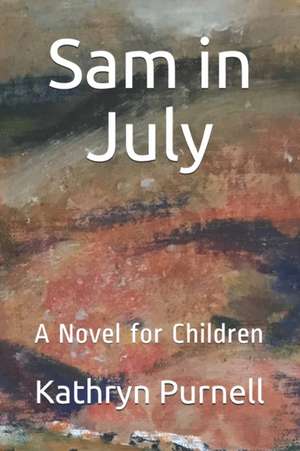
Sam in July
Autor Kathryn Purnellen Limba Engleză Paperback – 14 apr 2020
Preț: 74.97 lei
Puncte Express: 112
Carte disponibilă
Livrare economică 17 noiembrie-01 decembrie
Livrare prin curier în România Termenul estimat este afișat lângă disponibilitate.
Transport gratuit de la 400.00 lei Plată online sau ramburs, în funcție de opțiunile comenzii.
Retur gratuit în 14 zile Comandă securizată și suport în română.
Specificații
ISBN-13: 9780648247845
ISBN-10: 0648247848
Pagini: 204
Dimensiuni: 152 x 229 x 12 mm
Greutate: 0.34 kg
Editura: J R Garran
ISBN-10: 0648247848
Pagini: 204
Dimensiuni: 152 x 229 x 12 mm
Greutate: 0.34 kg
Editura: J R Garran
Notă biografică
Kathryn Purnell embodied the soul and spirit of a creative writer. She maintained an intense interest in everything around her, the natural and spiritual worlds, the everyday and the eternal, diverse countries and their cultures as well as the human condition (of which she had an uncanny understanding). A gifted educator, she was an inspiration to many aspiring writers to whom she taught creative writing. She believed intensely in the need to encourage women writers, the constraints on whom she felt herself at a very personal level.Born in Vancouver, Canada in 1911 and baptised Catherine Isabell (Maxwell), she later morphed her personal names into Kathryn Isobel for reasons never clearly evident. Travelling by sea to Australia with her family as a young woman she met on board and later married scientist William (Bill) Purnell. In a marriage that lasted 72 years the partnership of two highly intelligent but very different personalities was not always smooth, but that notwithstanding the union delivered Kathryn a wealth of opportunity for international experiences rare for most living in those times.Bill Purnell's work in the early years of UNESCO, as head of its Science Cooperation Division, took Kathryn to Paris to live in the early post war years, then to Cairo and later Jakarta. She travelled widely in Europe and later spent time in South Africa where her younger daughter lived for a time.When her husband's ill health compelled the family to return permanently to Australia in the late nineteen fifties, Kathryn maintained her international links through involvement with the United Nations Association, and her work with women through the YWCA. It was particularly in this period of her life, with the common pressures of maintaining a family, supporting a husband in his professional life and finding time to create, that she felt most strongly the constraints and limitations placed on the female creative spirit by the societal practices and beliefs of the time. But create she did, both poetry and prose work. She also spent much of her time teaching aspiring writers, mostly women. Active in the Society of Women Writers, in 1998 she won The Alice Award, a biennial award for long term and distinguished contribution to literature by an Australian woman. Previous winners have included Eleanor Dark, Judith Wright, Mary Durack and Nancy Cato. After Kathryn's death the Society of Women's Writers Victoria set up the biennial Kathryn Purnell Poetry Prize in her memory. Other awards over the years included the State of Victoria Short Story Award and the Moomba Short Story Prize in 1966/67, The Society of Women Writers Poetry Prize in 1972, Maryborough Poetry Prize in 1975, an award in the Geelong Arts Festival 1976 and in 1979 she was the inaugural winner of the Charles Meeking Poetry Award for women. A resident of the suburb, in the early nineties Kathryn was appointed East Melbourne Writer in Residence. During this appointment she edited "The Beautiful Hill: An Anthology of Writing from East Melbourne", a collection of short essays and poems written by local identities.In addition to her poetry, Kathryn left a fine legacy of prose writings, much of it unpublished. A current project is redressing this by publishing some of her novellas, short stories and her singular novel, the latter a fascinating story, with autobiographical undertones, covering the life of a young girl growing up in early twentieth century Vancouver, yet stretching to Cairo in the fifties.