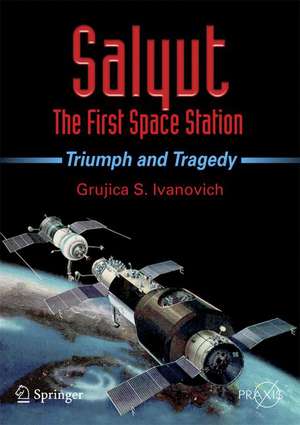
Salyut - The First Space Station: Springer Praxis Books
Autor Grujica S. Ivanovichen Limba Engleză Paperback – 7 iul 2008
Notăm cu interes faptul că, în ciuda importanței sale istorice, geneza primei stații spațiale a rămas mult timp documentată fragmentar în literatura de specialitate occidentală. Salyut - The First Space Station completează această lacună academică, oferind o perspectivă tehnică și politică asupra programului sovietic, bazată pe surse care nu au mai fost accesibile anterior în limba engleză. Autorul Grujica S. Ivanovich nu se limitează la cronologia lansărilor, ci investighează mecanismele decizionale din spatele cortinei de fier, de la conflictele dintre designerii șefi și generali, până la presiunea politică exercitată de Kremlin.
Structura volumului este riguros cronologică, începând cu proiectele militare Almaz și evoluția către DOS-1. Găsim în această carte o analiză exhaustivă a misiunilor Soyuz 10 și 11, punctul central fiind tragedia din iunie 1971. Autorul detaliază cele 112 secunde fatale în care presiunea din modulul de coborâre s-a anulat, explicând de ce lipsa costumelor presurizate a fost o eroare fatală de proiectare și antrenament. Cartea acoperă aceeași arie tematică precum The Story of Manned Space Stations, dar cu o abordare mult mai granulară și focalizată pe detaliul tehnic al sistemelor de supraviețuire și pe biografiile individuale ale cosmonauților. În timp ce The Continuing Story of The International Space Station privește spre viitorul cooperării internaționale, lucrarea lui Ivanovich rămâne ancorată în analiza critică a fundamentelor tehnologice rusești care, prin modulul Zvezda, formează și astăzi nucleul ISS. Tonul este unul sobru, documentar, evitând senzaționalismul în favoarea preciziei factuale și a mărturiilor directe de la echipa de recuperare.
Din seria Springer Praxis Books
-
 Preț: 300.82 lei
 -
 Preț: 289.78 lei
 -
 Preț: 212.55 lei
 -
 Preț: 322.33 lei
 -
 Preț: 324.12 lei
 -
 Preț: 299.26 lei
 -
 Preț: 507.31 lei
 -
 Preț: 223.52 lei
 -
 Preț: 310.41 lei
 -
 Preț: 333.61 lei
 -
 Preț: 230.44 lei
 - 18%
 Preț: 911.62 lei
 -
 Preț: 216.42 lei
 -
 Preț: 227.02 lei
 -
 Preț: 315.58 lei
 -
 Preț: 215.75 lei
 -
 Preț: 266.34 lei
 -
 Preț: 260.26 lei
 -
 Preț: 253.05 lei
 -
 Preț: 351.38 lei
 -
 Preț: 227.17 lei
 -
 Preț: 281.23 lei
 -
 Preț: 159.75 lei
 - 18%
 Preț: 1256.95 lei
 - 18%
 Preț: 940.46 lei
 -
 Preț: 323.74 lei
 - 18%
 Preț: 1250.20 lei
 - 18%
 Preț: 975.90 lei
 -
 Preț: 216.72 lei
 -
 Preț: 269.95 lei
 -
 Preț: 217.22 lei
 -
 Preț: 316.07 lei
 -
 Preț: 256.84 lei
 - 18%
 Preț: 972.77 lei
 -
 Preț: 219.27 lei
 -
 Preț: 222.12 lei
 -
 Preț: 392.52 lei
 -
 Preț: 257.95 lei
 -
 Preț: 319.85 lei
 -
 Preț: 350.65 lei
 - 15%
 Preț: 632.63 lei
 -
 Preț: 330.21 lei
 -
 Preț: 322.04 lei
 -
 Preț: 208.76 lei
 -
 Preț: 246.55 lei
 -
 Preț: 326.81 lei
 -
 Preț: 106.06 lei
 - 18%
 Preț: 1178.23 lei
 -
 Preț: 298.45 lei
Preț: 261.15 lei
Carte disponibilă
Livrare economică 29 octombrie-12 noiembrie
Specificații
ISBN-10: 0387735852
Pagini: 456
Ilustrații: XXVIII, 426 p. 103 illus.
Dimensiuni: 170 x 242 x 25 mm
Greutate: 0.78 kg
Ediția:2008
Editura: Praxis
Colecția Springer Praxis Books
Seria Springer Praxis Books
Locul publicării:New York, NY, United States
V-ar putea interesa
-
 Soviet and Russian Lunar ExplorationBrian HarveyPreț: 342.72 lei
 -
 Return to the MoonHarrison SchmittPreț: 301.27 lei
 -
 Astronomical Sketching: A Step-by-Step IntroductionRichard HandyPreț: 329.33 lei
 -
 Lunar and Planetary RoversAnthony YoungPreț: 285.01 lei
 -
 The Story of Manned Space StationsPhilip BakerPreț: 180.87 lei
 -
 Lonely Minds in the UniverseGiancarlo GentaPreț: 171.87 lei
 -
 Planetary Ring SystemsEllis D. MinerPreț: 209.55 lei
 -
 SupernovaeMartin MobberleyPreț: 189.60 lei
 -
 AuroraNeil BonePreț: 182.16 lei
 -
 Living Off the Land in SpaceC. BangsPreț: 220.76 lei
 -
 A User's Guide to the Meade LXD55 and LXD75 TelescopesMartin PestonPreț: 254.09 lei
 -
 The Herschel Objects and How to Observe ThemJames MullaneyPreț: 220.30 lei
 -
 Quirky Sides of ScientistsDavid R. TopperPreț: 217.65 lei
 -
 The Rebirth of the Russian Space ProgramBrian HarveyPreț: 227.81 lei
 -
 Space Exploration 2008David M. HarlandPreț: 165.08 lei
 -
 The Sky is Your LaboratoryRobert BuchheimPreț: 324.45 lei
 -
 Nebulae and How to Observe ThemSteven CoePreț: 221.18 lei
 -
 Galaxies and How to Observe ThemWolfgang SteinickePreț: 194.36 lei
 -
 To Mars and Beyond, Fast!Franklin Chang DíazPreț: 299.77 lei
 -
 Picture This!Michael CarrollPreț: 341.09 lei
 -
 Rock LegendsPaul MurdinPreț: 336.30 lei
 -
 Earths of Distant SunsMichael CarrollPreț: 205.49 lei
 -
 Visually Observing CometsDavid A. J. SeargentPreț: 202.51 lei
 -
 The Pillars of CreationMartin BeechPreț: 308.95 lei
 -
 TIM PEAKE and BRITAIN'S ROAD TO SPACEErik SeedhousePreț: 272.42 lei
 -
 Further Adventures of the Celestial SleuthDonald W. OlsonPreț: 325.42 lei
 -
 Gemini 4David J. ShaylerPreț: 260.26 lei
 -
 Buchi neri nel mio bagno di schiuma ovvero l'enigma di EinsteinC. V. VishveshwaraPreț: 149.87 lei
 -
 On To Mars!: Chronicles of Martian SimulationsVladimir PLETSERPreț: 204.74 lei
Public țintă
Popular/generalDe ce să citești această carte
Această monografie este esențială pentru cercetătorii istoriei spațiale și pasionații de inginerie aerospațială. Cititorul câștigă acces la date tehnice inedite despre eșecul misiunii Soyuz 11 și înțelege contextul politic tensionat al programului Salyut. Este o resursă rară care explică modul în care tragediile trecutului au modelat protocoalele de siguranță utilizate astăzi pe Stația Spațială Internațională.
Descriere scurtă
The first two chapters provide the history of the first Soviet space station projects Almaz, Soyuz-R, MKS and DOS from 1964 to1970 and cover the selection of DOS-1 crews in 1971, their training and crew rotations. Chapter 3 launches the Salyut space station with its first crew to occupy the first space station, while Chapter 4 portrays the drama of the Soyuz 10 mission in April 1971, which failed to dock with Salyut due to a broken docking probe element, culminating a dramatic night return to the Earth. The following two chapters describe the State Commission’s decision to replace the original crew of Soyuz 11 two days before the launch in June 1971 and introduce cosmonauts Dobrovolysky, Volkov and Patcayev. The launch of Soyuz 11, its docking with Salyut and the first days aboard the space station are described in Chapter 7 and the fire which almost curtailed the mission and led to Dobrovolsky and Volkov’s deteriorating relationship is then covered. The final stages of the mission, including the problems with the hatch before Soyuz 11 separated from the Salyut space station, areexplained before the author details the separation of the orbital and service modules and the tragic mistake made by the cosmonauts. Chapter 10 describes the normal landing of Soyuz 11, the discovery of and attempts to revive the dead cosmonauts.
and includes the first interview with one of the rescuers. The author then demonstrates how detailed analysis found that, after separation from the orbital module, the internal pressure in the descent module dropped from 920mm to zero in 112 seconds due to the premature opening of one of the valves. Without spacesuits, the cosmonauts had only 15-20 seconds to close the valve and save their lives. An attempt by Dobrovolsky sadly failed. Further investigation identified numerous problems which contributed to the tragedy, including the valve technology, leaking of personal protection equipment, problems with the hatch and omissions in crew training, as well as confusion between the cosmonauts.
The last chapters describe the Post-Salyut era. After three single modular stations, in 1986 the USSR launched the base module of the third generation space station Mir, which has six docking probes. In the following years, Mir grew rapidly and was extended with five additional scientific modules to become a true space outpost continually occupied by humans, the dream of space pioneers. The service module Zvezda, a modified Salyut/DOS-1, currently serves as a core for the International Space Station. The book ends with memories of all those affected by the DOS program and the tragedy of the heroic Soyuz 11 crew and looks forward to a continuation of the historic mission of Salyut.
Cuprins
Recenzii
"This work chronicles the history of the first space station, Salyut 1, which was built by the former Soviet Union and launched unmanned in April 1971. … The author also discusses the interactions between the space agency and the Kremlin in Moscow as well as other interpersonal rivalries. The book includes many excellent half-tone photographs, biographies of the cosmonauts, and a glossary. Summing Up: Recommended. Public, general, and undergraduate libraries, all levels." (J. Z. Kiss, Choice, Vol. 46 (5), January, 2009)