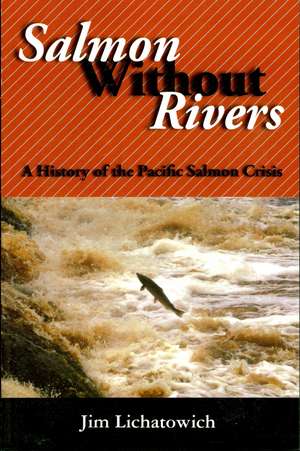
Salmon Without Rivers
Autor Jim Lichatowichen Limba Engleză Paperback – mar 2001
"Fundamentally, the salmon's decline has been the consequence of a vision based on flawed assumptions and unchallenged myths.... We assumed we could control the biological productivity of salmon and 'improve' upon natural processes that we didn't even try to understand. We assumed we could have salmon without rivers." --from the introduction
From a mountain top where an eagle carries a salmon carcass to feed its young to the distant oceanic waters of the California current and the Alaskan Gyre, salmon have penetrated the Northwest to an extent unmatched by any other animal. Since the turn of the twentieth century, the natural productivity of salmon in Oregon, Washington, California, and Idaho has declined by eighty percent. The decline of Pacific salmon to the brink of extinction is a clear sign of serious problems in the region.
In Salmon Without Rivers, fisheries biologist Jim Lichatowich offers an eye-opening look at the roots and evolution of the salmon crisis in the Pacific Northwest. He describes the multitude of factors over the past century and a half that have led to the salmon's decline, and examines in depth the abject failure of restoration efforts that have focused almost exclusively on hatcheries to return salmon stocks to healthy levels without addressing the underlying causes of the decline. The book:
From a mountain top where an eagle carries a salmon carcass to feed its young to the distant oceanic waters of the California current and the Alaskan Gyre, salmon have penetrated the Northwest to an extent unmatched by any other animal. Since the turn of the twentieth century, the natural productivity of salmon in Oregon, Washington, California, and Idaho has declined by eighty percent. The decline of Pacific salmon to the brink of extinction is a clear sign of serious problems in the region.
In Salmon Without Rivers, fisheries biologist Jim Lichatowich offers an eye-opening look at the roots and evolution of the salmon crisis in the Pacific Northwest. He describes the multitude of factors over the past century and a half that have led to the salmon's decline, and examines in depth the abject failure of restoration efforts that have focused almost exclusively on hatcheries to return salmon stocks to healthy levels without addressing the underlying causes of the decline. The book:
- describes the evolutionary history of the salmon along with the geologic history of the Pacific Northwest over the past 40 million years
- considers the indigenous cultures of the region, and the emergence of salmon-based economies that survived for thousands of years
- examines the rapid transformation of the region following the arrival of Europeans
- presents the history of efforts to protect and restore the salmon
- offers a critical assessment of why restoration efforts have failed
Preț: 301.02 lei
Puncte Express: 452
Carte disponibilă
Livrare economică 07-21 noiembrie
Livrare prin curier în România Termenul estimat este afișat lângă disponibilitate.
Transport gratuit de la 400.00 lei Plată online sau ramburs, în funcție de opțiunile comenzii.
Retur gratuit în 14 zile Comandă securizată și suport în română.
Specificații
ISBN-13: 9781559633611
ISBN-10: 1559633611
Pagini: 336
Ilustrații: 8 photos, 14 illustrations
Dimensiuni: 152 x 228 x 18 mm
Greutate: 0.45 kg
Ediția:None
Editura: Princeton University Press
ISBN-10: 1559633611
Pagini: 336
Ilustrații: 8 photos, 14 illustrations
Dimensiuni: 152 x 228 x 18 mm
Greutate: 0.45 kg
Ediția:None
Editura: Princeton University Press
V-ar putea interesa
-
 The Hunt for the Golden MoleRichard GirlingPreț: 112.51 lei
 -
 Preț: 66.11 lei
 -
 The Intrinsic Value of Endangered SpeciesIan A. Smith-18%Preț: 1245.81 lei1519.28 lei
 -
 The Sixth Extinction: An Unnatural HistoryElizabeth Kolbert-26%Preț: 69.44 lei93.77 lei
 -
 Tigers ForeverSharon GuynupPreț: 286.74 lei
 -
 Endangered Species: A Documentary and Reference GuideEdward P. Weber-44%Preț: 550.75 lei978.61 lei
 -
 -39%Preț: 88.18 lei144.01 lei
 -
 Endangered Species: Habitat, Protection & Ecological SignificanceManuel Esteban Lucas-Borja-27%Preț: 1601.04 lei2184.11 lei
Notă biografică
Jim Lichatowich has been a fisheries scientist for twenty-nine years, working for most of that time in salmon management and research in Oregon and Washington. He is a member of three independent teams of scientists investigating the salmon crisis, and has written numerous scientific and technical papers on the history, current status, and future prospects of salmon. His essays have appeared in a variety of publications including Trout magazine, Peninsula magazine, Riverkeeper, and Shirkin Comment.
Cuprins
Preface
Acknowledgments
Introduction
Chapter 1. Hooknose
Chapter 2. The Five Houses Of Salmon
Chapter 3. New Values For The Land And Water
Chapter 4. The Industrial Economy Enters The Northwest
Chapter 5. Free Wealth
Chapter 6. Cultivate The Waters
Chapter 7. The Winds Of Change
Chapter 8. A Story Of Two Rivers
Chapter 9. The Road To Extinction
Epilogue: Building A New Salmon Culture
Appendix A: Classification Of Anadromous Forms Of Salmon
Appendix B: Comparison Of The Life Histories Of Seven Species Of Pacific Salmon And Trout
Appendix C: Geologic Epochs Mentioned In The Text
Endnotes
Bibliography
Index
Acknowledgments
Introduction
Chapter 1. Hooknose
Chapter 2. The Five Houses Of Salmon
Chapter 3. New Values For The Land And Water
Chapter 4. The Industrial Economy Enters The Northwest
Chapter 5. Free Wealth
Chapter 6. Cultivate The Waters
Chapter 7. The Winds Of Change
Chapter 8. A Story Of Two Rivers
Chapter 9. The Road To Extinction
Epilogue: Building A New Salmon Culture
Appendix A: Classification Of Anadromous Forms Of Salmon
Appendix B: Comparison Of The Life Histories Of Seven Species Of Pacific Salmon And Trout
Appendix C: Geologic Epochs Mentioned In The Text
Endnotes
Bibliography
Index
Recenzii
"Lichatowich provides a critical perspective on salmon hatchery successes and failures, and his book of captivating stories provides a fascinating, readable, and chilling wake-up call to how humans have mismanaged their natural heritage."
Descriere
From a mountain top where an eagle carries a salmon carcass to feed its young to the oceanic waters of the California current and the Alaskan Gyre, salmon have penetrated the Northwest to an extent unmatched by other animals. Since the turn of the twentieth century, natural productivity of salmon in Oregon, Washington, California, and Idaho has declined 80 percent. The decline of Pacific salmon to the brink of extinction is a sign of serious problems in the region.
In Salmon Without Rivers, fisheries biologist Jim Lichatowich offers an eye-opening look at the roots and evolution of the salmon crisis in the Pacific Northwest. He describes the multitude of factors over the past century and a half that have led to the salmon's decline, and examines the failure of restoration efforts that have focused almost exclusively on hatcheries to return salmon stocks to healthy levels without addressing underlying causes of the decline.
In Salmon Without Rivers, fisheries biologist Jim Lichatowich offers an eye-opening look at the roots and evolution of the salmon crisis in the Pacific Northwest. He describes the multitude of factors over the past century and a half that have led to the salmon's decline, and examines the failure of restoration efforts that have focused almost exclusively on hatcheries to return salmon stocks to healthy levels without addressing underlying causes of the decline.
Lichatowich argues that the dominant worldview of our society -- a worldview that denies connections between humans and the natural world -- has created the conflict that characterizes the recent history of salmon; unless that worldview is challenged, there is little hope for recovery. Salmon Without Rivers exposes the myths that have guided recent human-salmon interactions. It explains the difficult choices facing citizens of the region, and provides unique insight into one of the most tragic chapters in our nation's environmental history.