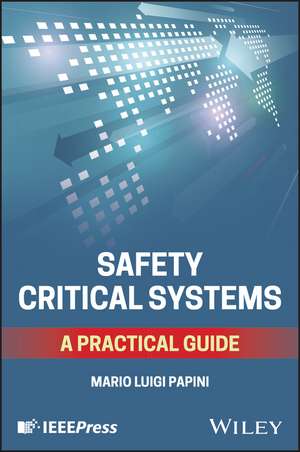
Safety Critical Systems: A Practical Guide
Autor Mario L. Papinien Limba Engleză Hardback – 22 sep 2026
Safety Critical Systems discusses and maps the relationship between various processes of safety critical systems processes, their interdependence, and necessary elements of independence. The book describes the types of systems currently in use, their structures, and their associated creation processes, gathering practical lessons primarily from the field of railway signaling and emphasizing the critical elements that render the requirements, design, analysis, implementation, and management processes robust.
The concept of "orthogonal views" is introduced to analyze the processes that surround the creation of a safety critical system and quantify their independence and interdependence. Practical guides for each of the key disciplines involved in system creation are presented, including the oft-neglected management of the overall process. Lastly, possible approaches to future technology are suggested, such as those related to autonomous vehicles.
Safety Critical Systems includes information on:
- Limits of safety systems, methods to measure safety, absolute versus relative safety, and the relationship between safety and liability
- General design considerations including complexity, self-checks, latent failures, and component failure modes
- Engineering techniques including functional segmentation, independent monitoring, and compound actuating
- Common fallacies including safety through testing, excessive maintenance as a safety measure, and the infallibility of personnel
- Managerial strategies to help engineering and safety groups thrive within an organization when the two are often at odds with one another
Preț: 648.78 lei
Preț vechi: 842.58 lei
-23% Nou
Puncte Express: 973
Carte disponibilă
Livrare economică 29 octombrie-12 noiembrie
Livrare prin curier în România Termenul estimat este afișat lângă disponibilitate.
Transport gratuit pentru acest produs Plată online sau ramburs, în funcție de opțiunile comenzii.
Retur gratuit în 14 zile Comandă securizată și suport în română.
Specificații
ISBN-13: 9781394232062
ISBN-10: 1394232063
Pagini: 224
Dimensiuni: 160 x 238 x 18 mm
Greutate: 0.44 kg
Editura: John Wiley & Sons, Inc.
Locul publicării:Hoboken, United States
ISBN-10: 1394232063
Pagini: 224
Dimensiuni: 160 x 238 x 18 mm
Greutate: 0.44 kg
Editura: John Wiley & Sons, Inc.
Locul publicării:Hoboken, United States
V-ar putea interesa
-
 Systems EngineeringDerek K Hitchins-23%Preț: 777.02 lei1009.12 lei
 -
 AliveMadeline Schwartzman-17%Preț: 239.01 lei286.75 lei
 -
 Electronics for DummiesCathleen ShamiehPreț: 164.82 lei
 -
 -19%Preț: 520.66 lei642.79 lei
 -
 Preț: 276.22 lei
 -
 Energy SystemsLeon Liebenberg-19%Preț: 552.11 lei681.62 lei
 -
 -23%Preț: 812.44 lei1055.12 lei
 -
 Practical Reliability EngineeringAndre V. Kleyner-23%Preț: 815.99 lei1059.74 lei
 -
 Critical Systems ThinkingMichael C Jackson-20%Preț: 290.89 lei363.61 lei
 -
 -18%Preț: 878.07 lei1070.82 lei
 -
 Systems Science for Engineers and ScholarsAvner Engel-20%Preț: 746.31 lei932.89 lei
 -
 Unmanned Aircraft SystemsSachin Kumar Gupta-23%Preț: 1397.57 lei1815.03 lei
 -
 Electrical Power System EssentialsPieter Schavemaker-19%Preț: 600.33 lei741.15 lei
 -
 iPhone For Dummies, 2026 EditionHart-DavisPreț: 138.37 lei
 -
 Preț: 123.51 lei
 -
 Space to GrowMatthew WeinzierlPreț: 190.29 lei
 -
 -20%Preț: 391.26 lei489.08 lei
 -
 -18%Preț: 1337.67 lei1631.31 lei
 -
 Intelligent SystemsSiba K. Udgata-18%Preț: 1400.84 lei1708.35 lei
 -
 Micro- and Nano-Systems in 21st-CenturyVinayak Pachkawade-18%Preț: 972.52 lei1185.99 lei
Notă biografică
MARIO LUIGI PAPINI is the Co-Founder of Rebus Solutions S.R.L. Previously, he was an Implementation Director, Engineering Manager, and Systems Engineer with GE.
Cuprins
1 It Has to Be Safe 3
1.1 What Is Safety? 4
1.2 The Limits of Safety 6
1.3 Quantifying Safety 7
2 Independence 13
2.1 Defining Independence 14
2.2 Types of Independence 15
2.3 Visualizing Independence (Orthogonal Views) 24
2.4 Applying Independence 26
2.5 Too much Independence 27
2.6 Balancing Independence and Integration 32
3 Engineering Change Control (ECC) 35
3.1 What is Engineering Change Control? 36
3.2 How to Implement Effective ECC 39
3.3 Why ECC Matters in Safety-Critical Systems 44
3.4 ECC in Project Management 46
3.5 Templates for ECC Documentation 48
3.6 Managing Emergency Changes 49
3.7 Integrating ECC with Configuration Management 51
4 Building a Safety-Critical System 53
4.1 System Context 55
4.2 General Design Considerations 56
4.3 Generic Process Steps 59
4.4 The Engineering Design Process 61
4.5 Engineering Techniques 62
4.6 Safety Architectures 65
4.7 Safety Lifecycle Management 67
5 Verification & Validation 71
5.1 The "Checking" Process 71
5.2 Key Principles of the "Checking" Process 74
5.3 Impact of Neglecting Early Iterative Planning 75
5.4 The V&V Lifecycle 78
5.5 Reducing Risk Through Effective V&V 80
5.6 Implications of Improper V&V Execution 82
5.7 V&V Documentation and Deliverables 84
6 Analytical Methods 87
6.1 Deterministic Analysis 87
6.2 Probabilistic Analysis 92
6.3 Orthogonal Views 96
6.4 Applying Analytical Methods 101
6.5 Advanced Analytical Techniques 104
7 Common Fallacies 107
7.1 Independence of Events 107
7.2 Complexity Versus Probability 111
7.3 Safer Than Safe 112
7.4 Safety Through Testing 114
7.5 Independence in the Design Process 116
7.6 Excessive Maintenance Is Not a Safety Issue 117
7.7 Complexity Is Not a Safety Issue 119
7.8 Latent Failures 120
7.9 Impossible but Conceivable Failure Mode 122
7.10 Personnel Are Infallible 124
7.11 Normalization of Deviance 125
7.12 System Safety is Just Component Safety 127
8 Dirty Little Secrets 131
8.1 Bug-Free Software 131
8.2 Quantification of Safety 134
8.3 Documentation Equals Safety 137
8.4 Process Can Be "Backfilled" 139
8.5 Safety Teams 141
8.6 Customers 142
8.7 Most Work Equals Least Results 143
8.8 The Better Idiot 145
9 Managing Projects 149
9.1 Introduction to Safety-Critical Project Management 149
9.2 Risk Management 151
9.3 Schedule Management 153
9.4 Temptations to Avoid 155
9.5 Viable Efficiency Strategies 157
9.6 Team Management in Safety-Critical Projects 160
9.7 Regulatory Compliance Management 162
10 Managing People 167
10.1 Understanding the Adversarial Dynamic 168
10.2 Organizational Structure Considerations 169
10.3 Strategies for Managing the Dynamic 172
10.4 Human Factors in Team Dynamics 177
10.5 Leadership Approaches 178
10.6 Case Example: Automated Medical Device 180
10.7 Measuring Team Effectiveness 181
11 Supporting New Systems 185
11.1 Why Monitor? 186
11.2 What to Monitor? 187
11.3 How to Monitor? 192
11.4 Data Analysis and Interpretation 195
11.5 Handling Corrections 196
11.6 Establishing a Comprehensive Support System 198
11.7 Templates for Monitoring 199
11.8 Regulatory Considerations in Operational Support 201
12 New Technologies 205
12.1 Key Terms and Applicable Standards 206
12.2 Self-Driving Cars and Neural Networks: Defining the Limits of "Safety" 207
12.3 Using Large Language Models in Safety-Critical Systems Engineering 213
12.4 Challenges and Considerations in Using LLMs 218
12.5 Case-Specific Considerations 221
12.6 Emerging Standards and Best Practices 223
12.7 Concluding Reflections 223
13 Final Considerations 227
13.1 Key Takeaways Revisited 228
13.2 Exploring Further: Practical Steps and Recommendations 232
13.3 Exploring New Domains and Cross-Disciplinary Applications 238
13.4 Looking to the Future: Your Role as a Safety Leader 239
1.1 What Is Safety? 4
1.2 The Limits of Safety 6
1.3 Quantifying Safety 7
2 Independence 13
2.1 Defining Independence 14
2.2 Types of Independence 15
2.3 Visualizing Independence (Orthogonal Views) 24
2.4 Applying Independence 26
2.5 Too much Independence 27
2.6 Balancing Independence and Integration 32
3 Engineering Change Control (ECC) 35
3.1 What is Engineering Change Control? 36
3.2 How to Implement Effective ECC 39
3.3 Why ECC Matters in Safety-Critical Systems 44
3.4 ECC in Project Management 46
3.5 Templates for ECC Documentation 48
3.6 Managing Emergency Changes 49
3.7 Integrating ECC with Configuration Management 51
4 Building a Safety-Critical System 53
4.1 System Context 55
4.2 General Design Considerations 56
4.3 Generic Process Steps 59
4.4 The Engineering Design Process 61
4.5 Engineering Techniques 62
4.6 Safety Architectures 65
4.7 Safety Lifecycle Management 67
5 Verification & Validation 71
5.1 The "Checking" Process 71
5.2 Key Principles of the "Checking" Process 74
5.3 Impact of Neglecting Early Iterative Planning 75
5.4 The V&V Lifecycle 78
5.5 Reducing Risk Through Effective V&V 80
5.6 Implications of Improper V&V Execution 82
5.7 V&V Documentation and Deliverables 84
6 Analytical Methods 87
6.1 Deterministic Analysis 87
6.2 Probabilistic Analysis 92
6.3 Orthogonal Views 96
6.4 Applying Analytical Methods 101
6.5 Advanced Analytical Techniques 104
7 Common Fallacies 107
7.1 Independence of Events 107
7.2 Complexity Versus Probability 111
7.3 Safer Than Safe 112
7.4 Safety Through Testing 114
7.5 Independence in the Design Process 116
7.6 Excessive Maintenance Is Not a Safety Issue 117
7.7 Complexity Is Not a Safety Issue 119
7.8 Latent Failures 120
7.9 Impossible but Conceivable Failure Mode 122
7.10 Personnel Are Infallible 124
7.11 Normalization of Deviance 125
7.12 System Safety is Just Component Safety 127
8 Dirty Little Secrets 131
8.1 Bug-Free Software 131
8.2 Quantification of Safety 134
8.3 Documentation Equals Safety 137
8.4 Process Can Be "Backfilled" 139
8.5 Safety Teams 141
8.6 Customers 142
8.7 Most Work Equals Least Results 143
8.8 The Better Idiot 145
9 Managing Projects 149
9.1 Introduction to Safety-Critical Project Management 149
9.2 Risk Management 151
9.3 Schedule Management 153
9.4 Temptations to Avoid 155
9.5 Viable Efficiency Strategies 157
9.6 Team Management in Safety-Critical Projects 160
9.7 Regulatory Compliance Management 162
10 Managing People 167
10.1 Understanding the Adversarial Dynamic 168
10.2 Organizational Structure Considerations 169
10.3 Strategies for Managing the Dynamic 172
10.4 Human Factors in Team Dynamics 177
10.5 Leadership Approaches 178
10.6 Case Example: Automated Medical Device 180
10.7 Measuring Team Effectiveness 181
11 Supporting New Systems 185
11.1 Why Monitor? 186
11.2 What to Monitor? 187
11.3 How to Monitor? 192
11.4 Data Analysis and Interpretation 195
11.5 Handling Corrections 196
11.6 Establishing a Comprehensive Support System 198
11.7 Templates for Monitoring 199
11.8 Regulatory Considerations in Operational Support 201
12 New Technologies 205
12.1 Key Terms and Applicable Standards 206
12.2 Self-Driving Cars and Neural Networks: Defining the Limits of "Safety" 207
12.3 Using Large Language Models in Safety-Critical Systems Engineering 213
12.4 Challenges and Considerations in Using LLMs 218
12.5 Case-Specific Considerations 221
12.6 Emerging Standards and Best Practices 223
12.7 Concluding Reflections 223
13 Final Considerations 227
13.1 Key Takeaways Revisited 228
13.2 Exploring Further: Practical Steps and Recommendations 232
13.3 Exploring New Domains and Cross-Disciplinary Applications 238
13.4 Looking to the Future: Your Role as a Safety Leader 239