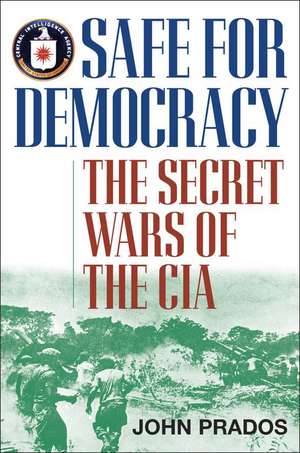
Safe for Democracy
Autor John Pradosen Limba Engleză Paperback – 16 feb 2009
Preț: 159.77 lei
Preț vechi: 182.25 lei
-12%
Puncte Express: 240
Carte tipărită la comandă
Livrare economică 02-16 decembrie
Livrare prin curier în România Termenul estimat este afișat lângă disponibilitate.
Transport gratuit de la 400.00 lei Plată online sau ramburs, în funcție de opțiunile comenzii.
Retur gratuit în 14 zile Comandă securizată și suport în română.
Specificații
ISBN-13: 9781566638234
ISBN-10: 1566638232
Pagini: 736
Dimensiuni: 140 x 228 x 40 mm
Greutate: 0.98 kg
Editura: Ivan R. Dee
Locul publicării:New York, United States
ISBN-10: 1566638232
Pagini: 736
Dimensiuni: 140 x 228 x 40 mm
Greutate: 0.98 kg
Editura: Ivan R. Dee
Locul publicării:New York, United States
Recenzii
This definitive history of covert action is both timely and necessary.
Prados brings together in one colorful narrative a sweeping history of America's covert wars.
Safe for Democracy is history for adults-not White House spin but what really happened and why.
Highly readable, this is intelligence history, and intelligent history at its best.
A comprehensive and up-to-date account.
Prados... constructs factual narratives of events based on thorough research with minimal analytic interpretation interspersed.
Prados has performed a valuable service....A comprehensive and superbly researched effort that is both engrossing and disturbing.
If you're studying the CIA's operations and routines you can't be without Safe for Democracy.
This is the most detailed single volume on the modern history of US covert operations.
Prados is an extraordinarily tenacious researcher....[This book is] an impressive achievement.
A rare degree of success....His coverage is unusually comprehensive and objective....An authoritative, original work....Prados demonstrates his virtuosity.
A well-researched, detailed, and vivid account....Prados proves a master of his subject.
Factual and capacious...if anyone writes hereafter about CIA's covert actions without consulting Prados, the result will be woefully deficient.
The book has many strengths.[Prados] introduces a mountain of newly declassified documents and information from memoirs and interviews. The book thus contains much new detail about individuals involved in covert operations and project costs.
Safe for Democracy argues its author's case very well, and it opens some very serious questions for scholarly military historians.
Prados brings together in one colorful narrative a sweeping history of America's covert wars.
Safe for Democracy is history for adults-not White House spin but what really happened and why.
Highly readable, this is intelligence history, and intelligent history at its best.
A comprehensive and up-to-date account.
Prados... constructs factual narratives of events based on thorough research with minimal analytic interpretation interspersed.
Prados has performed a valuable service....A comprehensive and superbly researched effort that is both engrossing and disturbing.
If you're studying the CIA's operations and routines you can't be without Safe for Democracy.
This is the most detailed single volume on the modern history of US covert operations.
Prados is an extraordinarily tenacious researcher....[This book is] an impressive achievement.
A rare degree of success....His coverage is unusually comprehensive and objective....An authoritative, original work....Prados demonstrates his virtuosity.
A well-researched, detailed, and vivid account....Prados proves a master of his subject.
Factual and capacious...if anyone writes hereafter about CIA's covert actions without consulting Prados, the result will be woefully deficient.
The book has many strengths.[Prados] introduces a mountain of newly declassified documents and information from memoirs and interviews. The book thus contains much new detail about individuals involved in covert operations and project costs.
Safe for Democracy argues its author's case very well, and it opens some very serious questions for scholarly military historians.