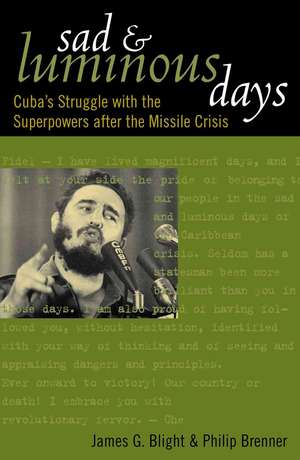
Sad and Luminous Days: Cuba's Struggle with the Superpowers after the Missile Crisis
Autor James G. Blight, Philip Brenneren Limba Engleză Hardback – 10 sep 2002
In tracing the developments of the missile crisis and beyond, Sad and Luminous Days presents and interprets a heretofore unavailable (and largely unknown) secret speech that Castro delivered to the Cuban leadership in 1968. In it, Castro reflects on the crisis and reveals the distrust and bitterness that characterized Cuban-Soviet relations in 1968. Blight and Brenner frame the annotated speech with an examination of the missile crisis itself, and an analysis of Cuban-Soviet relations between 1962-1968, ending with an epilogue that highlights the lessons the missile crisis offers us in the current search for security and a stable world order.
Sad and Luminous Days sheds new light on Cuban-Soviet relations and should be required reading not only for Cold-War scholars and historians, but also for anyone intrigued by the drama of the thirteen momentous days in October 1962.
Preț: 568.96 lei
Preț vechi: 843.41 lei
-33%
Puncte Express: 853
Carte tipărită la comandă
Livrare economică 08-22 iunie
Specificații
ISBN-13: 9780742522886
ISBN-10: 0742522881
Pagini: 352
Dimensiuni: 161 x 241 x 24 mm
Greutate: 0.58 kg
Ediția:0352
Editura: Bloomsbury Publishing
Colecția Rowman & Littlefield
Locul publicării:New York, United States
ISBN-10: 0742522881
Pagini: 352
Dimensiuni: 161 x 241 x 24 mm
Greutate: 0.58 kg
Ediția:0352
Editura: Bloomsbury Publishing
Colecția Rowman & Littlefield
Locul publicării:New York, United States
V-ar putea interesa
-
 MandelaAnthony SampsonPreț: 132.38 lei
 -
 Finding PolandMatthew KellyPreț: 116.45 lei
 -
 Berlin at WarRoger Moorhouse-20%Preț: 83.31 lei103.55 lei
 -
 The Cuban Missile Crisis: A Concise HistoryDon Munton-15%Preț: 270.86 lei318.06 lei
 -
 Luz Arce and Pinochet's ChileM. LazzaraPreț: 371.73 lei
 -
 Families and States in Western EuropeQuentin SkinnerPreț: 225.71 lei
 -
 Neo-Liberal IdeologyRachel S Turner-17%Preț: 173.36 lei210.12 lei
 -
 -25%Preț: 262.44 lei348.02 lei
 -
 The Sky Wept FireMikail EldinPreț: 104.12 lei
 -
 Kosovo: The Path to Contested Statehood in the BalkansJames Ker-Lindsay-19%Preț: 239.06 lei295.27 lei
 -
 -39%Preț: 795.65 lei1295.75 lei
 -
 -28%Preț: 64.55 lei89.09 lei
 -
 The Last Boarding Party: The USMC and the SS Mayaguez 1975Clayton K. S. Chun-33%Preț: 79.04 lei117.30 lei
 -
 Scream of EaglesRobert K Wilcox-28%Preț: 64.14 lei88.83 lei
Cuprins
Prologue: The Discovery and Meaning of Fidel Castro's Secret Speech
Chapter 1: The October Crisis
Chapter 2: Fidel Castro's Secret Speech
Chapter 3: October/November 1962: The Shadow of the Missile Crisis Descends on Havanna and Moscow
Chapter 4: June 1967-August 1968: From the Shadow of the Missile Crisis to the Shadow of the Future
Epilogue: Cuba's Struggle with the United States after the Missile Crisis: The Case for Realistic Empathy
Appendix A: Chronology of Events: 1963-1968
Appendix B: Text of Letter Dated 15 November from Prime Minister Fidel Castro of Cuba to Acting Secretary General U Thant
Appendix C: Speech Given By Major Fidel Castro Ruz, Prime Minister of the Revolutionary Government and First Secretary of the Central Committee of the Communist Party of Cuba, Analyzing the Events in Czechoslovakia Friday, August 23, 1968-Year of the Hero
Chapter 1: The October Crisis
Chapter 2: Fidel Castro's Secret Speech
Chapter 3: October/November 1962: The Shadow of the Missile Crisis Descends on Havanna and Moscow
Chapter 4: June 1967-August 1968: From the Shadow of the Missile Crisis to the Shadow of the Future
Epilogue: Cuba's Struggle with the United States after the Missile Crisis: The Case for Realistic Empathy
Appendix A: Chronology of Events: 1963-1968
Appendix B: Text of Letter Dated 15 November from Prime Minister Fidel Castro of Cuba to Acting Secretary General U Thant
Appendix C: Speech Given By Major Fidel Castro Ruz, Prime Minister of the Revolutionary Government and First Secretary of the Central Committee of the Communist Party of Cuba, Analyzing the Events in Czechoslovakia Friday, August 23, 1968-Year of the Hero
Recenzii
The value of Blight and Brenner's book is that it presents the Cuban perspective in extensive detail. Sad and Luminous Days will provide an important counterpoint to the stream of simplistic books about the missile crisis that are sure to appear.
Recommended.
The book is well written, meticulously researched, balanced, and is an excellent read.
Clearly written, well argued, thoroughly documented, and worth a read. Achieve[s] some major breakthroughs that aid in our understanding of contemporary Cuba.
Drawing on newly declassified documents from the U.S., Cuba, and Russia, as well as interviews with former officials in all three countries, Blight and Brenner show how the missile crisis was caused, in large part, by a lack of empathy between Washington, Havana, and Moscow. I have known for some time that we in the Kennedy administration misunderstood the Cubans and Russians. But in Sad and Luminous Days, we learn the many ways the Cubans and Russians misunderstood each other, and how those misunderstandings made the crisis as dangerous as it was. The book is a superb addition to recent history and is full of important lessons for relations between Great Powers and small countries, beginning with the lesson: 'Empathize with your adversary, or you may regret it!'
Using interviews with senior officials and recently declassified documents from Cuba, the United States, and the former Soviet Union, Blight and Brenner brilliantly show how Fidel Castro manipulated the Great Powers while posing as their innocent victim. This is a well-researched and beautifully written account of the triangular relationship that brought the world to the brink of nuclear catastrophe.
Sad and Luminous Days is an absolutely fundamental contribution to our knowledge of the Cuban missile crisis, Soviet-Cuban relations, and the difficulties facing Great Powers and small countries in their dealings with each other. Its principal lesson-the necessity (and the difficulty) of achieving realistic empathy with one's adversary-is especially salient at a moment when the remaining superpower, the United States, has declared a 'war on terrorism' involving potential confrontations between the U.S. and many other smaller countries. All U.S. decision-makers should read this book and learn its lessons before they attempt to carry out their 'war on terrorism.'
This splendid book shows starkly the deep differences between Cuba and the Soviet Union during the half-dozen years that followed the 1962 missile crisis. Those differences arose from the way the Soviets negotiated with the United States in 1962, without prior consultation with the Cubans. The authors eloquently build their case with many fascinating interviews with Soviet and Cuban decision makers and a spectacular, hitherto secret 1968 speech wherein Fidel Castro explained to the Cuban Communist Party's Central Committee why the Soviets were untrustworthy. This thoughtful and learned book is also a great read.
Empathy is believed by many to be a soft-hearted approach in a world that requires us to be hard-headed. This wonderful book amply demonstrates, however, that this view of empathy is false and derives from a fundamental misunderstanding of what empathy actually entails. The events of September 11, 2001 demonstrate how profoundly tragic may be the result of our failure to reach a deep and comprehensive understanding of how the world looks through the eyes of our adversaries. Blight and Brenner brilliantly explore how the failure of the U.S., Cuba, and the Soviet Union to achieve such understanding brought us to the very threshold of nuclear annihilation in October 1962 and, in so doing, provide an utterly essential guide to negotiating the treacherous waters of the twenty-first century.
This challenging account of the missile crisis and its aftermath casts fascinating light on Fidel Castro and his Cuba. After Sad and Luminous Days, no one will be able to write the same way about Castro's relationship with the Kremlin.
Every so often a work of history comes along that turns conventional wisdom on its head and brings to light previously mysterious, indeed hidden nuggets of truth, opening a new dimension to what we long held as the only conceivable plot line. Blight and Brenner's eloquent, beautifully written book brings to life in poignant, vivid, and solidly documented prose what until now has been a footnote in the standard accounts of the Cuban missile crisis: the Cuban perspective. Sad and Luminous Days demonstrates why the two authors are pioneers in writing Cold War history with newly declassified documents and sets the standard for the rest of us.
Recommended.
The book is well written, meticulously researched, balanced, and is an excellent read.
Clearly written, well argued, thoroughly documented, and worth a read. Achieve[s] some major breakthroughs that aid in our understanding of contemporary Cuba.
Drawing on newly declassified documents from the U.S., Cuba, and Russia, as well as interviews with former officials in all three countries, Blight and Brenner show how the missile crisis was caused, in large part, by a lack of empathy between Washington, Havana, and Moscow. I have known for some time that we in the Kennedy administration misunderstood the Cubans and Russians. But in Sad and Luminous Days, we learn the many ways the Cubans and Russians misunderstood each other, and how those misunderstandings made the crisis as dangerous as it was. The book is a superb addition to recent history and is full of important lessons for relations between Great Powers and small countries, beginning with the lesson: 'Empathize with your adversary, or you may regret it!'
Using interviews with senior officials and recently declassified documents from Cuba, the United States, and the former Soviet Union, Blight and Brenner brilliantly show how Fidel Castro manipulated the Great Powers while posing as their innocent victim. This is a well-researched and beautifully written account of the triangular relationship that brought the world to the brink of nuclear catastrophe.
Sad and Luminous Days is an absolutely fundamental contribution to our knowledge of the Cuban missile crisis, Soviet-Cuban relations, and the difficulties facing Great Powers and small countries in their dealings with each other. Its principal lesson-the necessity (and the difficulty) of achieving realistic empathy with one's adversary-is especially salient at a moment when the remaining superpower, the United States, has declared a 'war on terrorism' involving potential confrontations between the U.S. and many other smaller countries. All U.S. decision-makers should read this book and learn its lessons before they attempt to carry out their 'war on terrorism.'
This splendid book shows starkly the deep differences between Cuba and the Soviet Union during the half-dozen years that followed the 1962 missile crisis. Those differences arose from the way the Soviets negotiated with the United States in 1962, without prior consultation with the Cubans. The authors eloquently build their case with many fascinating interviews with Soviet and Cuban decision makers and a spectacular, hitherto secret 1968 speech wherein Fidel Castro explained to the Cuban Communist Party's Central Committee why the Soviets were untrustworthy. This thoughtful and learned book is also a great read.
Empathy is believed by many to be a soft-hearted approach in a world that requires us to be hard-headed. This wonderful book amply demonstrates, however, that this view of empathy is false and derives from a fundamental misunderstanding of what empathy actually entails. The events of September 11, 2001 demonstrate how profoundly tragic may be the result of our failure to reach a deep and comprehensive understanding of how the world looks through the eyes of our adversaries. Blight and Brenner brilliantly explore how the failure of the U.S., Cuba, and the Soviet Union to achieve such understanding brought us to the very threshold of nuclear annihilation in October 1962 and, in so doing, provide an utterly essential guide to negotiating the treacherous waters of the twenty-first century.
This challenging account of the missile crisis and its aftermath casts fascinating light on Fidel Castro and his Cuba. After Sad and Luminous Days, no one will be able to write the same way about Castro's relationship with the Kremlin.
Every so often a work of history comes along that turns conventional wisdom on its head and brings to light previously mysterious, indeed hidden nuggets of truth, opening a new dimension to what we long held as the only conceivable plot line. Blight and Brenner's eloquent, beautifully written book brings to life in poignant, vivid, and solidly documented prose what until now has been a footnote in the standard accounts of the Cuban missile crisis: the Cuban perspective. Sad and Luminous Days demonstrates why the two authors are pioneers in writing Cold War history with newly declassified documents and sets the standard for the rest of us.