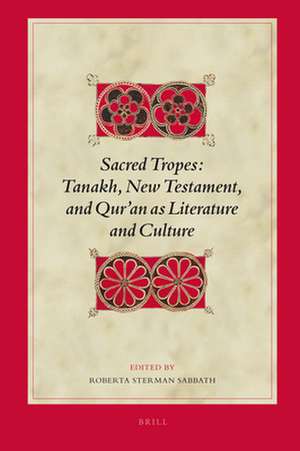
Sacred Tropes: Sacred Tropes, cartea 98
en Limba Engleză Hardback – 30 sep 2009
Nivel de studiu: master, doctorat și referință pentru cercetători în științe umaniste. Ne-a atras atenția Sacred Tropes: Tanakh, New Testament, and Qur'an as Literature and Culture prin abordarea sa curajoasă de a analiza cele trei mari tradiții scripturale ale umanității nu separat, ci într-un dialog metodologic integrat. Publicat de prestigioasa editură Brill, volumul coordonat de Roberta Sterman Sabbath răspunde unei nevoi acute în mediul academic: aceea de a depăși analizele teologice tradiționale în favoarea unor lentile critice moderne. Reținem faptul că această lucrare nu se limitează la o singură teorie, ci folosește un mix de abordări, de la critici economice și istorice până la studii de gen și drept, pentru a deconstrui modul în care textele sacre funcționează ca artefacte culturale. Comparabil cu Reading the Abrahamic Faiths în rigurozitate, dar actualizat pentru un peisaj academic unde intersecționalitatea și studiile de mediu au devenit esențiale, volumul oferă o perspectivă mult mai largă asupra modului în care narațiunile religioase modelează identitățile contemporane. Structura cărții, care adună peste 500 de pagini de analiză densă, permite o lectură fragmentată, fiind mai degrabă un festin intelectual de tip „multi-course” decât o narațiune liniară. Observăm o progresie de la analiza figurilor profetice la implicațiile ideologice profunde, facilitată de contribuțiile unor experți de renume. Este o resursă care transformă studiul biblic și coranic dintr-o disciplină confesională într-una de critică culturală comparată, oferind instrumentele necesare pentru a înțelege complexitatea literară a textelor care fundamentează civilizația vestică și islamică.
Preț: 1686.01 lei
Preț vechi: 2189.62 lei
-23%
Carte disponibilă
Livrare economică 28 octombrie-11 noiembrie
Specificații
ISBN-10: 9004177523
Pagini: 562
Dimensiuni: 162 x 239 x 35 mm
Greutate: 0.94 kg
Editura: Koninklijke Brill Bv
Colecția Sacred Tropes
Seriile Sacred Tropes, Brill
V-ar putea interesa
-
 A New English Translation of the SeptuagintAlbert PietersmaPreț: 310.26 lei
 -
 Virgil OperaRoger Mynors-25%Preț: 161.64 lei215.02 lei
 -
 For Everyone Bible Study GuideTom WrightPreț: 43.41 lei
 -
 The Things He SaidStephen CottrellPreț: 61.06 lei
 -
 Key Principles of Biblical FastingKay ArthurPreț: 41.68 lei
 -
 The Theology of the Book of GenesisR. W. L. MoberlyPreț: 245.57 lei
 -
 Preț: 353.55 lei
 -
 The Hebrew-Greek Key Word Study Bible: KJV Edition, HardboundDr. Spiros ZodhiatesPreț: 424.97 lei
 -
 Great Lives: Jesus: The Greatest Life of AllCharles R. SwindollPreț: 123.85 lei
 -
 Preț: 450.86 lei
 -
 What's the Difference?John PiperPreț: 77.32 lei
 -
 Preț: 47.29 lei
 -
 The Biblical Doctrine of Sovereign ElectionJohn Henry MillerPreț: 54.31 lei
 -
 Writing in the SandThomas MoorePreț: 109.17 lei
De ce să citești această carte
Recomandăm această carte studenților la teologie, istoria religiilor și literatură comparată care doresc să depășească exegeza clasică. Cititorul câștigă o înțelegere profundă a modului în care Tanakhul, Noul Testament și Coranul interacționează la nivel tematic și stilistic. Este un instrument esențial pentru oricine dorește să exploreze textele sacre prin prisma teoriilor critice moderne, oferind un cadru academic solid pentru dialogul interreligios și cultural.
Despre autor
Roberta Sterman Sabbath este o cercetătoare recunoscută în domeniul literaturii și religiei, activând în cadrul Universității Nevada, Las Vegas. Expertiza sa se concentrează pe intersecția dintre textele sacre și cultura contemporană, fiind o voce importantă în promovarea studiilor interdisciplinare. În Sacred Tropes: Tanakh, New Testament, and Qur'an as Literature and Culture, ea reușește să coordoneze un colectiv impresionant de savanți internaționali, demonstrând o capacitate remarcabilă de a sintetiza perspective divergente într-un dialog academic coerent și inovator.
Notă biografică
Descriere
Recenzii
Harvey Cox, Harvard University in Journal of the American Oriental Society
"Despite the growth in modern scholarship of interest in sacred texts and interfaith and
interreligious studies, prior to this work there has been no collection of essays or otherwise
that addresses the Tanak, the New Testament, and the Qur’an as works of literature and
their influence on different world cultures. While this initially would seem a rather
daunting endeavor, mainly due to the scope of the texts in question and the varying
methods of approach to them, Sacred Tropes manages to overcome these obvious
difficulties and to offer a coherent, well-edited, and structured group of essays that not
only is easy to read but is of interest to scholars from a wide variety of disciplines and faith
backgrounds."
Maire Byrne, Milltown Institute of Theology and Philosophy, Dublin, Ireland in Review of Biblical Literature (SBL).
"Reading this volume is like eating at an extravagant banquet where foods from three related yet distinct cultures are being served. Food items are not separated by cultures but by culinary themes. It is clear that each dish is from its own culture; there are no fusion dishes here. Similarities and differences between these culinary traditions must be
made by the guest. No one will complain about the amount and diversity of food. Each reader will find their new favorite dishes. All will find plenty to chew on and leave this banquet well fed."
Uriah Y. Kim, Hartford Seminary, in Muslim World.
“Clearly, one volume cannot be taken as representational of the scope of three
academic fields, but this collection does give a snapshot of a wide variety of
approaches. Despite the eclecticism of the collection and the range of approaches, it
encompasses, what do come through are correspondences between scholastic attitudes
and interests and the problematics of dealing with any scripture in terms of literary
culture. Above and beyond this, it is refreshing to be presented with a collection of
articles that is so unreservedly devoted to diversity in the process of interpretation
itself. The volume is well thought out and generally well presented, and the footnotes
are a goldmine for directions for further reading.”
Helen Blautherwick, School of Oriental and Asian Studies, London, in Journal of Qur'anic Studies.