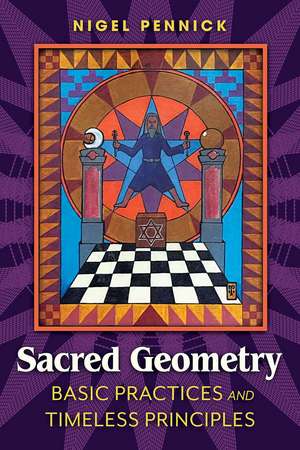
Sacred Geometry: Basic Practices and Timeless Principles
Autor Nigel Pennicken Limba Engleză Paperback – 3 dec 2026
• Traces the origins and core concepts of sacred geometry from ancient Egypt, Mesopotamia, and Britain through the Renaissance and modern science
• Reveals how geometric forms, proportions, and measurements shape sacred architecture, ritual objects, and esoteric symbolism
• Applies foundational principles such as the Golden Section, Platonic solids, and ad quadratum methods to understand the connection between spiritual practice and cosmic order
Sacred geometry is a universal language that links the structure of the cosmos, sacred sites, and spiritual symbolism. In this book, Nigel Pennick introduces the basic principles and esoteric secrets of this ancient tradition.
Pennick explores how sacred geometry shaped temples, pyramids, ziggurats, and cathedrals, showing how builders encoded metaphysical knowledge into architecture and ritual objects. He shares accounts of sacred geometry in Ancient Egypt, Mesopotamia, Israel, and Greece as well as its influence on Medieval and Renaissance architecture, Freemasonry, and Baroque city planning. Readers will learn practical ways to apply this knowledge by crafting geometric sigils and amulets and how to use proportional systems for harmonious design.
By connecting ancient traditions with modern discoveries, the author shows how sacred geometry remains a foundation for meaningful architecture and spiritual understanding. In addition, Pennick provides the necessary tools to integrate sacred geometry into personal, spiritual, and creative practices.
This concise guide to basic practices and timeless principles reveals the enduring significance of sacred geometry as a bridge between the material and the spiritual worlds.
Preț: 76.02 lei
Preț vechi: 100.40 lei
-24% Precomandă
Puncte Express: 114
Carte nepublicată încă
Livrare prin curier în România Precomanda se expediază când titlul devine disponibil.
Transport gratuit de la 400.00 lei Plată online sau ramburs, în funcție de opțiunile comenzii.
Retur gratuit în 14 zile Comandă securizată și suport în română.
Doresc să fiu notificat când acest titlu va fi disponibil:
Se trimite...
Specificații
ISBN-13: 9798888504543
Pagini: 176
Ilustrații: 43 b&w illustrations
Dimensiuni: 152 x 229 x 25 mm
Greutate: 0.28 kg
Ediția:4th Edition, New Edition
Editura: Inner Traditions/Bear & Company
Colecția Inner Traditions
Pagini: 176
Ilustrații: 43 b&w illustrations
Dimensiuni: 152 x 229 x 25 mm
Greutate: 0.28 kg
Ediția:4th Edition, New Edition
Editura: Inner Traditions/Bear & Company
Colecția Inner Traditions
Notă biografică
Nigel Pennick is an authority on ancient belief systems, traditions, runes, and geomancy and has traveled and lectured extensively in Europe and the United States. He is the author and illustrator of more than 50 books, including The Pagan Book of Days. The founder of the Institute of Geomantic Research and the Library of the European Tradition, he lives near Cambridge, England.
Extras
1. The Principles of Sacred Geometry
The principles that underlie disciplines such as geomancy, sacred geometry, magic, or electronics are fundamentally linked with the nature of the universe. Variations in external form may be dictated by the varying tenets of different religions or even political groupings, but the operative fundamentals remain constant. An analogy with electricity may be made. In order to illuminate an electric light bulb, various conditions must be fulfilled. A certain current must be fed to the bulb by means of insulated conductors with a complete circuit, etc. These conditions are not negotiable. If something is done incorrectly, the bulb will not light. Technicians throughout the world must adhere to the fundamental principles or otherwise fail. The principles transcend political or sectarian considerations. If done properly, the circuit will function equally well in a communist state, under a military dictatorship, or in a democratic country—even on another planet.
Similarly, with sacred geometry, the underlying principles transcend sectarian religious considerations. As a technology which aims to reintegrate humanity with the cosmic whole, it will work, like electricity, for anyone who fulfills the criteria, no matter what their principles or aims. The universal application of the identical principles of sacred geometry in places separated by vast gulfs of time, place, and belief attests to its transcendental nature. Thus, sacred geometry has been applied to pagan temples of the Sun, shrines of Isis, tabernacles of Jehovah, sanctuaries of Marduk, martyrs of Christian saints, Islamic mosques, and mausolea of kings and holy ones. In every case, the thread of immutable principles connects these sacred structures.
Geometry is normally included in the discipline of mathematics; however, numerical mathematics is in fact derived from geometry, which is of a much more fundamental order than the manipulation of numbers, which is the creation of man.
Nowadays, geometrical ratios are invariably expressed in mathematical terms, and it seems unthinkable that geometry could be separated from mathematics. However, the mathematical expression of ratios like pi and the golden section are merely conveniences geared to a literate civilization schooled in figures and calculation. Being primarily concerned with ratios and relationships, geometry's expression in terms of number belongs to a late period in its development. The complex geometry of ancient Egypt, which enabled architects and geometers to measure the exact size of the country, set down geodetic markers, and erect vast structures like the pyramids, was a practical art whose relationship with number was implicit. The Greek geometers, whose knowledge they admitted came from the Egyptians, likewise remained at the practical level and did not venture into the realms of complex mathematics, which exist only to prove that which is already known. In fact, it was not until the seventeenth century with the rise of the peculiarly Protestant European cult of science that the precise calculation of irrational numbers became a pressing concern.
The interpretation of geometry in terms of numerical relationships is a later intellectual rationalization of a natural system for the division of space. Such an interpretation came with the divorce of geometry from that corpus of science, magic, and metaphysics, which now goes by the name of ancient religion. Many ratios in length, for example the square roots of most whole numbers, cannot be expressed in terms of whole numbers, and thus can only be properly described in geometrical terms. Similarly the division of the circle into 360 units, known as degrees in the conventional Babylonian system, is not absolute. Although it is geometrically derived, it is merely a matter of convenience.
However, number, as expressed in the sacred dimensions of holy buildings, has often been used to camouflage their underlying sacred geometry. The Hebrew Tabernacle and Temple described in the Bible, and the dimensions of King's College Chapel in Cambridge, are laid down as measurements, which may be interpreted by the cognoscenti in terms of mystical geometry. King Henry VI could only lay down the form of his Chapel at Cambridge in terms of measures lest he divulged the masonic mysteries to the uninitiated. Reginald Ely, his master mason, had then only to draw out the dimensions as a plan to determine the ad Triangulum geometry inherent in those dimensions.*
Because geometry is an image of the structure of the cosmos, it can readily be used as a symbolic system for understanding various features of the universe. This symbolic function is exemplified by a little-known scientific instrument, which was used in pre-colonial times to teach Polynesian boys the fundamentals of navigation. Although the Polynesians did not have any of the instruments now considered necessary for navigation—the sextant, compass, and chronometer—they were able to travel regularly across great expanses of ocean and reach their objectives. Using the stars and other physical features like the presence of cloud banks over land, Polynesian navigators could detect the presence of islands, but the most useful method was by reading the waves. Just as any object in the sea, like a rock, will have an effect on the pattern of the ripples, so on a much larger scale the presence of an island will cause diffraction patterns in the waves many miles away.
The science of wave recognition was taught to the boys by means of a mnemonic system, the mattang. In its form, this instrument, composed of sticks arranged in a precise geometrical pattern, was uncannily like European sacred geometry. This geometrical device demonstrated to the pupils all of the basic patterns which waves form when deflected by land. Likewise, all geometrical patterns reflect further truths far beyond their simple derivations, even the complex relationships with other geometries. Their structure is at one with the universe and all the physical, structural, and psychological forces that make up its oneness.
Since the earliest times, geometry has been inseparable from magic. Even the most archaic rock-scribings are geometrical in form. These hint at a notational and invocational system practiced by some ancient priesthood. Because the complexities and abstract truths expressed by geometrical form could only be explained as reflections of the innermost truths of the world's being, they were held to be sacred mysteries of the highest order and were shielded from the eyes of the profane. Specialist knowledge was required to draw such figures, and their mystic importance was unheeded by the untutored masses. Complex concepts could be transmitted from one initiate to another by means of individual geometrical symbols or combinations of them without the ignorant even realizing that any communication had taken place. Like the modern system of secret symbols employed by gypsies, at best they would be puzzling enigmas to the curious.
Each geometrical form is invested with psychological and symbolic meaning. Thus anything made by the hands of men which incorporates these symbols in some way or other becomes a vehicle for the ideas and conceptions embodied in its geometry. Through the ages, complex symbolic geometries have acted as the bases for sacred and profane architecture, the geometry varying according to the function. Some geometries remain today as patent archetypal images of faith: the hexagram as the symbol of Judaism springs to mind. Other geometries have remained less overt, being used to indicate to those “in the know” some esoteric truth, like the vesica piscis on the lid of the Chalice Well at Glastonbury. Yet others lie hidden in the depths of mystical artworks—or even in the games of children.
One game common among schoolchildren is a remnant of an ancient system of sacred geometry. Known as “fortune telling,” the game involves folding a square of paper in a certain way. This enables the paper to be opened at will to disclose one of four choices. The folding of the paper and the form it takes when unfolded again is a ready mnemonic for creating the ad quadratum* geometry used by the old masons.
A square of paper is taken, and the four corners are folded to meet one another. This produces a square whose area is half that of the original. These corners are again folded from the back, which creates another square half the size of the former, making an eightfold division. From this, a three-dimensional figure can be made, with two groups of opposing “cusps,” which can be opened and shut at will. The association of this precisely-defined geometry with fortune telling may well be the degenerate remnant of an ancient system of divination, for the pattern thus formed not only reproduces the basic configuration for ad quadratum, but also the traditional layout for drawing the horoscope. This latter pattern combines in an ingenious way the pagan eightfold division of the square with the Eastern twelvefold division of the zodiac.
The use of geometrical forms is well known in ritual magic, both for the evocation of spirits and powers and for the protection of the magician from their malevolent attentions. Each spirit has traditionally a sigil or geometrical pattern associated with its name, by which means, with the appropriate spells and ritual, it may be contacted. Many of these sigils are geometrical expressions of the names, produced by plotting out number equivalents of letters on magic squares. The determination of number equivalents to names is known as gematria. In the Greek and Hebrew alphabets, each character stands not only for a sound but also for a numerical equivalent. Thus the name Israel would be written in Hebrew: Yod Shin Resh Aleph Lamed. These characters have the numerical equivalent: 10, 300, 200, 1, 30 = 541. In gematria, the convention then allows other words of equivalent numerical value to be used as substitutes. Qabalists over the centuries have studied the hidden meaning of the book of Isaiah in this way. Substituting one word for another can be used as an occult method of communication that obviates the necessity for using the actual name, which has its own special powers. The numbers themselves can also be plotted as positions on magic squares. Thus, our example, Israel, plotted on the Magic Square of the Sun, creates a specific sigil, which may then be transferred to magical utensils, etc.
Wherever geometry has been used, whether consciously or unconsciously, its symbolism still functions. Throughout the known universe the function of this geometry is an unchanging value in transitory existence. Artists and magicians alike have recognized this transcendental quality, and it has consequently formed the changeless basis upon which the fabric of culture is hung. Throughout recorded history, the geometrician has been quietly working at his craft, providing the inner matrix upon which the outward forms are based.
The principles that underlie disciplines such as geomancy, sacred geometry, magic, or electronics are fundamentally linked with the nature of the universe. Variations in external form may be dictated by the varying tenets of different religions or even political groupings, but the operative fundamentals remain constant. An analogy with electricity may be made. In order to illuminate an electric light bulb, various conditions must be fulfilled. A certain current must be fed to the bulb by means of insulated conductors with a complete circuit, etc. These conditions are not negotiable. If something is done incorrectly, the bulb will not light. Technicians throughout the world must adhere to the fundamental principles or otherwise fail. The principles transcend political or sectarian considerations. If done properly, the circuit will function equally well in a communist state, under a military dictatorship, or in a democratic country—even on another planet.
Similarly, with sacred geometry, the underlying principles transcend sectarian religious considerations. As a technology which aims to reintegrate humanity with the cosmic whole, it will work, like electricity, for anyone who fulfills the criteria, no matter what their principles or aims. The universal application of the identical principles of sacred geometry in places separated by vast gulfs of time, place, and belief attests to its transcendental nature. Thus, sacred geometry has been applied to pagan temples of the Sun, shrines of Isis, tabernacles of Jehovah, sanctuaries of Marduk, martyrs of Christian saints, Islamic mosques, and mausolea of kings and holy ones. In every case, the thread of immutable principles connects these sacred structures.
Geometry is normally included in the discipline of mathematics; however, numerical mathematics is in fact derived from geometry, which is of a much more fundamental order than the manipulation of numbers, which is the creation of man.
Nowadays, geometrical ratios are invariably expressed in mathematical terms, and it seems unthinkable that geometry could be separated from mathematics. However, the mathematical expression of ratios like pi and the golden section are merely conveniences geared to a literate civilization schooled in figures and calculation. Being primarily concerned with ratios and relationships, geometry's expression in terms of number belongs to a late period in its development. The complex geometry of ancient Egypt, which enabled architects and geometers to measure the exact size of the country, set down geodetic markers, and erect vast structures like the pyramids, was a practical art whose relationship with number was implicit. The Greek geometers, whose knowledge they admitted came from the Egyptians, likewise remained at the practical level and did not venture into the realms of complex mathematics, which exist only to prove that which is already known. In fact, it was not until the seventeenth century with the rise of the peculiarly Protestant European cult of science that the precise calculation of irrational numbers became a pressing concern.
The interpretation of geometry in terms of numerical relationships is a later intellectual rationalization of a natural system for the division of space. Such an interpretation came with the divorce of geometry from that corpus of science, magic, and metaphysics, which now goes by the name of ancient religion. Many ratios in length, for example the square roots of most whole numbers, cannot be expressed in terms of whole numbers, and thus can only be properly described in geometrical terms. Similarly the division of the circle into 360 units, known as degrees in the conventional Babylonian system, is not absolute. Although it is geometrically derived, it is merely a matter of convenience.
However, number, as expressed in the sacred dimensions of holy buildings, has often been used to camouflage their underlying sacred geometry. The Hebrew Tabernacle and Temple described in the Bible, and the dimensions of King's College Chapel in Cambridge, are laid down as measurements, which may be interpreted by the cognoscenti in terms of mystical geometry. King Henry VI could only lay down the form of his Chapel at Cambridge in terms of measures lest he divulged the masonic mysteries to the uninitiated. Reginald Ely, his master mason, had then only to draw out the dimensions as a plan to determine the ad Triangulum geometry inherent in those dimensions.*
Because geometry is an image of the structure of the cosmos, it can readily be used as a symbolic system for understanding various features of the universe. This symbolic function is exemplified by a little-known scientific instrument, which was used in pre-colonial times to teach Polynesian boys the fundamentals of navigation. Although the Polynesians did not have any of the instruments now considered necessary for navigation—the sextant, compass, and chronometer—they were able to travel regularly across great expanses of ocean and reach their objectives. Using the stars and other physical features like the presence of cloud banks over land, Polynesian navigators could detect the presence of islands, but the most useful method was by reading the waves. Just as any object in the sea, like a rock, will have an effect on the pattern of the ripples, so on a much larger scale the presence of an island will cause diffraction patterns in the waves many miles away.
The science of wave recognition was taught to the boys by means of a mnemonic system, the mattang. In its form, this instrument, composed of sticks arranged in a precise geometrical pattern, was uncannily like European sacred geometry. This geometrical device demonstrated to the pupils all of the basic patterns which waves form when deflected by land. Likewise, all geometrical patterns reflect further truths far beyond their simple derivations, even the complex relationships with other geometries. Their structure is at one with the universe and all the physical, structural, and psychological forces that make up its oneness.
Since the earliest times, geometry has been inseparable from magic. Even the most archaic rock-scribings are geometrical in form. These hint at a notational and invocational system practiced by some ancient priesthood. Because the complexities and abstract truths expressed by geometrical form could only be explained as reflections of the innermost truths of the world's being, they were held to be sacred mysteries of the highest order and were shielded from the eyes of the profane. Specialist knowledge was required to draw such figures, and their mystic importance was unheeded by the untutored masses. Complex concepts could be transmitted from one initiate to another by means of individual geometrical symbols or combinations of them without the ignorant even realizing that any communication had taken place. Like the modern system of secret symbols employed by gypsies, at best they would be puzzling enigmas to the curious.
Each geometrical form is invested with psychological and symbolic meaning. Thus anything made by the hands of men which incorporates these symbols in some way or other becomes a vehicle for the ideas and conceptions embodied in its geometry. Through the ages, complex symbolic geometries have acted as the bases for sacred and profane architecture, the geometry varying according to the function. Some geometries remain today as patent archetypal images of faith: the hexagram as the symbol of Judaism springs to mind. Other geometries have remained less overt, being used to indicate to those “in the know” some esoteric truth, like the vesica piscis on the lid of the Chalice Well at Glastonbury. Yet others lie hidden in the depths of mystical artworks—or even in the games of children.
One game common among schoolchildren is a remnant of an ancient system of sacred geometry. Known as “fortune telling,” the game involves folding a square of paper in a certain way. This enables the paper to be opened at will to disclose one of four choices. The folding of the paper and the form it takes when unfolded again is a ready mnemonic for creating the ad quadratum* geometry used by the old masons.
A square of paper is taken, and the four corners are folded to meet one another. This produces a square whose area is half that of the original. These corners are again folded from the back, which creates another square half the size of the former, making an eightfold division. From this, a three-dimensional figure can be made, with two groups of opposing “cusps,” which can be opened and shut at will. The association of this precisely-defined geometry with fortune telling may well be the degenerate remnant of an ancient system of divination, for the pattern thus formed not only reproduces the basic configuration for ad quadratum, but also the traditional layout for drawing the horoscope. This latter pattern combines in an ingenious way the pagan eightfold division of the square with the Eastern twelvefold division of the zodiac.
The use of geometrical forms is well known in ritual magic, both for the evocation of spirits and powers and for the protection of the magician from their malevolent attentions. Each spirit has traditionally a sigil or geometrical pattern associated with its name, by which means, with the appropriate spells and ritual, it may be contacted. Many of these sigils are geometrical expressions of the names, produced by plotting out number equivalents of letters on magic squares. The determination of number equivalents to names is known as gematria. In the Greek and Hebrew alphabets, each character stands not only for a sound but also for a numerical equivalent. Thus the name Israel would be written in Hebrew: Yod Shin Resh Aleph Lamed. These characters have the numerical equivalent: 10, 300, 200, 1, 30 = 541. In gematria, the convention then allows other words of equivalent numerical value to be used as substitutes. Qabalists over the centuries have studied the hidden meaning of the book of Isaiah in this way. Substituting one word for another can be used as an occult method of communication that obviates the necessity for using the actual name, which has its own special powers. The numbers themselves can also be plotted as positions on magic squares. Thus, our example, Israel, plotted on the Magic Square of the Sun, creates a specific sigil, which may then be transferred to magical utensils, etc.
Wherever geometry has been used, whether consciously or unconsciously, its symbolism still functions. Throughout the known universe the function of this geometry is an unchanging value in transitory existence. Artists and magicians alike have recognized this transcendental quality, and it has consequently formed the changeless basis upon which the fabric of culture is hung. Throughout recorded history, the geometrician has been quietly working at his craft, providing the inner matrix upon which the outward forms are based.
Cuprins
Foreword by Jon E. Graham
Introduction to the 2026 Edition
THE ORIGINAL TEXT
Sacred Geometry
Symbolism and Purpose
in Religious Structures
Introduction
1 The Principles of Sacred Geometry
2 The Forms
3 Ancient British Geometry
4 Ancient Egyptian Sacred Geometry
5 Mesopotamian and Hebrew Sacred Geometry
6 Ancient Greece
7 Vitruvius
8 The Comacines and Medieval Sacred Geometry
9 Masonic Symbolism and Documentary Evidence
10 Problems, Conflicts and Divulgence
of the Mysteries
11 Renaissance Sacred Geometry
12 Baroque Geometry
13 Sacred Geometry in Exile
14 Science: The Verifier of Sacred Geometry
Index
Introduction to the 2026 Edition
THE ORIGINAL TEXT
Sacred Geometry
Symbolism and Purpose
in Religious Structures
Introduction
1 The Principles of Sacred Geometry
2 The Forms
3 Ancient British Geometry
4 Ancient Egyptian Sacred Geometry
5 Mesopotamian and Hebrew Sacred Geometry
6 Ancient Greece
7 Vitruvius
8 The Comacines and Medieval Sacred Geometry
9 Masonic Symbolism and Documentary Evidence
10 Problems, Conflicts and Divulgence
of the Mysteries
11 Renaissance Sacred Geometry
12 Baroque Geometry
13 Sacred Geometry in Exile
14 Science: The Verifier of Sacred Geometry
Index
Recenzii
“By presenting the sacred geometry of twelve cultural epochs, Pennick’s landmark book provides a balanced and concrete introduction to a range of traditions that significantly employed it.”
“Sacred geometry is the basis for all esoteric practice. Its importance includes even the Royal Art itself—practical alchemy—wherein the structures of crystals are the literal basis for the confection of the Philosophic Stone. Once again, we are blessed to have Nigel Pennick’s masterpiece back in print and available to students of the Arcane Arts and Sciences. This book is a classic and essential reading for those wishing for theoretical as well as practical understanding of sacred geometry.”
“Sacred Geometry: Basic Practices and Timeless Principles by Nigel Pennick is a very valuable overview of the almost-lost Western sacred science of Earth measurement. Highly recommended!”
“In keeping with its compact title, Nigel Pennick’s Sacred Geometry is simple and straightforward in configuration but endlessly revealing in scope and depth. This is because the lens of sacred proportion is etched with eternal templates that lead to more beautiful and inspired human works. As this book shows, these higher principles, which describe the ratios of harmony and aesthetic composition, have informed the arts, crafts, and temple-building aspirations of human societies for millennia. The principles are never obsolete, for they manifest across time, space, and culture. One could ask for no better guide into this hidden yet ever-present world than Nigel Pennick, a prolific author who trained as a scientist only to become what might be called a historian of the human spirit. Having dedicated much of his life to mastering the spiritual arts and crafts in theory and practice, he truly knows whereof he speaks.”
“Sacred geometry is the basis for all esoteric practice. Its importance includes even the Royal Art itself—practical alchemy—wherein the structures of crystals are the literal basis for the confection of the Philosophic Stone. Once again, we are blessed to have Nigel Pennick’s masterpiece back in print and available to students of the Arcane Arts and Sciences. This book is a classic and essential reading for those wishing for theoretical as well as practical understanding of sacred geometry.”
“Sacred Geometry: Basic Practices and Timeless Principles by Nigel Pennick is a very valuable overview of the almost-lost Western sacred science of Earth measurement. Highly recommended!”
“In keeping with its compact title, Nigel Pennick’s Sacred Geometry is simple and straightforward in configuration but endlessly revealing in scope and depth. This is because the lens of sacred proportion is etched with eternal templates that lead to more beautiful and inspired human works. As this book shows, these higher principles, which describe the ratios of harmony and aesthetic composition, have informed the arts, crafts, and temple-building aspirations of human societies for millennia. The principles are never obsolete, for they manifest across time, space, and culture. One could ask for no better guide into this hidden yet ever-present world than Nigel Pennick, a prolific author who trained as a scientist only to become what might be called a historian of the human spirit. Having dedicated much of his life to mastering the spiritual arts and crafts in theory and practice, he truly knows whereof he speaks.”
Descriere
A practical introduction to the history, principles, and tradition of sacred geometry