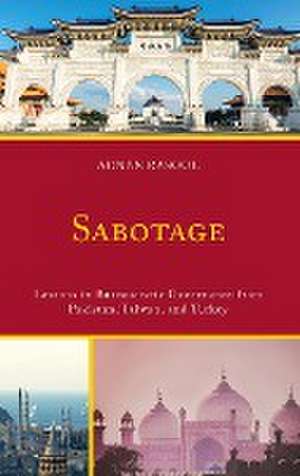
Sabotage: Lessons in Bureaucratic Governance from Pakistan, Taiwan, and Turkey
Autor Adnan Rasoolen Limba Engleză Hardback – 31 iul 2023
Preț: 490.30 lei
Preț vechi: 720.68 lei
-32%
Puncte Express: 735
Carte tipărită la comandă
Livrare economică 26 octombrie-09 noiembrie
Livrare prin curier în România Termenul estimat este afișat lângă disponibilitate.
Transport gratuit pentru acest produs Plată online sau ramburs, în funcție de opțiunile comenzii.
Retur gratuit în 14 zile Comandă securizată și suport în română.
Specificații
ISBN-13: 9781666901757
ISBN-10: 166690175X
Pagini: 164
Ilustrații: 12 b/w illustrations; 3 tables;
Dimensiuni: 157 x 237 x 19 mm
Greutate: 0.41 kg
Editura: Bloomsbury Publishing
Colecția Lexington Books
Locul publicării:New York, United States
ISBN-10: 166690175X
Pagini: 164
Ilustrații: 12 b/w illustrations; 3 tables;
Dimensiuni: 157 x 237 x 19 mm
Greutate: 0.41 kg
Editura: Bloomsbury Publishing
Colecția Lexington Books
Locul publicării:New York, United States
Cuprins
Chapter 1: Governance Stability: The Logic of Bureaucratic Efficiency and Autonomy
Chapter 2: Measuring and Observing Governance Stability
Chapter 3: Chaotic Stability: The Case of Pakistan's Governance Amid Political Chaos
Chapter 4: The Autocratic Roots of Democracy: The Case of Taiwan's Reformed Bureaucracy
Chapter 5: Institutions Wrecked and a Democracy Lost: The Case of Turkey's Governance Breakdown
Chapter 6: Governance Stability. That Is How Countries Keep Functioning During Political Crises
Chapter 2: Measuring and Observing Governance Stability
Chapter 3: Chaotic Stability: The Case of Pakistan's Governance Amid Political Chaos
Chapter 4: The Autocratic Roots of Democracy: The Case of Taiwan's Reformed Bureaucracy
Chapter 5: Institutions Wrecked and a Democracy Lost: The Case of Turkey's Governance Breakdown
Chapter 6: Governance Stability. That Is How Countries Keep Functioning During Political Crises
Recenzii
Drawing on an innovative network analysis, Professor Rasool argues that existing analyses of regime instability myopically focus on conflicts between politicians and generals. He proposes that senior bureaucrats may be the true 'king makers' because they can most directly "make and break" regimes. Rasool thus insightfully redefines a long-standing debate.
"Sabotage: Lessons in Bureaucratic Governance from Pakistan, Taiwan, and Turkey by Adnan Rasool,is innovative, imaginative, and refreshing in its approach, content, and style. The book has three outstanding features; first, it is theoretically rigorous and makes an effective articulation of the failsafe theory in making critical appraisal of competencies and professionalism of bureaucracies. Second, it transmits a comparative analytical method-professionalism of bureaucracies, juxtaposing it to the absence of professionalism among politicians and political parties; third it is exceptional and innovative in picking three cases: Pakistan, Turkey and Taiwan, culturally and geographically distinctly separate and yet the political systems have similarities-- underscoring that all three have witnessed prolonged military rule, and in case of Turkey and Taiwan extended single party rule, while the yearning for democracy and democratic movements continue to reappear.
The study brings to attention the persistence of military rule and highlights the historical, cultural, economic, and political circumstances of each country, in struggling to construct democracy under authoritarian tendencies and rulership. The author provides an insightful view into the causes of political chaos and the resilience, professionalism and competencies of the bureaucracy ensuring continuity and stability."
"Sabotage: Lessons in Bureaucratic Governance from Pakistan, Taiwan, and Turkey by Adnan Rasool,is innovative, imaginative, and refreshing in its approach, content, and style. The book has three outstanding features; first, it is theoretically rigorous and makes an effective articulation of the failsafe theory in making critical appraisal of competencies and professionalism of bureaucracies. Second, it transmits a comparative analytical method-professionalism of bureaucracies, juxtaposing it to the absence of professionalism among politicians and political parties; third it is exceptional and innovative in picking three cases: Pakistan, Turkey and Taiwan, culturally and geographically distinctly separate and yet the political systems have similarities-- underscoring that all three have witnessed prolonged military rule, and in case of Turkey and Taiwan extended single party rule, while the yearning for democracy and democratic movements continue to reappear.
The study brings to attention the persistence of military rule and highlights the historical, cultural, economic, and political circumstances of each country, in struggling to construct democracy under authoritarian tendencies and rulership. The author provides an insightful view into the causes of political chaos and the resilience, professionalism and competencies of the bureaucracy ensuring continuity and stability."