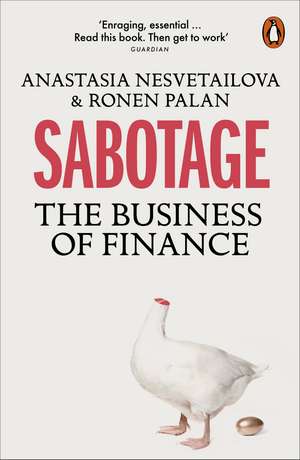
Sabotage: The Business of Finance
Autor Anastasia Nesvetailova, Ronen Palanen Limba Engleză Paperback – 27 ian 2021
Considerăm că volumul Sabotage propune o schimbare radicală de paradigmă: sistemul financiar modern nu suferă de erori izolate de parcurs, ci este proiectat structural pentru a funcționa prin sabotaj. Anastasia Nesvetailova și Ronen Palan demonstrează că inovația financiară nu vizează optimizarea fluxurilor de capital, ci crearea unor mecanisme de disimulare care să permită evitarea supravegherii și a reglementărilor. Cititorul va înțelege cum ceea ce a început ca o practică modestă la începutul secolului XX a devenit, în anii '80, o industrie globală a înșelăciunii legalizate, culminând cu instrumentele opace care au declanșat colapsul din 2008.
Abordarea autorilor este una de tip detectivistic, investigând rădăcinile intelectuale ale acestui comportament sistemic. Ca și Nicholas Dunbar în The Devil's Derivatives, autorii distilează experiența reală din piețele de capital în principii acționabile pentru a înțelege cum au fost 'aranjate' piețele în favoarea marilor jucători. Spre deosebire de alte analize care caută vinovați individuali, această lucrare argumentează că întregul ecosistem este construit pe ideea de arbitraj reglementar.
Sabotage reprezintă o evoluție firească în opera Anastasiei Nesvetailova, completând temele explorate în Shadow Banking și Global Finance in the New Century. Dacă în lucrările anterioare se concentra pe arhitectura sistemului bancar paralel și pe expansiunea puterii financiare, aici ea oferă instrumentele critice pentru a decoda intenționalitatea din spatele produselor financiare complexe. Este o lectură tehnică, dar accesibilă, esențială pentru a înțelege de ce reformele post-criză au eșuat adesea în a schimba comportamentul fundamental al industriei.
Preț: 53.98 lei
Preț vechi: 68.19 lei
-21%
Carte disponibilă
Livrare economică 19-25 noiembrie
Specificații
ISBN-10: 0141986247
Pagini: 240
Dimensiuni: 129 x 198 x 14 mm
Greutate: 0.18 kg
Editura: Penguin Books
Colecția Penguin
Locul publicării:London, United Kingdom
V-ar putea interesa
-
 High FinancierNiall Ferguson-19%Preț: 128.09 lei157.94 lei
 -
 Crisis EconomicsNouriel Roubini-18%Preț: 65.57 lei79.82 lei
 -
 The Ascent of MoneyNiall Ferguson-26%Preț: 91.13 lei123.22 lei
 -
 13 BankersSimon JohnsonPreț: 105.99 lei
 -
 -26%Preț: 69.96 lei94.17 lei
 -
 -25%Preț: 81.03 lei108.74 lei
 -
 Preț: 110.89 lei
 -
 Preț: 187.57 lei
 -
 Finance, Sustainability, and the Climate Crisis: An Incommensurable AllianceDr Cengizhan Kaptan-32%Preț: 566.66 lei830.12 lei
 -
 Catching Up to FtxBen ArmstrongPreț: 148.11 lei
 -
 InflatedR Christopher WhalenPreț: 175.02 lei
 -
 The Republic of InnovationAndrea Lorenzo CapusselaPreț: 140.60 lei
 -
 Disrupt EverythingJames PattersonPreț: 122.07 lei
 -
 -17%Preț: 60.48 lei73.08 lei
 -
 -19%Preț: 63.34 lei78.53 lei
 -
 Future FinanceSabine DorryPreț: 260.76 lei
 -
 Gambling ManLionel BarberPreț: 108.34 lei
 -
 What Went Wrong With CapitalismRuchir SharmaPreț: 93.80 lei
 -
 You Weren't Supposed To See ThatJoshua M. Brown-11%Preț: 95.37 lei107.57 lei
 -
 Stealing The FutureDavid MorrisPreț: 116.45 lei
De ce să citești această carte
Recomandăm această carte profesioniștilor din economie și științe politice care doresc să treacă dincolo de discursul oficial al piețelor libere. Veți câștiga o perspectivă critică asupra modului în care reglementările sunt sistematic evitate și veți înțelege mecanismele prin care inovația financiară este utilizată pentru a extrage valoare, nu pentru a o crea. Este un ghid indispensabil pentru a descifra realitatea din spatele produselor financiare complexe.
Despre autor
Anastasia Nesvetailova este o autoritate recunoscută în economia politică globală, activând ca lector la Departamentul de Relații Internaționale și Politică din cadrul Universității Sussex, Regatul Unit. Expertiza sa se concentrează pe sistemele financiare internaționale, cu un accent deosebit pe fenomenul 'shadow banking' și pe crizele de lichiditate. Prin lucrările sale, precum Shadow Banking sau Global Finance in the New Century, Nesvetailova a explorat mecanismele prin care puterea financiară influențează deciziile politice și stabilitatea economică mondială, fiind o voce critică în analiza reglementărilor post-2008.
Notă biografică
Ronen Palanis Professor of International Political Economy at City University, London. He has written extensively on the political economy of the state and globalization, as well as specializing in offshore finance.
Recenzii
If you're a progressive, in Britain or elsewhere, and if you think the movement needs fresh ideas, read this book, it's full of them. Then get to work.
Distinctive, fresh and well-justified...Sabotagedeserves high praise for fulfilling the most valuable injunction of all when it comes to catastrophic crises with terrible human costs: never forget.
Nesvetailova and Palan trace how financiers have corrupted the purpose of the corporation, undermined our tax authorities, foxed the regulators, evaded the forces of law and order, and generally rigged markets in their favour. There's a word for all this - sabotage. And as it has unfolded, finance has been steadily sabotaging our democracies. This lucid, persuasive and timely new book hits the nail on the head.
Descriere scurtă
'It ought to be required reading for every civil servant, regulator and politician in the UK and elsewhere'Literary Review
Financial malpractice, we're told, is an aberration: the actions of a few bad apples deviating from the norms of a market-governed process and gaming the system. InSabotage, political scientists Anastasia Nesvetailova and Ronen Palan blow this fiction apart, showing that sabotage is not an anomaly, but part of the business model of finance - and always has been.
Abusive lending practices, misleading investors, manipulating prices, deliberately falsifying figures, cheating, obstruction and taking advantage of 'the dumbest person in the room' - they're actually the main source of profitability in finance, and the surest way to a bonus. If you want to make money in the industry, you need to find ways of sabotaging either your clients, your competitors or the government (or all three), and above all, the market itself. Talking to industry insiders, economists and high net worth customers, examining the history of finance and its workings today, the authors show us how the idea of sabotage not only makes sense of all past economic crises, but must also be at the heart of all future regulations.