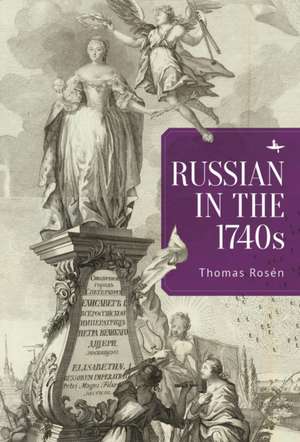

Russian in the 1740s
Autor Thomas Rosénen Limba Engleză Paperback – 22 mar 2022
Preț: 160.48 lei
Preț vechi: 194.86 lei
-18%
Puncte Express: 241
Carte disponibilă
Livrare economică 14-28 noiembrie
Livrare express 03-07 noiembrie pentru 61.92 lei
Livrare prin curier în România Termenul estimat este afișat lângă disponibilitate.
Transport gratuit de la 400.00 lei Plată online sau ramburs, în funcție de opțiunile comenzii.
Retur gratuit în 14 zile Comandă securizată și suport în română.
Specificații
ISBN-13: 9781644697979
ISBN-10: 1644697971
Pagini: 212
Dimensiuni: 178 x 254 x 12 mm
Greutate: 0.38 kg
Ediția:Bilingvă
Editura: Academic Studies Press
Colecția Academic Studies Press
Locul publicării:Boston, MA, United States
ISBN-10: 1644697971
Pagini: 212
Dimensiuni: 178 x 254 x 12 mm
Greutate: 0.38 kg
Ediția:Bilingvă
Editura: Academic Studies Press
Colecția Academic Studies Press
Locul publicării:Boston, MA, United States
Cuprins
Author’s Notes
Notes on Transliteration
Spelling of Names
The Old Style Calendar
Translation of Quotations
Acknowledgments
Chapter 1: Introduction
1.1 Aim and Purpose of the Investigation
1.2 Language and Society in Eighteenth-Century Russia
1.3 Historical Sociolinguistics?
1.4 Chronological Delimitations
1.5 Was Post-Petrine Russian in Disarray?
1.6. Research Questions
1.6.1 Extralinguistic Questions
1.6.2 Linguistic Questions:
1.7 Outline of the Investigation
Chapter 2: Survey of Existing Research
2.1 Russian Language from the 1740s as a Field of Study
2.2 General Studies of Eighteenth-Century Russian
2.3 Sociolinguistically Oriented Studies of Eighteenth-Century Russian
2.4 Language and Politics in the 1740s
2.5 Assessing the Situation
2.6 Conclusions
Chapter 3: The Impact of Society on Language
3.1 Introductory Remarks
3.1.1 Peoples and Languages
3.1.2 Social Stratification
3.1.3 Politics and Administration
3.2 Education and Literacy in Eighteenth-Century Russia
3.2.1 Education
3.2.2 Literacy
3.3 Language Management
3.3.1 Examining Language Management in Handwritten Documents from the 1740s
3.3.2 The Imperial Academy of Sciences, a Language Management Agency
3.3.3 A New Function: The Founding of the Russian Conference
3.3.4 The Demise of the Russian Conference
3.4 Language Management in the Administration
3.4.1 Template for the Imperial Title, 1741
3.4.2 Template for a Letter of Credit, 1744
3.5 Conclusions
Chapter 4: Available Sources
4.1 Electronic Corpora of Eighteenth-Century Texts
4.2 Printed Texts
4.2.1 Books
4.2.2 Newspapers
4.2.3 Popular Prints
4.3 Archival Material
4.3.1 Selection of Sources
4.4 Paleographic Characteristics of the Material
4.4.1 Developments in Printing during the 1740s
4.4.2 Handwritten Documents
4.5 The People behind the Material
Chapter 5: Methodological Considerations
5.1 Existing Methods
5.2 Methodological Renewal
5.2.1 The Uniformitarian Principle
5.2.2 The Uniformitarian Principle and the Registers of Eighteenth-Century Russian
5.2.3 What May Have Influenced the Registers?
5.2.4 Register Analysis
5.3 Register Analysis of Russian from the 1740s
Chapter 6: Situational Analysis of Registers
6.1 Participants
6.1.1 Individuals
6.1.2 Institutions
6.2 Relationships among Participants
6.3 Channel
6.3.1 Change of Printed Medium: A Weather Phenomenon in Spain
6.3.2 Speech to Writing: Witness Statements
6.4 Processing Circumstances
6.5 Setting
6.6 Communicative Purpose
6.7 Topics
6.8 Conclusions
Chapter 7: Linguistic Analysis
7.1 Autographs
7.1.1 Mate Filipp Lanikin’s Receipt
7.1.2 Mikhail Turchenikov’s Letter and Its Cultural Context
a) The Report
b) The Letters
7.2 The Language of Regional Administration
7.3 The Language of Diplomacy
7.3.1 The Treaty on Subsidies
7.3.2 Letters to the Royal Families
7.3.3 A Letter by A. I. Rumiantsev
7.4 The Life of Printed Texts
7.4.1 Printing and Obsolete Characters
7.4.2 The Development of Printed Texts
7.4.3 Parallel Editions: Field-Marshal de Lacy’s Reports from the Front
Chapter 8: Functional Analysis
8.1 Tradition
8.2 Education
8.3 Social Identity
8.4 Efficiency of Administration
8.5 Informativity
8.6 Conclusion
Chapter 9: General Conclusions
9.1 Territorial Expansion and the Need for Trained Specialists
9.2 Education and Literacy
9.3 Organized Language Management
9.4 Functional Spheres of Russian in the 1740s
9.5 Perspectives
Bibliography
Archival Sources
Archival Sources on the Internet
Printed Sources
Literature
Notes on Transliteration
Spelling of Names
The Old Style Calendar
Translation of Quotations
Acknowledgments
Chapter 1: Introduction
1.1 Aim and Purpose of the Investigation
1.2 Language and Society in Eighteenth-Century Russia
1.3 Historical Sociolinguistics?
1.4 Chronological Delimitations
1.5 Was Post-Petrine Russian in Disarray?
1.6. Research Questions
1.6.1 Extralinguistic Questions
1.6.2 Linguistic Questions:
1.7 Outline of the Investigation
Chapter 2: Survey of Existing Research
2.1 Russian Language from the 1740s as a Field of Study
2.2 General Studies of Eighteenth-Century Russian
2.3 Sociolinguistically Oriented Studies of Eighteenth-Century Russian
2.4 Language and Politics in the 1740s
2.5 Assessing the Situation
2.6 Conclusions
Chapter 3: The Impact of Society on Language
3.1 Introductory Remarks
3.1.1 Peoples and Languages
3.1.2 Social Stratification
3.1.3 Politics and Administration
3.2 Education and Literacy in Eighteenth-Century Russia
3.2.1 Education
3.2.2 Literacy
3.3 Language Management
3.3.1 Examining Language Management in Handwritten Documents from the 1740s
3.3.2 The Imperial Academy of Sciences, a Language Management Agency
3.3.3 A New Function: The Founding of the Russian Conference
3.3.4 The Demise of the Russian Conference
3.4 Language Management in the Administration
3.4.1 Template for the Imperial Title, 1741
3.4.2 Template for a Letter of Credit, 1744
3.5 Conclusions
Chapter 4: Available Sources
4.1 Electronic Corpora of Eighteenth-Century Texts
4.2 Printed Texts
4.2.1 Books
4.2.2 Newspapers
4.2.3 Popular Prints
4.3 Archival Material
4.3.1 Selection of Sources
4.4 Paleographic Characteristics of the Material
4.4.1 Developments in Printing during the 1740s
4.4.2 Handwritten Documents
4.5 The People behind the Material
Chapter 5: Methodological Considerations
5.1 Existing Methods
5.2 Methodological Renewal
5.2.1 The Uniformitarian Principle
5.2.2 The Uniformitarian Principle and the Registers of Eighteenth-Century Russian
5.2.3 What May Have Influenced the Registers?
5.2.4 Register Analysis
5.3 Register Analysis of Russian from the 1740s
Chapter 6: Situational Analysis of Registers
6.1 Participants
6.1.1 Individuals
6.1.2 Institutions
6.2 Relationships among Participants
6.3 Channel
6.3.1 Change of Printed Medium: A Weather Phenomenon in Spain
6.3.2 Speech to Writing: Witness Statements
6.4 Processing Circumstances
6.5 Setting
6.6 Communicative Purpose
6.7 Topics
6.8 Conclusions
Chapter 7: Linguistic Analysis
7.1 Autographs
7.1.1 Mate Filipp Lanikin’s Receipt
7.1.2 Mikhail Turchenikov’s Letter and Its Cultural Context
a) The Report
b) The Letters
7.2 The Language of Regional Administration
7.3 The Language of Diplomacy
7.3.1 The Treaty on Subsidies
7.3.2 Letters to the Royal Families
7.3.3 A Letter by A. I. Rumiantsev
7.4 The Life of Printed Texts
7.4.1 Printing and Obsolete Characters
7.4.2 The Development of Printed Texts
7.4.3 Parallel Editions: Field-Marshal de Lacy’s Reports from the Front
Chapter 8: Functional Analysis
8.1 Tradition
8.2 Education
8.3 Social Identity
8.4 Efficiency of Administration
8.5 Informativity
8.6 Conclusion
Chapter 9: General Conclusions
9.1 Territorial Expansion and the Need for Trained Specialists
9.2 Education and Literacy
9.3 Organized Language Management
9.4 Functional Spheres of Russian in the 1740s
9.5 Perspectives
Bibliography
Archival Sources
Archival Sources on the Internet
Printed Sources
Literature
Recenzii
“Rosén makes a large contribution to the study of eighteenth-century Russian and displays a thorough knowledge of the field. The language of eighteenth-century Russia remains a highly complex, important and rich area of research, and this monograph is sure to lead to further work in this field by the author himself and by other scholars.”
— Robert Lagerberg, University of Melbourne, New Zealand Slavonic Journal
“Thomas Rosén’s Russian in the 1740s opens on a personal note outlining the story that sparked this very focused, meticulously structured research of a fairly narrow subject and this little personal touch somehow turns this generally very academic study into something much more intriguing.”
— Vera Tsareva-Brauner, Slavic Review
“This book offers a meticulous examination of written Russian texts dating to the 1740s, the first decade of Tsarina Elizabeth’s reign. … The author’s methodology will inform future investigations of brief time periods in the history of Russian language usage needed to better understand the country’s social development. This book is a model for sociolinguists, especially social historians interested in the development of education and literacy in czarist Russia. … Recommended.”
— E. J. Vajda, Western Washington University, CHOICE (April 2023: Vol. 60 No. 8)
"...[T]he manuscript heritage of the 1740s is an extensive and very heterogeneous material. A comprehensive analysis of this array in all its diversity is a matter of the future – in this regard, T. Rosen's book offers a promising direction for further research and is an essential step towards them."
— Natalia Kareva, Вивлiоѳика: E-Journal of Eighteenth-Century Russian Studies (Translated from Russian)
— Robert Lagerberg, University of Melbourne, New Zealand Slavonic Journal
“Thomas Rosén’s Russian in the 1740s opens on a personal note outlining the story that sparked this very focused, meticulously structured research of a fairly narrow subject and this little personal touch somehow turns this generally very academic study into something much more intriguing.”
— Vera Tsareva-Brauner, Slavic Review
“This book offers a meticulous examination of written Russian texts dating to the 1740s, the first decade of Tsarina Elizabeth’s reign. … The author’s methodology will inform future investigations of brief time periods in the history of Russian language usage needed to better understand the country’s social development. This book is a model for sociolinguists, especially social historians interested in the development of education and literacy in czarist Russia. … Recommended.”
— E. J. Vajda, Western Washington University, CHOICE (April 2023: Vol. 60 No. 8)
"...[T]he manuscript heritage of the 1740s is an extensive and very heterogeneous material. A comprehensive analysis of this array in all its diversity is a matter of the future – in this regard, T. Rosen's book offers a promising direction for further research and is an essential step towards them."
— Natalia Kareva, Вивлiоѳика: E-Journal of Eighteenth-Century Russian Studies (Translated from Russian)