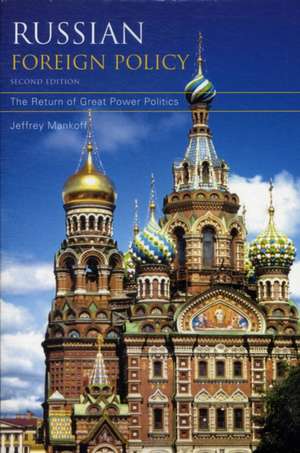
Russian Foreign Policy: The Return of Great Power Politics: A Council on Foreign Relations Book
Autor Jeffrey Mankoffen Limba Engleză Paperback – 22 sep 2011
Recomandăm acest volum drept o monografie esențială pentru înțelegerea mecanismelor de putere de la Kremlin, fiind publicat sub egida prestigioasei serii A Council on Foreign Relations Book. Această a doua ediție a lucrării Russian Foreign Policy aduce o perspectivă actualizată asupra modului în care Federația Rusă și-a redefinit statutul pe scena internațională, trecând de la introspecția post-sovietică la o politică de mare putere. Jeffrey Mankoff evită explicațiile simpliste, argumentând că asertivitatea Moscovei nu este doar rezultatul voinței unui singur lider, ci produsul unui consens profund la nivelul elitelor ruse cu privire la interesele naționale.
Structura volumului este riguros organizată pe vectori geografici și tematici. După o introducere care analizează „tunurile din august” (referire la conflictul din Georgia), autorul explorează în capitole dedicate relația tensionată cu SUA, dilema europeană între integrare și confruntare, și parteneriatul strategic cu China. Cititorii familiarizați cu Russia and the World in the Putin Era de Roger E. Kanet vor aprecia aici analiza detaliată a politicii interne („Bulldogs Fighting Under the Rug”) ca motor al deciziilor externe. Spre deosebire de Russia's Foreign Security Policy in the 21st Century de Marcel De Haas, care pune accent pe dimensiunea militară, Mankoff echilibrează discuția prin includerea factorilor economici, precum influența prețurilor la energie.
În contextul operei sale, această carte face tranziția de la analizele regionale punctuale, precum cele din The United States and Central Asia After 2014, către o sinteză geopolitică vastă, teme explorate ulterior și în Empires of Eurasia. Găsim în acest text o examinare echilibrată care demonstrează că, deși retorica Moscovei este adesea dură, obiectivul central rămâne restabilirea locului Rusiei în ierarhia globală.


Preț: 366.89 lei
Preț vechi: 493.22 lei
-26%
Carte tipărită la comandă
Livrare economică 30 mai-13 iunie
Specificații
ISBN-10: 1442208252
Pagini: 352
Ilustrații: illustrations
Dimensiuni: 154 x 229 x 25 mm
Greutate: 0.54 kg
Ediția:2 Rev ed.
Editura: Bloomsbury Publishing
Colecția Rowman & Littlefield
Seria A Council on Foreign Relations Book
Locul publicării:New York, United States
V-ar putea interesa
-
 From Cold War to Hot PeaceMichael Mcfaul-19%Preț: 83.69 lei103.95 lei
 -
 Russian Foreign PolicyEric Shiraev-24%Preț: 275.19 lei361.07 lei
 -
 Preț: 138.12 lei
 -
 Preț: 248.96 lei
 -
 Russian Foreign PolicyEric Shiraev-16%Preț: 263.67 lei314.80 leiNou
 -
 -26%Preț: 56.22 lei75.77 lei
 -
 The New RussiaMikhail GorbachevPreț: 188.05 lei
 -
 Should We Fear Russia?Dmitri TreninPreț: 83.76 lei
 -
 Russia and AmericaAndrei P. TsygankovPreț: 87.60 lei
 -
 The Return of the Russian LeviathanSergei MedvedevPreț: 153.19 lei
 -
 Getting Russia RightThomas GrahamPreț: 159.53 lei
 -
 Russia's GambleVladimir Gel'ManPreț: 151.66 lei
 -
 Getting Russia RightThomas GrahamPreț: 124.03 lei
 -
 -26%Preț: 82.28 lei110.51 lei
 -
 Who Lost Russia?Peter ConradiPreț: 77.36 lei
 -
 Russia Without PutinTony WoodPreț: 99.51 lei
 -
 Russia in AfricaSamuel Ramani-17%Preț: 132.84 lei159.73 lei
 -
 Explaining Russian Foreign Policy Behavior: Theory and PracticeAlexander Sergunin-12%Preț: 158.39 lei179.75 lei
 -
 -12%Preț: 151.44 lei172.22 lei
 -
 Russia's Foreign PolicyAndrei P TsygankovPreț: 215.47 lei
De ce să citești această carte
Această monografie se adresează studenților la relații internaționale și analiștilor politici care caută o înțelegere nuanțată a Rusiei contemporane. Cititorul câștigă o viziune clară asupra modului în care istoria, economia și consensul elitelor modelează deciziile de la Moscova. Este un instrument indispensabil pentru a descifra de ce politica externă rusă menține o direcție constantă, indiferent de schimbările de fațadă de la nivelul conducerii statului.
Descriere
Presenting an evenhanded treatment of controversial issues, Mankoff analyzes Russia's interactions with major global actors, including the United States, the European Union, the Commonwealth of Independent States, and China. Despite Moscow's often-harsh rhetoric and the deployment of Russian forces against Georgia in 2008, the author convincingly demonstrates that there is little reason to fear a return to a Cold War-like standoff with the West. Instead, he argues, today's Russia is more interested in restoring what its leaders consider to be its rightful place among the world's major powers rather than in directly challenging the West. Thoroughly researched and knowledgeable, this book will be invaluable for all readers interested in Russia.
Cuprins
Chapter 1: Contours of Russian Foreign Policy
Chapter 2: Bulldogs Fighting Under the Rug: The Making of Russian Foreign Policy
Chapter 3: Resetting Expectations: Russia and the United States
Chapter 4: Europe: Between Integration and Confrontation
Chapter 5: Rising China and Russia's Asian Vector
Chapter 6: Playing with Home Field Advantage? Russia and its Post-Soviet Neighbors
Conclusion: Dealing with Russia's Foreign Policy Reawakening
Recenzii
Mankoff explores in detail the ups and downs in U.S.-Russian relations, Russia's complex interaction with Europe, its relations with Asia, and the course of its dealings with its post-Soviet neighbors. The analysis is balanced and rich.
Mankoff has produced an extremely valuable account of Russian foreign policy, which manages to be both comprehensive and concise in its treatment of the subject. It has a lot to offer not just to the general reader but also to the specialist seeking to understand recent events in their proper historical context.
Jeffrey Mankoff's analysis of Russian foreign policy is a carefully researched, sober assessment of Russia's strategy for return to international significance.
For students and scholars of international affairs, there is no better choice regarding Russian foreign relations.
This is truly an excellent book. From the factual as well as from the interpretive point of view, it is suitable for both the specialist and nonspecialist reader searching for a serious, historical explanation of the direction of Russian foreign policy in the immediate post-Yeltsin era. Highly recommended.
With this book, Jeffrey Mankoff has established himself as the best young American analyst of post-Cold War Russia. This careful and clear assessment of Putin's grand strategy should be required reading for the Obama administration, as well as for anyone else interested in Russia's rapid but fragile resurgence as a great power in twenty-first-century world politics.
It was refreshing to read a book that was so well written. Using both Western and Russian sources, the author carefully researches and analyzes controversial issues in Russian foreign policy but does so in an evenhanded and nuanced way.
Jeffrey Mankoff's analysis of Russia's foreign policy is a serious and well-researched exercise in understanding the complexities of a country still in search of its post-communist, post-imperial identity. Russia is no longer on a path to Western integration; but it still struggles with what it means to be a great power in the twenty-first century.
Mankoff argues convincingly that there is little reason to believe that Russia will challenge the West or start a confrontation; they are so highly interdependent that any attempt at open confrontation would be reduced to a senseless zero-sum game. Hence-and despite its sometimes-biased overtones-Mankoff's book is thoroughly researched and provides in-depth knowledge and expertise regarding the contours of Russian foreign-policy thinking. Furthermore, Mankoff has successfully found a balance that makes the book valuable for both informed and uninformed audiences. Anyone with an interest in the thorny issue of Russia's foreign policy should read this book.
Russian foreign policy has never been explicitly anti-American and Russian leaders have always sought good relations with the United States to the extent that it was compatible with their main goal: Russia is a great power. With this second edition, revised and enlarged, the author hopes to show how this hypothesis remains relevant and shapes the behavior of Russia on the international scene. According J.Mankoff, the statement of Russian foreign policy is the culmination of a process begun under President Yeltsin when the majority of the Russian political elite considered that the integration of Russia in the West was neither possible nor desirable. Despite the presence of some stereotypes widespread in the place of Russia, the richness of the analyzes presented in the book helps in any case to understand the ambitions and aspirations of post-Soviet Russia on the international scene.