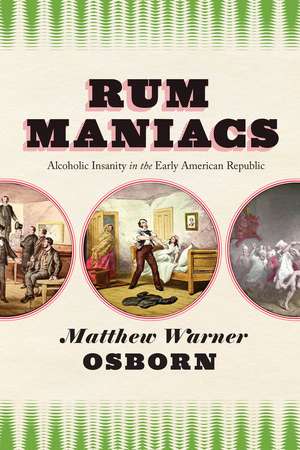
Rum Maniacs: Alcoholic Insanity in the Early American Republic
Autor Matthew Warner Osbornen Limba Engleză Paperback – 5 ian 2027
A cultural history that reveals how and why pathological drinking became a subject of medical interest, social controversy, and lurid fascination in the early American republic.
Edgar Allan Poe vividly recalls standing in a prison cell, fearing for his life, as he watched men mutilate and dismember the body of his mother. That memory, however graphic and horrifying, was not real. It was a hallucination, one of many suffered by the writer, caused by his addiction to alcohol.
In Rum Maniacs, Matthew Warner Osborn reveals how and why pathological drinking became a subject of medical interest, social controversy, and lurid fascination in the early American republic. At the heart of that story is the disease that Poe suffered: delirium tremens. First described in 1813, delirium tremens and its characteristic hallucinations inspired sweeping changes in how the medical profession saw and treated the problems of alcohol abuse. Based on new theories of pathological anatomy, human physiology, and mental illness, the new diagnosis founded the medical conviction and popular belief that habitual drinking could become a psychological and physiological disease. By midcentury, delirium tremens had inspired a wide range of popular theater, poetry, fiction, and illustration. This romantic fascination endured into the twentieth century, most notably in the classic Disney cartoon Dumbo, in which a pink pachyderm marching band haunts a drunken young elephant. Rum Maniacs reveals just how delirium tremens shaped the modern experience of alcohol addiction as a psychic struggle with inner demons.
In Rum Maniacs, Matthew Warner Osborn reveals how and why pathological drinking became a subject of medical interest, social controversy, and lurid fascination in the early American republic. At the heart of that story is the disease that Poe suffered: delirium tremens. First described in 1813, delirium tremens and its characteristic hallucinations inspired sweeping changes in how the medical profession saw and treated the problems of alcohol abuse. Based on new theories of pathological anatomy, human physiology, and mental illness, the new diagnosis founded the medical conviction and popular belief that habitual drinking could become a psychological and physiological disease. By midcentury, delirium tremens had inspired a wide range of popular theater, poetry, fiction, and illustration. This romantic fascination endured into the twentieth century, most notably in the classic Disney cartoon Dumbo, in which a pink pachyderm marching band haunts a drunken young elephant. Rum Maniacs reveals just how delirium tremens shaped the modern experience of alcohol addiction as a psychic struggle with inner demons.
Preț: 207.37 lei
Precomandă
Puncte Express: 311
Carte nepublicată încă
Livrare prin curier în România Precomanda se expediază când titlul devine disponibil.
Transport gratuit de la 400.00 lei Plată online sau ramburs, în funcție de opțiunile comenzii.
Retur gratuit în 14 zile Comandă securizată și suport în română.
Doresc să fiu notificat când acest titlu va fi disponibil:
Se trimite...
Specificații
ISBN-13: 9780226854519
ISBN-10: 0226854515
Pagini: 280
Ilustrații: 18 halftones, 1 table
Dimensiuni: 152 x 229 x 23 mm
Greutate: 0.45 kg
Editura: University of Chicago Press
Colecția University of Chicago Press
ISBN-10: 0226854515
Pagini: 280
Ilustrații: 18 halftones, 1 table
Dimensiuni: 152 x 229 x 23 mm
Greutate: 0.45 kg
Editura: University of Chicago Press
Colecția University of Chicago Press
Notă biografică
Matthew Warner Osborn is associate professor of history at the University of Missouri - Kansas City. He is the author of Rum Maniacs: Alcoholic Insanity in the Early American Republic, also published by the University of Chicago Press.
Cuprins
Acknowledgments
Introduction
1 Ardent Spirits and Republican Medicine
2 Discovering Delirium Tremens
3 Hard Drinking and Want
4 The Benevolent Empire of Medicine
5 The Pathology of Intemperance
6 The Drunkard’s Demons
Epilogue: Alcoholics and Pink Elephants
NotesIndex
Introduction
1 Ardent Spirits and Republican Medicine
2 Discovering Delirium Tremens
3 Hard Drinking and Want
4 The Benevolent Empire of Medicine
5 The Pathology of Intemperance
6 The Drunkard’s Demons
Epilogue: Alcoholics and Pink Elephants
NotesIndex
Recenzii
“It is hard to imagine a better guide to the many meanings with which delirium tremens was freighted in nineteenth-century America than Rum Maniacs. This is a consistently fascinating account exhibiting an impeccably even-handed approach to its often disturbing subject matter.”
"This important study explores the medicalization of alcohol abuse in the 19th-century US. Focusing largely on the experience of physicians and patients in Philadelphia, Osborn examines the social and economic climates in which heavy drinking came to be seen as a medical condition. . . . Highly recommended."
"Although history professor Matthew Werner Osborn concentrates on how alcohol influenced this country two centuries or more ago, perhaps the greatest virtue of his learned, intelligent study is the light it sheds on the phenomenon that continues to plague us right up to the present. Given the cost to society--in money and in so much else--of addiction to alcohol (and to other substances), it is salutary to learn about the roots of the problem."
“Osborn’s deep engagement with previously unstudied sources, medical and philosophical discourse, literary production, and social history are on bright display in this smart and pleasurable contribution to scholarship. If you want to grapple with the history of alcoholism, medicine, culture, and society in nineteenth-century America, then read and reckon with Rum Maniacs.”
“Osborn's path-breaking book explains the largely ignored physician-based temperance movement in Philadelphia from 1820 to 1850 in an entirely new way. This work is a major contribution not only to the history of alcohol but also to the history of medicine and to the history of ideas. The author demonstrates that rising alcohol consumption, along with a concomitant rise in delirium tremens, coincided with a need to rethink the very meaning of medicine in Philadelphia during these years.”
“A fascinating social and intellectual history of the medical profession in early America, Rum Maniacs traces the many ways in which a new disease of delirium tremens became visible — in newspapers, medical journals, hospital records, temperance activism, popular entertainment, and clinical practice. In its detailed but wide-ranging attention to institutions, practices, theories, and aspirations shaping medical education, it offers a sophisticated case study of the interplay of learned and popular cultures by which pathological drinking came to be imagined by nineteenth-century Americans.”
“This beautifully structured and persuasive cultural history argues that representations of alcoholic insanity as a terrifying disease allowed Americans to grapple with powerful anxieties about failure and its causes in a century of unprecedented economic uncertainty.”
“Osborn’s book is richly documented and intellectually impressive . . . Alcohol abuse came to be seen as a medical problem, sadly one without a medical remedy, and Osborn impressively contextualizes this chapter in the history of medicine.”
“The real verve of the book develops our understanding of how medical ideas seep into culture (and vice versa) and lend validity to the tropes they create and come to, or wish to, leave behind. This is an energetic and magpie text, embracing evidence from medical and popular literature, theater, case histories, official reports, lecture notes, and student dissertations. . . . Osborn is certainly a gifted communicator and a historian to watch.”
“Osborn offers a much needed update to the historiography of early-American temperance, revealing the central role played by the medical profession in furthering the movement. . . . Osborn’s analysis greatly enhances the historical literature on temperance by revealing the movement’s distinctly medical dimension, a feature that has hitherto remained obscured in the background of the political, social, and economic interpretations that dominate the historiography of alcohol and drugs in this period. But, Rum Maniacs is more than just a significant addition to the historiography of American temperance. As a social history of medicine, it also explains how the construction of a new disease underpinned the response of an emergent American middle class to the demographic, socioeconomic, and cultural realities of the market revolution.”
“This book is a most welcome addition to a surprisingly sparse strand of research in the realm of medical history. The story of delirium tremens is undoubtedly a fascinating one.”