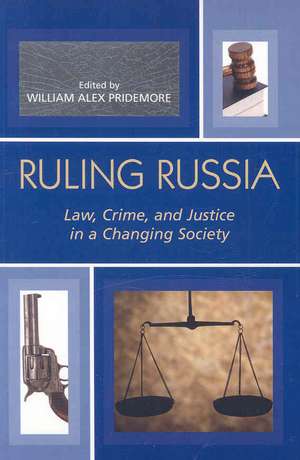
Ruling Russia: Law, Crime, and Justice in a Changing Society
Editat de William Alex Pridemoreen Limba Engleză Paperback – 3 oct 2007
Contributions by: Adrian Beck, William E. Butler, Linda J. Cook, Galina N. Evdokushkina, Leonid A. Gavrilov, Natalia S. Gavrilova, Alla E. Ivanova, Janet Elise Johnson, Roy King, Robert W. Orttung, Letizia Paoli, Laura Piacentini, William Alex Pridemore, Annette Robertson, Daniel G. Rodeheaver, Richard Sakwa, Olga Schwartz, Victoria G. Semyonova, Louise I. Shelley, Peter H. Solomon Jr., Janine R. Wedel, and James L. Williams
Preț: 352.14 lei
Preț vechi: 451.74 lei
-22%
Puncte Express: 528
Preț estimativ în valută:
62.32€ • 72.83$ • 54.11£
62.32€ • 72.83$ • 54.11£
Carte tipărită la comandă
Livrare economică 19 februarie-05 martie
Preluare comenzi: 021 569.72.76
Specificații
ISBN-13: 9780742536760
ISBN-10: 0742536769
Pagini: 325
Dimensiuni: 148 x 226 x 24 mm
Greutate: 0.5 kg
Editura: Bloomsbury Publishing
Colecția Rowman & Littlefield Publishers
Locul publicării:New York, United States
ISBN-10: 0742536769
Pagini: 325
Dimensiuni: 148 x 226 x 24 mm
Greutate: 0.5 kg
Editura: Bloomsbury Publishing
Colecția Rowman & Littlefield Publishers
Locul publicării:New York, United States
V-ar putea interesa
-
 The Pie at Night: In Search of the North at PlayStuart Maconie-31%Preț: 79.74 lei114.81 lei
 -
 -20%Preț: 55.43 lei69.09 lei
 -
 Parliament: The Biography (Volume II - Reform)Chris Bryant-20%Preț: 82.87 lei103.49 lei
 -
 Squares of LondonJohn CoulterPreț: 396.99 lei
 -
 Shakespeare's BastardSimon StirlingPreț: 93.30 lei
 -
 CoffeePaul ChrystalPreț: 70.21 lei
 -
 Landscape and Englishness: Second Expanded EditionDavid Matless-11%Preț: 81.19 lei91.09 lei
 -
 Preț: 90.60 lei
Cuprins
Introduction: Law, Crime, and Justice in Transitional Russia
Part I: Law
Chapter 1: Presidential Power: The Struggle for Hegemony
Chapter 2: Russian Political Parties, the Duma, and the Welfare State
Chapter 3: The Creation of an Independent Judiciary and the Changing Nature of Courts and the Courtroom
Chapter 4: The Criminal Procedure Code of 2001: Will It Make Russian Justice More Fair?
Part II: Crime
Chapter 5: Flex Organizing and the Clan-State: Perspectives on Crime and Corruption in the New Russia
Chapter 6: Patterns of Violent Crime in Russia
Chapter 7: Violence against Women in Russia
Chapter 8: Russia's Efforts to Combat Human Trafficking: Efficient Crime Groups versus Irresolute Societies and Uncoordinated States
Chapter 9: The Ugly Side of Capitalism and Democracy: The Development of the Illegal Drug Market in Post-Soviet Russia
Part III: Justice
Chapter 10: Injecting Drug Use and HIV: Harm Reduction Programs and the Russian Legal System
Chapter 11: Juvenile Crime and Justice in Post-Soviet Russia
Chapter 12: Policing in Post-Soviet Russia
Chapter 13: The Russian Correctional System during the Transition
Conclusion: Whither Russia: Transition or Turmoil?
Part I: Law
Chapter 1: Presidential Power: The Struggle for Hegemony
Chapter 2: Russian Political Parties, the Duma, and the Welfare State
Chapter 3: The Creation of an Independent Judiciary and the Changing Nature of Courts and the Courtroom
Chapter 4: The Criminal Procedure Code of 2001: Will It Make Russian Justice More Fair?
Part II: Crime
Chapter 5: Flex Organizing and the Clan-State: Perspectives on Crime and Corruption in the New Russia
Chapter 6: Patterns of Violent Crime in Russia
Chapter 7: Violence against Women in Russia
Chapter 8: Russia's Efforts to Combat Human Trafficking: Efficient Crime Groups versus Irresolute Societies and Uncoordinated States
Chapter 9: The Ugly Side of Capitalism and Democracy: The Development of the Illegal Drug Market in Post-Soviet Russia
Part III: Justice
Chapter 10: Injecting Drug Use and HIV: Harm Reduction Programs and the Russian Legal System
Chapter 11: Juvenile Crime and Justice in Post-Soviet Russia
Chapter 12: Policing in Post-Soviet Russia
Chapter 13: The Russian Correctional System during the Transition
Conclusion: Whither Russia: Transition or Turmoil?
Recenzii
A mine of information about the evolution of crime and the justice system in Russia over the past fifteen years. . . . Highly recommended.
A brave attempt to synthesize many important themes and topics into one volume. . . . The volume as a whole is rewarding.
A comprehensive look at Russian society in flux as reflected in the development of the law, crime, and judicial reform.
Pridemore has provided a great service to the English-speaking reader interested in crime and punishment in today's Russia.
This collection is an ambitious undertaking. . . . This is a collection with a broad remit, and succeeds in providing a comprehensive and insightful overview.
This book shows how hard the transition from dictatorship to democracy really is. It is not just a transition from seventy years of communism but from more than one thousand years of Russia's past.
This collection provides a wealth of analysis and food for thought on one of the most puzzling problems in Russia's post-communist transition. The huge increase in crime rates after the collapse of the Soviet system was a challenge to the new regime and is an intellectual challenge to us all. As the chapters in the volume show, in a variety of ways, building rule of law and rebuilding the state are as complex and many-sided a task as the more oft-studied processes of moving to market economics and democratic forms of government.
A brave attempt to synthesize many important themes and topics into one volume. . . . The volume as a whole is rewarding.
A comprehensive look at Russian society in flux as reflected in the development of the law, crime, and judicial reform.
Pridemore has provided a great service to the English-speaking reader interested in crime and punishment in today's Russia.
This collection is an ambitious undertaking. . . . This is a collection with a broad remit, and succeeds in providing a comprehensive and insightful overview.
This book shows how hard the transition from dictatorship to democracy really is. It is not just a transition from seventy years of communism but from more than one thousand years of Russia's past.
This collection provides a wealth of analysis and food for thought on one of the most puzzling problems in Russia's post-communist transition. The huge increase in crime rates after the collapse of the Soviet system was a challenge to the new regime and is an intellectual challenge to us all. As the chapters in the volume show, in a variety of ways, building rule of law and rebuilding the state are as complex and many-sided a task as the more oft-studied processes of moving to market economics and democratic forms of government.