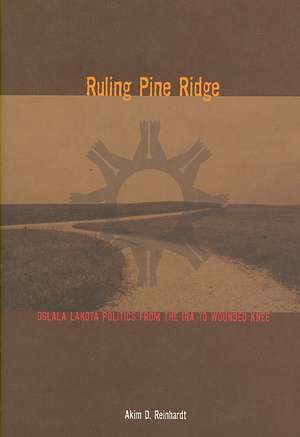
Ruling Pine Ridge: Oglala Lakota Politics from the IRA to Wounded Knee: Plains Histories
Autor Akim D. Reinhardt Cuvânt înainte de Clara Sue Kidwellen Limba Engleză Hardback – 15 mar 2007
“Reinhardt furnishes revealing portraits of Gerald One Feather, Dick Wilson, Russell Means; he offers a telling indictment of Pine Ridge’s economy. He is one of the few historians who understands the distinction D’Arcy McNickle made decades ago between loss and defeat. He and the late Vine Deloria, Jr. would have welcomed this volume because of its thorough research and, above all, its unflinching honesty. Writing in 1970 Deloria called for historians to ‘bring historical consciousness to the whole Indian story.’ Ruling Pine Ridge achieves that goal. It will be required reading for all who care about not only the indigenous past but as well its connection to the problems of the present and the challenges of the 21st century.” —Peter Iverson, author of Diné: A History of the NavajosIncorporating previously overlooked materials, including tribal council records, oral histories, and reservation newspapers, Ruling Pine Ridge explores the political history of South Dakota’s Oglala Lakota reservation during the mid-twentieth century. Akim D. Reinhardt examines the reservation’s transition from the direct colonialism of the pre–1934 era to the indirect colonial policies of the controversial Indian Reorganization Act (IRA). Reinhardt then examines the period of 1968–1973, showing that many of the political players on the reservation had changed, and although the tribal council system was well established by this point, deep dissatisfaction with the IRA government persisted on Pine Ridge. This longstanding unhappiness came to a head in 1973, with the occupation and siege of Wounded Knee. Reinhardt demonstrates that the siege is best understood not as a political stunt of the American Indian Movement (AIM), but as a spontaneous, grassroots protest that was at least forty years in the making.
Din seria Plains Histories
-
 Preț: 251.69 lei
 -
 Preț: 226.83 lei
 -
 Preț: 207.90 lei
 -
 Preț: 215.36 lei
 -
 Preț: 193.66 lei
 -
 Preț: 252.39 lei
 -
 Preț: 444.32 lei
 -
 Preț: 274.61 lei
 -
 Preț: 117.28 lei
 -
 Preț: 165.40 lei
 -
 Preț: 192.31 lei
 -
 Preț: 188.90 lei
 -
 Preț: 349.43 lei
 - 24%
 Preț: 192.96 lei
Preț: 199.49 lei
Puncte Express: 299
Preț estimativ în valută:
35.27€ • 41.28$ • 30.80£
35.27€ • 41.28$ • 30.80£
Carte disponibilă
Livrare economică 13-27 februarie
Specificații
ISBN-13: 9780896726017
ISBN-10: 0896726010
Pagini: 288
Dimensiuni: 162 x 230 x 28 mm
Greutate: 0.64 kg
Editura: Texas Tech University Press
Colecția Texas Tech University Press
Seria Plains Histories
ISBN-10: 0896726010
Pagini: 288
Dimensiuni: 162 x 230 x 28 mm
Greutate: 0.64 kg
Editura: Texas Tech University Press
Colecția Texas Tech University Press
Seria Plains Histories
Notă biografică
Akim D. Reinhardt is an associate professor of History at Towson University in Maryland. His work has also appeared in American Indian Quarterly, the Journal of Colonialism and Colonial History, and La Pensée.
Descriere
“Reinhardt furnishes revealing portraits of Gerald One Feather, Dick Wilson, Russell Means; he offers a telling indictment of Pine Ridge’s economy. He is one of the few historians who understands the distinction D’Arcy McNickle made decades ago between loss and defeat. He and the late Vine Deloria, Jr. would have welcomed this volume because of its thorough research and, above all, its unflinching honesty. Writing in 1970 Deloria called for historians to ‘bring historical consciousness to the whole Indian story.’ Ruling Pine Ridge achieves that goal. It will be required reading for all who care about not only the indigenous past but as well its connection to the problems of the present and the challenges of the 21st century.” —Peter Iverson, author of Diné: A History of the NavajosIncorporating previously overlooked materials, including tribal council records, oral histories, and reservation newspapers, Ruling Pine Ridge explores the political history of South Dakota’s Oglala Lakota reservation during the mid-twentieth century. Akim D. Reinhardt examines the reservation’s transition from the direct colonialism of the pre–1934 era to the indirect colonial policies of the controversial Indian Reorganization Act (IRA). The new federal approach to Indian politics was evident in the advent of the tribal council governing system, which is still in place today on Pine Ridge and on many other reservations. While the structure of the reservation’s governing body changed dramatically to reflect mainstream American cultural values, certain political equations on the reservation changed very little. In particular, despite promises to the contrary, the new reservation government’s authority was still severely constrained by the Bureau of Indian Affairs. In addition, the new governing format led to an aggravation of social divisions on the reservation.Reinhardt then examines the period of 1968–1973, showing that many of the political players on the reservation had changed, and although the tribal council system was well established by this point, deep dissatisfaction with the IRA government persisted on Pine Ridge. This longstanding unhappiness came to a head in 1973, with the occupation and siege of Wounded Knee. Reinhardt demonstrates that the siege is best understood not as a political stunt of the American Indian Movement (AIM), but as a spontaneous, grassroots protest that was at least forty years in the making.