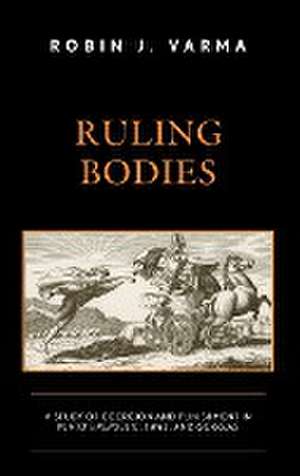
Ruling Bodies: A Study of Coercion and Punishment in Plato's Republic, Laws, and Gorgias
Autor Robin Varmaen Limba Engleză Hardback – 28 iun 2022
Preț: 516.71 lei
Preț vechi: 768.19 lei
-33%
Puncte Express: 775
Carte tipărită la comandă
Livrare economică 28 octombrie-11 noiembrie
Livrare prin curier în România Termenul estimat este afișat lângă disponibilitate.
Transport gratuit pentru acest produs Plată online sau ramburs, în funcție de opțiunile comenzii.
Retur gratuit în 14 zile Comandă securizată și suport în română.
Specificații
ISBN-13: 9781666907292
ISBN-10: 1666907294
Pagini: 172
Dimensiuni: 159 x 228 x 19 mm
Greutate: 0.43 kg
Editura: Bloomsbury Publishing
Colecția Lexington Books
Locul publicării:New York, United States
ISBN-10: 1666907294
Pagini: 172
Dimensiuni: 159 x 228 x 19 mm
Greutate: 0.43 kg
Editura: Bloomsbury Publishing
Colecția Lexington Books
Locul publicării:New York, United States
Cuprins
Introduction: Why We Should Inquire
Chapter 1: The Republic
Chapter 2: The Laws
Chapter 3: The Gorgias
Conclusion: Coercion in the Statecraft of Hobbes
Chapter 1: The Republic
Chapter 2: The Laws
Chapter 3: The Gorgias
Conclusion: Coercion in the Statecraft of Hobbes
Recenzii
A thought-provoking and exceptionally original exploration of the role of punishment and coercion in Platonic political theory and the limitations of rhetoric and education in shaping the characters of good citizens. Especially noteworthy is his interpretation of the Laws where he demonstrates that, contrary to the long-standing assumption that Plato had "come to his senses" in that work about the prospects of a perfect society where philosophy would rule, there is a very strong philosophic presence in the Athenian Stranger's statecraft. By way of conclusion, he contrasts the Platonic approach to the role of coercion in political life with that of Hobbes, throwing the classical paradigm into sharp relief against a major exemplar of modern political thought. A must-read for everyone interested in Platonic political theory.
What is the proper role of coercion and punishment in statecraft? This work illuminates the question afresh by orchestrating a titanic debate: Plato's account of penal legislation, in his political philosophy of statecraft as soulcraft, vs the accounts elaborated by three recent major political theorists-Arendt, Habermas, and Foucault, with an inquiry back into their shared roots in Hobbes. The result is a deeply provocative perspective on the philosophy of crime and punishment.
[A] breathtaking analysis.. Varma's reflection is deeply insightful and prescient.
This short, lively book is a clearly written introduction to statecraft in three Platonic dialogues, and an analysis of the subordinate theme of how well organized regimes use coercion and/or punishment.
What is the proper role of coercion and punishment in statecraft? This work illuminates the question afresh by orchestrating a titanic debate: Plato's account of penal legislation, in his political philosophy of statecraft as soulcraft, vs the accounts elaborated by three recent major political theorists-Arendt, Habermas, and Foucault, with an inquiry back into their shared roots in Hobbes. The result is a deeply provocative perspective on the philosophy of crime and punishment.
[A] breathtaking analysis.. Varma's reflection is deeply insightful and prescient.
This short, lively book is a clearly written introduction to statecraft in three Platonic dialogues, and an analysis of the subordinate theme of how well organized regimes use coercion and/or punishment.