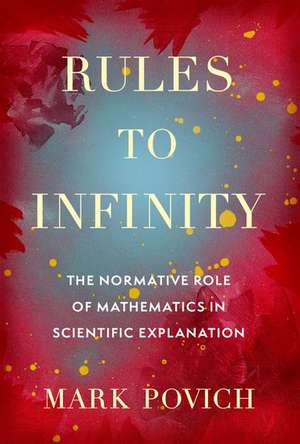
Rules to Infinity: The Normative Role of Mathematics in Scientific Explanation
Autor Mark Povichen Limba Engleză Hardback – 24 apr 2025
Preț: 433.20 lei
Preț vechi: 610.93 lei
-29%
Puncte Express: 650
Carte disponibilă
Livrare economică 06-17 noiembrie
Livrare prin curier în România Termenul estimat este afișat lângă disponibilitate.
Transport gratuit pentru acest produs Plată online sau ramburs, în funcție de opțiunile comenzii.
Retur gratuit în 14 zile Comandă securizată și suport în română.
Specificații
ISBN-13: 9780197679005
ISBN-10: 0197679005
Pagini: 336
Dimensiuni: 168 x 237 x 27 mm
Greutate: 0.65 kg
Editura: Oxford University Press
Colecția OUP USA
Locul publicării:New York, United States
ISBN-10: 0197679005
Pagini: 336
Dimensiuni: 168 x 237 x 27 mm
Greutate: 0.65 kg
Editura: Oxford University Press
Colecția OUP USA
Locul publicării:New York, United States
Recenzii
An excellent book for anyone who wants to think seriously about how mathematical explanations work in science, and especially for those who think this may have important consequences for a Platonic view of mathematics.
Rules to Infinity is one of the most creative and insightful books written on the relationship between mathematics and scientific explanation in several decades. At a time when many philosophical discussions on these issues travel well-worn paths, Mark Povich's work charts a new and exciting course.
The kind of philosophy I like best involves connecting seemingly disparate ideas to solve a stubborn philosophical problem in an unexpected way. That is exactly what Mark Povich achieves. This is a wonderful contribution to the debate!
This book is essential reading for those working on scientific explanation, scientific representation and the metaphysical interpretation of pure mathematics.
Mark Povich's ontic conception of scientific explanation, combined with his deflationary conception of mathematics, has many attractive features, but also faces significant challenges. Povich offers vigorous arguments in defense of this combination, as well as incisive comparisons to rival accounts.
If you thought scientific explanations are made true by the facts, you might wonder what makes mathematical assertions true. Mark Povich provides a subtly defended and illuminating approach to these and related questions, bringing together topics that are often treated as orthogonal. The result is an important, timely, and most impressive book.
It is not written for students or mathematicians, but for post-graduate philosophers of a very specific bent-those interested in such questions as to whether mathematics is a body of knowledge reflecting an abstract Platonic point of view, a more basic, empirically-generated kind of knowledge, or numerous views in between these two extremes.
Rules to Infinity is one of the most creative and insightful books written on the relationship between mathematics and scientific explanation in several decades. At a time when many philosophical discussions on these issues travel well-worn paths, Mark Povich's work charts a new and exciting course.
The kind of philosophy I like best involves connecting seemingly disparate ideas to solve a stubborn philosophical problem in an unexpected way. That is exactly what Mark Povich achieves. This is a wonderful contribution to the debate!
This book is essential reading for those working on scientific explanation, scientific representation and the metaphysical interpretation of pure mathematics.
Mark Povich's ontic conception of scientific explanation, combined with his deflationary conception of mathematics, has many attractive features, but also faces significant challenges. Povich offers vigorous arguments in defense of this combination, as well as incisive comparisons to rival accounts.
If you thought scientific explanations are made true by the facts, you might wonder what makes mathematical assertions true. Mark Povich provides a subtly defended and illuminating approach to these and related questions, bringing together topics that are often treated as orthogonal. The result is an important, timely, and most impressive book.
It is not written for students or mathematicians, but for post-graduate philosophers of a very specific bent-those interested in such questions as to whether mathematics is a body of knowledge reflecting an abstract Platonic point of view, a more basic, empirically-generated kind of knowledge, or numerous views in between these two extremes.
Notă biografică
Mark Povich is Visiting Assistant Professor in Philosophy at University of Rochester. He has published articles in The British Journal for the Philosophy of Science, Erkenntnis, Mind, Philosophy of Science, Studies in History and Philosophy of Science Part A, Synthese, among others.
Cuprins
- Preface
- Chapter 1. Introduction: Scientific Explanation, Mathematics, and Metaontology
- Chapter 2. Distinctively Mathematical Explanation
- Chapter 3. Renormalization Group Explanation
- Chapter 4. The Narrow Ontic Counterfactual Account
- Chapter 5. Deflating the Narrow Ontic Counterfactual Account
- Chapter 6. Semantics, Metasemantics, and Function
- Chapter 7. The Content of a Mathematical Model
- Chapter 8. Normativism and its Rivals
- Chapter 9. Conclusion
- References
- Index