
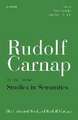
Rudolf Carnap: Early Writings: The Collected Works of Rudolf Carnap, Volume 1: The Collected Works of Rudolf Carnap
Editat de A.W. Carus, Michael Friedman, Wolfgang Kienzler, Alan Richardson, Sven Schlotteren Limba Engleză Hardback – 12 iul 2019
Preț: 749.74 lei
Preț vechi: 1060.58 lei
-29%
Puncte Express: 1125
Carte disponibilă
Livrare economică 09-20 octombrie
Livrare prin curier în România Termenul estimat este afișat lângă disponibilitate.
Transport gratuit pentru acest produs Plată online sau ramburs, în funcție de opțiunile comenzii.
Retur gratuit în 14 zile Comandă securizată și suport în română.
Specificații
ISBN-13: 9780198748403
ISBN-10: 019874840X
Pagini: 528
Dimensiuni: 162 x 242 x 36 mm
Greutate: 0.97 kg
Editura: OUP OXFORD
Colecția OUP Oxford
Seria The Collected Works of Rudolf Carnap
Locul publicării:Oxford, United Kingdom
ISBN-10: 019874840X
Pagini: 528
Dimensiuni: 162 x 242 x 36 mm
Greutate: 0.97 kg
Editura: OUP OXFORD
Colecția OUP Oxford
Seria The Collected Works of Rudolf Carnap
Locul publicării:Oxford, United Kingdom
V-ar putea interesa
-
 Berkeley's Idealism: A Critical ExaminationGeorges Dicker-11%Preț: 359.61 lei405.83 lei
 -
 Philosophy without IntuitionsHerman Cappelen-13%Preț: 278.80 lei320.69 lei
 -
 Reading Frege's GrundgesetzeRichard G. Heck, Jr.-18%Preț: 301.83 lei369.59 lei
 -
 The Construction of Logical SpaceAgustín Rayo-19%Preț: 283.46 lei349.65 lei
 -
 The Rules of ThoughtJonathan Jenkins Ichikawa-17%Preț: 254.76 lei307.17 lei
 -
 Think with SocratesPaul Herrick-23%Preț: 667.35 lei866.69 lei
 -
 Relativism and Monadic TruthHerman Cappelen-21%Preț: 264.31 lei333.42 lei
 -
 Wittgenstein's MetaphilosophyPaul Horwich-13%Preț: 293.28 lei337.43 lei
 -
 Vagueness and Degrees of TruthNicholas J. J. Smith-11%Preț: 354.60 lei398.62 lei
 -
 Frege - Arg Philosophers (RPD)H SlugaPreț: 478.08 lei
 -
 The Cambridge Companion to CarnapRichard CreathPreț: 287.77 lei
 -
 Kant & the Exact Sciences (Paper)Michael FriedmanPreț: 396.37 lei
 -
 Preț: 113.50 lei
 -
 Kant's Construction of NatureMichael FriedmanPreț: 339.65 lei
 -
 Understanding St. Thomas on Analogy: From a Biblical PrespectiveJohn R. MortensenPreț: 163.71 lei
 -
 Plug in Your ChipDuke OlioguPreț: 181.30 lei
 -
 Lmps - Proc of 13th Int Congress, Vol 2Shushan CaiPreț: 231.55 lei
 -
 The Logica Yearbook 2008Michal PelisPreț: 179.22 lei
 -
 Chaos, Gaia, ErosRalph H. AbrahamPreț: 181.88 lei
 -
 Philosophy and African Development. Theory and PracticeLansana KeitaPreț: 318.73 lei
 -
 Preț: 277.14 lei
 -
 Mark. Recherche Sociale: Nicole DecostreMatthew LipmanPreț: 330.67 lei
Recenzii
...enlightening and useful...
...the editors have done an excellent job firstly, in making all these texts available to English readers for the first time, and secondly, in making them more understandable thanks to their very rich in-depth analysis. This volume enhances the increasing English literature on the early young Carnap...
...the editors have done an excellent job firstly, in making all these texts available to English readers for the first time, and secondly, in making them more understandable thanks to their very rich in-depth analysis. This volume enhances the increasing English literature on the early young Carnap...
Notă biografică
A.W. Carus received a PhD in history from the University of Cambridge and a PhD in philosophy from the University of Chicago. He is Visiting Research Fellow at the Munich Center for Mathematical Philosophy at Ludwig-Maximilians-Universität Munich. Carus has written many papers on Carnap, Gödel, logical empiricism, and philosophy of social science.Michael Friedman is currently Suppes Professor of Philosophy of Science at Stanford University, having previously worked at Princeton, Indiana, and the University of Illinois at Chicago. He obtained his PhD in philosophy at University of Pittsburgh. Friedman is best known for his books and papers about Kant's philosophy of science, Carnap and logical empiricism, and general relativity.Wolfgang Kienzler studied for his doctorate in philosophy at the University of Konstanz. He is now a Lecturer in Philosophy at the University of Jena. His research spans early analytical philosophy, the history of logic, and philosophy of language, and he has written numerous articles on Husserl, Kant, Carnap, and Wittgenstein.Alan Richardson is Professor of Philosophy at the University of British Columbia. He undertook his PhD at University of Illinois at Chicago. Richardson's main interests are in the history of the philosophy of science and he has written many papers on Carnap and logical empiricism in their broader contexts. He is currently working on a book about the lasting effects of logical empiricism and other "scientific philosophy" on the research organization of philosophy today.Sven Schlotter gained a PhD in philosophy from the University of Jena. He has written many papers on the local and historical context of Frege and neo-Kantianism, and he is currently working on a book about Frege's local and intellectual context. Schlotter is interested in the history of analytical philosophy, as well as the local history of Jena.Rudolf Carnap (1891-1970) taught at Vienna, Prague, Chicago, and UCLA during his long and distinguished career. A German-born philosopher best known for his association with the Vienna Circle of the 1920s and 30s, he was the author of influential works such as The Logical Construction of the World (1928), Logical Syntax of Language (1934), Meaning and Necessity (1947), and The Logical Foundations of Probability (1950).
Cuprins
- Foreword
- Chronology of Carnap's Life
- Information for the Reader
- Introduction
- 1918a: League of Nations - League of States
- 1921a: Who Forces Laws of Nature to Hold?
- 1922a: Space: A Contribution to the Theory of Science
- 1923a: On the Task of Physics and the Application of the Principle of Maximal Simplicity
- 1924a: Three-Dimensionality of Space and Causality: An Investigation of the Logical Connection Between Two Fictions
- 1925a: On the Dependence of the Properties of Space on Those of Time
- 1926a: Physical Concept Formation
- 1927a: Abstract of Physical Concept Formation
- Textual Notes