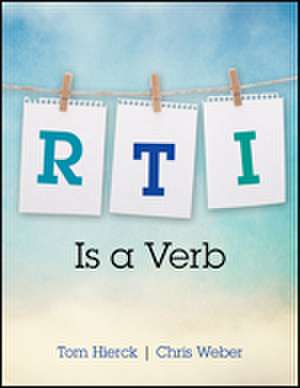
RTI Is a Verb
Autor Tom Hierck, Chris Weberen Limba Engleză Paperback – 11 dec 2013
- Interventions linked to the Common Core State Standards, with emphasis on college and career readiness
- Practical strategies for screening, progress monitoring, and diagnostics
- Sample approaches to specific interventions across the curriculum
- A companion website with additional samples and templates
Preț: 289.10 lei
Puncte Express: 434
Carte tipărită la comandă
Livrare economică 30 noiembrie-14 decembrie
Livrare prin curier în România Termenul estimat este afișat lângă disponibilitate.
Transport gratuit de la 400.00 lei Plată online sau ramburs, în funcție de opțiunile comenzii.
Retur gratuit în 14 zile Comandă securizată și suport în română.
Specificații
ISBN-13: 9781483307480
ISBN-10: 1483307484
Pagini: 210
Ilustrații: black & white tables
Dimensiuni: 216 x 280 x 12 mm
Greutate: 0.54 kg
Ediția:1
Editura: Corwin
Locul publicării:Thousand Oaks, United States
ISBN-10: 1483307484
Pagini: 210
Ilustrații: black & white tables
Dimensiuni: 216 x 280 x 12 mm
Greutate: 0.54 kg
Ediția:1
Editura: Corwin
Locul publicării:Thousand Oaks, United States
V-ar putea interesa
-
 Preț: 79.14 lei
 -
 Preț: 77.10 lei
 -
 Creating Inclusive Learning Environments for Young ChildrenClarissa WillisPreț: 285.75 lei
 -
 Before the Special Education ReferralMatthew JenningsPreț: 217.70 lei
 -
 Strategies for Teaching Students with Learning DisabilitiesLucy C. MartinPreț: 281.23 lei
 -
 Preț: 396.47 lei
 -
 Dyslexia-Friendly Further and Higher EducationBarbara PaveyPreț: 427.68 lei
 -
 Inclusive EducationAnn Cheryl ArmstrongPreț: 447.77 lei
 -
 -8%Preț: 485.90 lei528.15 lei
 -
 Effective Multi-Agency PartnershipsRita Cheminais-15%Preț: 620.30 lei729.77 lei
Recenzii
“Requiring that all students graduate with the ability to enter college or a skilled career with the 21st Century Skills required to continue to learn further heightens the challenge...RTI, then, is about so much more than interventions. It defines what we are as a profession and philosophically underpins the reflective checkpoints we use to assess the extent to which all students are learning.”
“I have been incredibly impressed with RTI Is a Verb. The authors have skillfully shown how RTI, when done properly, is an opportunity to transform the school environment into one that maximizes the learning opportunities of all involved- staff, students, and community. A must read!”
“A breath of fresh air, RTI is a Verb offers an insightful, collaborative approach to RTI. In this comprehensive yet easy-to-read format, the authors reveal that RTI is in fact a VERB; and that in order to create the change that is required in today’s schools, the very culture of the school itself must be transformed. The book offers a demonstration of how creating a culture of cooperation is imperative for the successful implementation of RTI: teachers working with teachers; teachers working with parents; and teachers working individually with students.
The authors argue that 'cultures not structures' instill lasting reform; and through an interactive, thoughtful discussion on where we are now versus where we are headed, the authors construct a roadmap along with a set of directions on how it is we shall get there.
The most appealing part of the book is that it is candid and forthright: it takes the worn-out use of the RTI acronym and breaks it down to a workable and applicable tool. The authors remind us that 'RTI is simply allowing for the time and support for students to be successful.' It means meeting students where they are and taking the time required to get them where they need to be. Sounds simple enough – but just because it’s simple doesn’t mean it’s easy.”
“Historically, mandates have not provided solutions for school improvement. Instead, solutions have been found by schools collaborating to clearly define key content and effective instruction. Hierck & Weber share these solutions as they invite readers to engage in collaboration and establish a common language around RTI. Their collection of templates and samples are based on what works in real schools. Equipped with this text, school leaders are prepared to move from the theory of RTI to real gains in student achievement.”
“I have been incredibly impressed with RTI Is a Verb. The authors have skillfully shown how RTI, when done properly, is an opportunity to transform the school environment into one that maximizes the learning opportunities of all involved- staff, students, and community. A must read!”
“A breath of fresh air, RTI is a Verb offers an insightful, collaborative approach to RTI. In this comprehensive yet easy-to-read format, the authors reveal that RTI is in fact a VERB; and that in order to create the change that is required in today’s schools, the very culture of the school itself must be transformed. The book offers a demonstration of how creating a culture of cooperation is imperative for the successful implementation of RTI: teachers working with teachers; teachers working with parents; and teachers working individually with students.
The authors argue that 'cultures not structures' instill lasting reform; and through an interactive, thoughtful discussion on where we are now versus where we are headed, the authors construct a roadmap along with a set of directions on how it is we shall get there.
The most appealing part of the book is that it is candid and forthright: it takes the worn-out use of the RTI acronym and breaks it down to a workable and applicable tool. The authors remind us that 'RTI is simply allowing for the time and support for students to be successful.' It means meeting students where they are and taking the time required to get them where they need to be. Sounds simple enough – but just because it’s simple doesn’t mean it’s easy.”
“Historically, mandates have not provided solutions for school improvement. Instead, solutions have been found by schools collaborating to clearly define key content and effective instruction. Hierck & Weber share these solutions as they invite readers to engage in collaboration and establish a common language around RTI. Their collection of templates and samples are based on what works in real schools. Equipped with this text, school leaders are prepared to move from the theory of RTI to real gains in student achievement.”
Cuprins
About the Authors
Acknowledgments
Chapter 1. Introduction and the Research
Chapter 2. Content and Instruction in Tier 1
Chapter 3. Common Formative Assessments, Evidence, Data Analysis, and Collaboration
Chapter 4. Information Within RTI: Screening, Progress Monitoring, and Diagnoses
Chapter 5. Tier 2 and 3 Interventions, Strategies, and Resources
Chapter 6. Social and Academic Behavioral Interventions
Chapter 7. Lead the Work With Confidence, Leadership, and Accountability
Epilogue: The Next Steps
References
Index
Acknowledgments
Chapter 1. Introduction and the Research
Chapter 2. Content and Instruction in Tier 1
Chapter 3. Common Formative Assessments, Evidence, Data Analysis, and Collaboration
Chapter 4. Information Within RTI: Screening, Progress Monitoring, and Diagnoses
Chapter 5. Tier 2 and 3 Interventions, Strategies, and Resources
Chapter 6. Social and Academic Behavioral Interventions
Chapter 7. Lead the Work With Confidence, Leadership, and Accountability
Epilogue: The Next Steps
References
Index
Notă biografică
Tom Hierck has been an educator since 1983 in a career that has spanned all grade levels and many roles in public education. His experiences as a teacher, an administrator, a district leader, a department of education project leader, and an executive director have provided a unique context for his education philosophy.
Tom is a compelling presenter, infusing his message of hope with strategies culled from the real world. He understands that educators face unprecedented challenges and knows which strategies will best serve learning communities. Tom has presented to schools and districts across North America with a message of celebration for educators seeking to make a difference in the lives of students. His dynamic presentations explore the importance of positive learning environments and the role of assessment to improve student learning. His belief that "every student is a success story waiting to be told" has led him to work with teachers and administrators to create positive school cultures and build effective relationships that facilitate learning for all students.
Tom Hierck's blog can be found at tomhierck.com/blog/.
Tom is a compelling presenter, infusing his message of hope with strategies culled from the real world. He understands that educators face unprecedented challenges and knows which strategies will best serve learning communities. Tom has presented to schools and districts across North America with a message of celebration for educators seeking to make a difference in the lives of students. His dynamic presentations explore the importance of positive learning environments and the role of assessment to improve student learning. His belief that "every student is a success story waiting to be told" has led him to work with teachers and administrators to create positive school cultures and build effective relationships that facilitate learning for all students.
Tom Hierck's blog can be found at tomhierck.com/blog/.
Descriere
Turn RTI research into practice with interventions linked to the Common Core; strategies for screening and progress monitoring; and a companion website with additional resources.