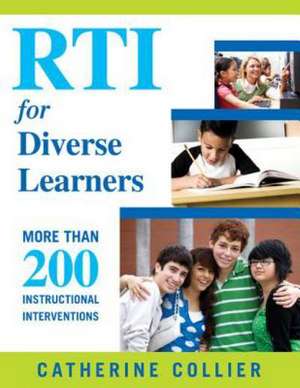
RTI for Diverse Learners: More Than 200 Instructional Interventions
Autor Catherine C. Collieren Electronic book text – 10 iun 2012
- A reader-friendly format that allows busy teachers to easily find the interventions they need
- Straightforward, concrete directions for using each intervention
- Examples from practice and a glossary to aid implementation
RTI for Diverse Learnersoffers step-by-step guidance for distinguishing between language development and special education needs in diverse students and providing appropriate instruction.
Preț: 221.37 lei
Puncte Express: 332
Preț estimativ în valută:
35.95€ • 41.86$ • 31.23£
35.95€ • 41.86$ • 31.23£
Indisponibil temporar
Doresc să fiu notificat când acest titlu va fi disponibil:
Se trimite...
Preluare comenzi: 021 569.72.76
Specificații
ISBN-13: 9781452223452
ISBN-10: 1452223459
Pagini: 288
Dimensiuni: 216 x 279 mm
Ediția:1
Editura: SAGE Publications
Colecția Corwin
Locul publicării:Thousand Oaks, United States
ISBN-10: 1452223459
Pagini: 288
Dimensiuni: 216 x 279 mm
Ediția:1
Editura: SAGE Publications
Colecția Corwin
Locul publicării:Thousand Oaks, United States
Recenzii
"A
user-friendly
and
highly
practical
book
full
of
research-based
intervention
strategies
for
teachers
who
are
implementing
RTI
programs
for
second-language
learners
and
other
culturally
diverse
students."
"This highly readable book is appropriate for teachers, administrators, researchers, and other leaders in the field who seek to know more about the increasingly common practice of using RTI as an intervention, support, and eligibility determination system for diverse learners. Collier provides a thorough, research-based overview of what RTI is and why it is important, followed by a clear, practical overview of each tier of intervention. This book is filled with practical advice that guides educators through each stage of the intervention process, explains some of the most relevant issues in the educational system and their relationship to RTI, and provides a manual for applying RTI-based principles and approaches to the particular needs of culturally and linguistically diverse students."
"Like Collier's other books, this one provides an essential resource for teachers, particularly those who work with culturally and linguistically diverse (CLD) students along the continuum fo needs. Collier not only explains some of the current pitfalls and challenges related to the traditional assessment and intervention process, but also expounds on the reasons tiered interventions are rapidly becoming a highly regarded practice in the educational community. This easy-to-understand, practical book helps teachers put clear guidelines, effective collaboration, and appropriate decision-making processes in place to distinguish between students who are merely in the process of second-language acquisition and those who have genuine special education needs."
"Collier has crafted an indispensible resource for school districts faced with increasing numbers of culturally and linguistically diverse students. Many of these students arrive with issues that seem to indicate disability. In this book, Collier provides research-based and classroom-proven intervention strategies that allow schools to effectively address learning and adaptation issues of diverse students. By using these strategies within an RTI model, school teams can ensure that the needs of culturally and linguistically diverse students are appropriately identified and addressed."
"No one is left out! This all-inclusive volume builds on Catherine Collier's extensive work over many years and provides the one handbook teachers in the field have for years been wishing someone would write. Teachers can follow the carefully structured diagnosis and intervention plan with confidence and know their learners will be set on a learning path that will provide them with optimal support."
"This highly readable book is appropriate for teachers, administrators, researchers, and other leaders in the field who seek to know more about the increasingly common practice of using RTI as an intervention, support, and eligibility determination system for diverse learners. Collier provides a thorough, research-based overview of what RTI is and why it is important, followed by a clear, practical overview of each tier of intervention. This book is filled with practical advice that guides educators through each stage of the intervention process, explains some of the most relevant issues in the educational system and their relationship to RTI, and provides a manual for applying RTI-based principles and approaches to the particular needs of culturally and linguistically diverse students."
"Like Collier's other books, this one provides an essential resource for teachers, particularly those who work with culturally and linguistically diverse (CLD) students along the continuum fo needs. Collier not only explains some of the current pitfalls and challenges related to the traditional assessment and intervention process, but also expounds on the reasons tiered interventions are rapidly becoming a highly regarded practice in the educational community. This easy-to-understand, practical book helps teachers put clear guidelines, effective collaboration, and appropriate decision-making processes in place to distinguish between students who are merely in the process of second-language acquisition and those who have genuine special education needs."
"Collier has crafted an indispensible resource for school districts faced with increasing numbers of culturally and linguistically diverse students. Many of these students arrive with issues that seem to indicate disability. In this book, Collier provides research-based and classroom-proven intervention strategies that allow schools to effectively address learning and adaptation issues of diverse students. By using these strategies within an RTI model, school teams can ensure that the needs of culturally and linguistically diverse students are appropriately identified and addressed."
"No one is left out! This all-inclusive volume builds on Catherine Collier's extensive work over many years and provides the one handbook teachers in the field have for years been wishing someone would write. Teachers can follow the carefully structured diagnosis and intervention plan with confidence and know their learners will be set on a learning path that will provide them with optimal support."
Cuprins
Acknowledgments
About the Author
1. Framework for Instructional Intervention With Diverse Learners
What Is Response to Intervention?
Figure 1: Example of the Three Tier Model
Figure 2: Example of the Four Tier Model
Figure 3: Continuous Problem Solving Model
Figure 4: Pyramid of Resiliency, Instruction and Strategy Monitoring
Asking the Right Questions
What Information Do We Need?
How Should We Use the Information?
Providing Some Context
2. Tier 1 Interventions
Introduction to the Tier 1 Instructional Focus
Progress Monitoring at Tier 1
Figure 5: Example of Progress Monitoring
So What do I do with an ELL Student at Tier 1: Interventions
Example from Classroom Practice
Readiness and Resiliency Issues at Tier 1
Communication Issues at Tier 1
Literacy Issues at Tier 1
Behavior Issues at Tier 1
Cognitive Issues at Tier 1
3. Tier 2 Interventions
Introduction to Tier 2 Instructional Focus
Progress Monitoring at Tier 2
Figure 6: Progress Monitoring at Tier 2
So What do I do with an ELL Student at Tier 2 Interventions
Example from Classroom Practice
Adaptation and Development Issues at Tier 2
Communication Issues at Tier 2
Literacy Issues at Tier 2
Behavior Issues at Tier 2
Cognitive Issues at Tier 2
4. Tier 3 Interventions
Introduction to Tier 3 Instructional Focus
Progress Monitoring at Tier 3
Figure 7: Progress Monitoring of Diverse Concerns at Tier 3
So What do I do with an ELL Student at Tier 3: Intervention
Example from Classroom Practice
Communication Issues at Tier 3
Literacy Issues at Tier 3
Behavior Issues at Tier 3
Cognitive Issues at Tier 3
5. Tier 4 Interventions
Introduction to Tier 4 Instructional Focus
Progress Monitoring at Tier 4
So What do I do with an ELL Student at Tier 4: Interventions
Example from Classroom Practice
Adapting Interventions for ELL/CLD Students in Individualized Special Programs
6. In Conclusion
References
Glossary
Index
About the Author
1. Framework for Instructional Intervention With Diverse Learners
What Is Response to Intervention?
Figure 1: Example of the Three Tier Model
Figure 2: Example of the Four Tier Model
Figure 3: Continuous Problem Solving Model
Figure 4: Pyramid of Resiliency, Instruction and Strategy Monitoring
Asking the Right Questions
What Information Do We Need?
How Should We Use the Information?
Providing Some Context
2. Tier 1 Interventions
Introduction to the Tier 1 Instructional Focus
Progress Monitoring at Tier 1
Figure 5: Example of Progress Monitoring
So What do I do with an ELL Student at Tier 1: Interventions
Example from Classroom Practice
Readiness and Resiliency Issues at Tier 1
Communication Issues at Tier 1
Literacy Issues at Tier 1
Behavior Issues at Tier 1
Cognitive Issues at Tier 1
3. Tier 2 Interventions
Introduction to Tier 2 Instructional Focus
Progress Monitoring at Tier 2
Figure 6: Progress Monitoring at Tier 2
So What do I do with an ELL Student at Tier 2 Interventions
Example from Classroom Practice
Adaptation and Development Issues at Tier 2
Communication Issues at Tier 2
Literacy Issues at Tier 2
Behavior Issues at Tier 2
Cognitive Issues at Tier 2
4. Tier 3 Interventions
Introduction to Tier 3 Instructional Focus
Progress Monitoring at Tier 3
Figure 7: Progress Monitoring of Diverse Concerns at Tier 3
So What do I do with an ELL Student at Tier 3: Intervention
Example from Classroom Practice
Communication Issues at Tier 3
Literacy Issues at Tier 3
Behavior Issues at Tier 3
Cognitive Issues at Tier 3
5. Tier 4 Interventions
Introduction to Tier 4 Instructional Focus
Progress Monitoring at Tier 4
So What do I do with an ELL Student at Tier 4: Interventions
Example from Classroom Practice
Adapting Interventions for ELL/CLD Students in Individualized Special Programs
6. In Conclusion
References
Glossary
Index
Descriere
Addressing
cognitive,
behaviour,
literacy,
and
communication
issues,
these
instructional
interventions
help
teachers
support
students
from
culturally
and
linguistically
diverse
backgrounds
within
an
RTI
framework.