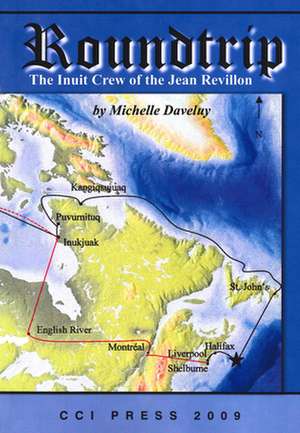
Roundtrip: The Inuit Crew of the Jean Revillon
Contribuţii de Michelle Daveluyen Limba Engleză Paperback – 2009
Preț: 342.29 lei
Preț vechi: 447.62 lei
-24%
Puncte Express: 513
Carte disponibilă
Livrare economică 16-30 noiembrie
Livrare prin curier în România Termenul estimat este afișat lângă disponibilitate.
Transport gratuit de la 400.00 lei Plată online sau ramburs, în funcție de opțiunile comenzii.
Retur gratuit în 14 zile Comandă securizată și suport în română.
Specificații
ISBN-13: 9781896445472
ISBN-10: 1896445470
Pagini: 140
Ilustrații: illustrations
Dimensiuni: 171 x 248 x 10 mm
Greutate: 0.38 kg
Editura: University of Alberta Press
Colecția CCI Press
Locul publicării:Edmonton, Canada
ISBN-10: 1896445470
Pagini: 140
Ilustrații: illustrations
Dimensiuni: 171 x 248 x 10 mm
Greutate: 0.38 kg
Editura: University of Alberta Press
Colecția CCI Press
Locul publicării:Edmonton, Canada
V-ar putea interesa
-
 Preț: 188.82 lei
 -
 Preț: 227.86 lei
 -
 The Barbarous YearsBernard BailynPreț: 150.36 lei
 -
 Arms and Equipment of the Civil WarJack CogginsPreț: 91.46 lei
 -
 Plane QueerPhil TiemeyerPreț: 247.43 lei
 -
 Empire's CrossroadsCarrie Gibson-33%Preț: 63.86 lei94.78 lei
Comentariile autorului
7 maps, 1 colour google map, 23 B&W photographs, 25 colour photographs, 19 figures, 2 foldout timelines (with 1 map, 5 B&W photographs, 1 colour photograph, 2 figures), absract, references, appendices
Recenzii
In 1925, four Inuit men from the central Canadian Arctic boarded a Revillon Frères supply ship bound for the South. Stuck in the ice-pack during the winter of 1924-25, the Jean Revillon needed repair and a crew to make it back to its hauling location at Shelburne, Nova Scotia. Some non-Inuit involved in this voyage referred to it as an 'experiment.' Since it was the first time Inuit would man a company ship on such a long journey. Lionel Angutinguaq, Athanasie Angutitaq, Louis Taapatai, and Savikataaq, having brought the ship to save harbour, spent the winter in the South and returned home the next spring. In relating their experience to people on their return they provided first-hand accounts of life in the South. In the 1990s, the story of these Inuit sailors was still a topic of discussion in the North. However, memories about it were fragmented. Archival research and fieldwork provided missing information and a relatively complete account of their round trip is now available. Their story was also adapted as teaching material for Inuit students participating in a university introductory summer program, called NunaScotia. This monograph, based on collaborative ethno-historical research and fieldwork, relates the story, the collaborative process and its outcomes, both scientific (numerous conference presentations) and pedagogical. The trip from Qamani'tuaq (Baker Lake), in contemporary Nunavut, to southern Canada documents the early relationships between Inuit and Nova Scotians. Various points-of-view contribute to the broadest possible understanding of the journey. Such diverse perspectives are expected since the Inuit sailors, the Revillon family and the people associated with the shipbuilding industry or the fur trade were involved in the trip per se to various degrees. The reasons they were all engaged in this voyage are also, to some extent, quite disparate. Still, Roundtrip is a clear example of how people from very different backgrounds collaborated in the past, when Inuit actually sailed onboard the Jean Revillon, and more recently, when the research was conducted.
"Roundtrip is not a history book per se.... This kind of research has now become the norm in Arctic anthropology and history. Yet very few books describe the researcher / research relationship in a more dynamic, thoughtful, and thorough manner. This is where the book is most successful. …Roundtrip shows that successful, productive, and legitimate collaborative research is possible and even attainable in the Arctic. And for this reason, the book is worth a look."
"Roundtrip is not a history book per se.... This kind of research has now become the norm in Arctic anthropology and history. Yet very few books describe the researcher / research relationship in a more dynamic, thoughtful, and thorough manner. This is where the book is most successful. …Roundtrip shows that successful, productive, and legitimate collaborative research is possible and even attainable in the Arctic. And for this reason, the book is worth a look."