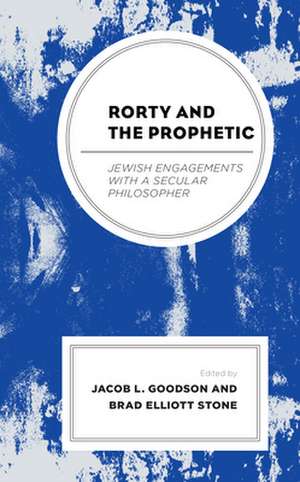
Rorty and the Prophetic: Jewish Engagements with a Secular Philosopher
Editat de Jacob L. Goodson, Brad Elliott Stone Contribuţii de Akiba Lerner, Gary Slater, Samuel Hayim Brody, Elliot Ratzman, Stephen Minister, Megan Craig, J. Aaron Simmons, Hannah Hashkesen Limba Engleză Hardback – 11 feb 2021
Preț: 583.43 lei
Preț vechi: 864.14 lei
-32%
Puncte Express: 875
Carte tipărită la comandă
Livrare economică 02-16 decembrie
Livrare prin curier în România Termenul estimat este afișat lângă disponibilitate.
Transport gratuit pentru acest produs Plată online sau ramburs, în funcție de opțiunile comenzii.
Retur gratuit în 14 zile Comandă securizată și suport în română.
Specificații
ISBN-13: 9781498523004
ISBN-10: 1498523005
Pagini: 256
Dimensiuni: 160 x 240 x 25 mm
Greutate: 0.53 kg
Editura: Bloomsbury Publishing
Colecția Lexington Books
Locul publicării:New York, United States
ISBN-10: 1498523005
Pagini: 256
Dimensiuni: 160 x 240 x 25 mm
Greutate: 0.53 kg
Editura: Bloomsbury Publishing
Colecția Lexington Books
Locul publicării:New York, United States
Cuprins
Introduction by Jacob L: Goodson
Part 1: Social Hope and Solidarity: Bringing Jewish Philosophy and Rorty's Neo-pragmatism Together
Chapter 1: Rorty, my Atheist Rabbi? Between Irony and Social Hope by Akiba Lerner
Chapter 2: Prudence in the Twenty-first Century: Moving Beyond the Morality-Prudence Distinction with Maimonides and Rorty by Jacob L: Goodson
Chapter 3: Charlottesville Pragmatism: Richard Rorty's Neo-pragmatism and Peter Ochs's Rabbinic Pragmatism by Gary Slater
Part 2: Politics and Prophecy: Finding Common Ground in Jewish Theology and Rorty's Secular Liberalism
Chapter 4: The Grounds of Prophecy: Richard Rorty and the Hermeneutics of History by Samuel Hayim Brody
Chapter 5: Messianism as a Conversation Stopper? Ironic Utopianism and Pragmatist Jewish Politics by Elliot Ratzman
Chapter 6: How to Read Rorty as a Political Theologian: And Why We Should by Stephen Minister
Part 3: Conversation and Cruelty: Putting Rorty's Philosophy in Conversation with Emmuel Levinas's Jewish Ethics
Chapt
Part 1: Social Hope and Solidarity: Bringing Jewish Philosophy and Rorty's Neo-pragmatism Together
Chapter 1: Rorty, my Atheist Rabbi? Between Irony and Social Hope by Akiba Lerner
Chapter 2: Prudence in the Twenty-first Century: Moving Beyond the Morality-Prudence Distinction with Maimonides and Rorty by Jacob L: Goodson
Chapter 3: Charlottesville Pragmatism: Richard Rorty's Neo-pragmatism and Peter Ochs's Rabbinic Pragmatism by Gary Slater
Part 2: Politics and Prophecy: Finding Common Ground in Jewish Theology and Rorty's Secular Liberalism
Chapter 4: The Grounds of Prophecy: Richard Rorty and the Hermeneutics of History by Samuel Hayim Brody
Chapter 5: Messianism as a Conversation Stopper? Ironic Utopianism and Pragmatist Jewish Politics by Elliot Ratzman
Chapter 6: How to Read Rorty as a Political Theologian: And Why We Should by Stephen Minister
Part 3: Conversation and Cruelty: Putting Rorty's Philosophy in Conversation with Emmuel Levinas's Jewish Ethics
Chapt
Recenzii
"Rorty in dialogue with traditions of Jewish prophecy? When lecturing in my Pragmatism and Religion class at the University of Virginia, Professor Rorty was generous with heart and mind--even while wincing at our scripture-based questions. I do not imagine Rorty's students and readers wincing at this exciting collection devised by Goodson and Stone. They would be too intrigued by the juxtapositions: Rorty, prophecy, rabbinic Judaism, and Christianity too? They will be too stimulated by the deep philosophic work that assembles the likes of Jacques Derrida, Martin Buber, C. S. Peirce, Walter Benjamin, Emmanuel Levinas, Cornel West, and more into a company of Rortyan societal reformers. They will be too moved by the civilizational urgency of this book at this moment in this time."
"Many books are good, a few rise to the level of 'important', but very few deserve to be called 'necessary.' This is one of those very rare and truly necessary books. We live in a time Rorty foresaw throughout his career, and his writing offers insight for the years that lie ahead. These essays connect Rorty's hopeful, forward-looking vision with the timeless and deep tradition of Jewish commentary, and with the timely and necessary possibility of prophetic voices that can speak truth to power. Especially in his later writings, Rorty offered a hopeful vision of hospitality instead of hostility, of solidarity in the face of increasing polarization and fearful solitude, and the preaching of mutual flourishing instead of the weaponization of sound bites. Goodson, Stone, and the authors they have assembled offer relevant and timely words of hope exactly when we need them."
"Many books are good, a few rise to the level of 'important', but very few deserve to be called 'necessary.' This is one of those very rare and truly necessary books. We live in a time Rorty foresaw throughout his career, and his writing offers insight for the years that lie ahead. These essays connect Rorty's hopeful, forward-looking vision with the timeless and deep tradition of Jewish commentary, and with the timely and necessary possibility of prophetic voices that can speak truth to power. Especially in his later writings, Rorty offered a hopeful vision of hospitality instead of hostility, of solidarity in the face of increasing polarization and fearful solitude, and the preaching of mutual flourishing instead of the weaponization of sound bites. Goodson, Stone, and the authors they have assembled offer relevant and timely words of hope exactly when we need them."