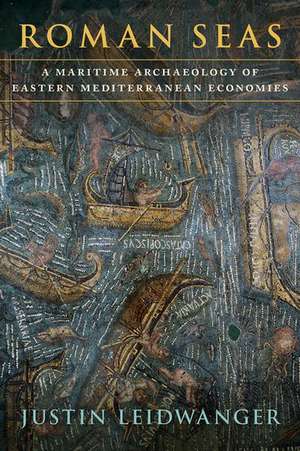
Roman Seas: A Maritime Archaeology of Eastern Mediterranean Economies
Autor Justin Leidwangeren Limba Engleză Hardback – 16 iun 2020
Preț: 679.72 lei
Preț vechi: 1008.24 lei
-33%
Puncte Express: 1020
Carte disponibilă
Livrare economică 12-18 noiembrie
Livrare prin curier în România Termenul estimat este afișat lângă disponibilitate.
Transport gratuit pentru acest produs Plată online sau ramburs, în funcție de opțiunile comenzii.
Retur gratuit în 14 zile Comandă securizată și suport în română.
Specificații
ISBN-13: 9780190083656
ISBN-10: 0190083654
Pagini: 336
Dimensiuni: 236 x 155 x 25 mm
Greutate: 0.61 kg
Editura: Oxford University Press
Colecția OUP USA
Locul publicării:New York, United States
ISBN-10: 0190083654
Pagini: 336
Dimensiuni: 236 x 155 x 25 mm
Greutate: 0.61 kg
Editura: Oxford University Press
Colecția OUP USA
Locul publicării:New York, United States
V-ar putea interesa
-
 World War II at Sea: A Global HistoryCraig L. Symonds-18%Preț: 219.28 lei266.66 lei
 -
 Atlantic Canada: A HistoryMargaret. ConradPreț: 196.88 lei
 -
 Maritime India: Rival Empires of Trade in the Orient, 1600-1800Kenneth McPhersonPreț: 227.73 lei
 -
 -33%Preț: 3171.38 lei4718.07 lei
 -
 -33%Preț: 995.68 lei1491.32 lei
 -
 -16%Preț: 215.10 lei257.25 lei
 -
 Carriers in Combat: The Air War at SeaChester G. Hearn-20%Preț: 350.69 lei439.38 lei
 -
 -26%Preț: 501.66 lei681.76 lei
 -
 -27%Preț: 497.92 lei679.26 lei
 -
 Preț: 437.08 lei
 -
 Mapping Gendered Routes and Spaces in the Early Modern WorldMerry E. Wiesner-HanksPreț: 449.85 lei
 -
 The Invisible HookPeter LeesonPreț: 111.56 lei
 -
 Poseidon's CurseChristopher P. MagraPreț: 306.49 lei
 -
 Maritime Networks in the Ancient Mediterranean WorldJustin Leidwanger-14%Preț: 740.13 lei860.62 lei
 -
 The Geography of the Ocean: Knowing the ocean as a spaceAnne-Flore LaloëPreț: 471.93 lei
 -
 Preț: 75.12 lei
 -
 Scotch on the RocksArthur SwinsonPreț: 57.59 lei
 -
 Preț: 360.03 lei
Recenzii
This volume takes a broad view of the intersection of maritime activities with the socioeconomic development of the Mediterranean world. Focusing on evidence from the Roman and late antique eastern Mediterranean, with particular attention to the area of southwestern Turkey and southern Cyprus from the second century BCE to the seventh century CE, Leidwanger presents an economic history intrinsically connected to the dynamic maritime world.
[Lediwanger's] innovative research represents a most welcome contribution to the analysis of the ancient Roman economy, which will certainly spark a rich debate.
With this book the author admirably masters a first deep insight into the complex world of Mediterranean economies. With the archaeological records indicating a diverse relationship and interdependency between economic networks and environmental, social and political impacts, a highly difficult task has been undertaken, especially for Late Antiquity.
This publication provides a refreshing approach in the study of maritime economic networks in the Roman Mediterranean.... This book represents an important contribution to the study of ancient maritime economies through its measured and clear methodological approach.... The book should be considered as a core piece of literature in the field and will stand out as a reflection of the promise and potential in the application of network analysis on a regional scale using multiple lines of data.
This volume represents an important move forward in our understanding of how multiscalar connectivity influenced not only maritime trade but the Roman economy itself. This comprehensive research provides a valuable model for future regional studies.
[Leidwanger] contributes to a new generation of scholarship on connectivity.... Through his case studies, he convincingly demonstrates that the key for understanding the dynamics of complex maritime networks is from the bottom up.
There is no doubt that the application of network analysis in maritime archaeology is an inspiring exercise and that this book has opened promising paths in this direction. This is true not only for those interested in exploring new approaches to old data but also for anyone who cares for a fresh view and more voyages across periods, in different corners of the maritime Mediterranean and beyond.
This book is a vital and worthy addition for any reader who is fascinated by the Roman Empire, ancient trade and marine archaeology.
This is an insightful work that encourages useful discussions that wed economics, change, space, and perceptions of space, precisely because what is done here could inform related discussions in biblical studies.
A hugely important third volume... the author provides a masterful synthesis of 'Roman and late antique shipwrecks from southwest Turkey and the northeast Mediterranean'
Archaeologists and historians looking to undertake such studies would be hard pressed to find a better model for their research than this monograph.
[Lediwanger's] innovative research represents a most welcome contribution to the analysis of the ancient Roman economy, which will certainly spark a rich debate.
With this book the author admirably masters a first deep insight into the complex world of Mediterranean economies. With the archaeological records indicating a diverse relationship and interdependency between economic networks and environmental, social and political impacts, a highly difficult task has been undertaken, especially for Late Antiquity.
This publication provides a refreshing approach in the study of maritime economic networks in the Roman Mediterranean.... This book represents an important contribution to the study of ancient maritime economies through its measured and clear methodological approach.... The book should be considered as a core piece of literature in the field and will stand out as a reflection of the promise and potential in the application of network analysis on a regional scale using multiple lines of data.
This volume represents an important move forward in our understanding of how multiscalar connectivity influenced not only maritime trade but the Roman economy itself. This comprehensive research provides a valuable model for future regional studies.
[Leidwanger] contributes to a new generation of scholarship on connectivity.... Through his case studies, he convincingly demonstrates that the key for understanding the dynamics of complex maritime networks is from the bottom up.
There is no doubt that the application of network analysis in maritime archaeology is an inspiring exercise and that this book has opened promising paths in this direction. This is true not only for those interested in exploring new approaches to old data but also for anyone who cares for a fresh view and more voyages across periods, in different corners of the maritime Mediterranean and beyond.
This book is a vital and worthy addition for any reader who is fascinated by the Roman Empire, ancient trade and marine archaeology.
This is an insightful work that encourages useful discussions that wed economics, change, space, and perceptions of space, precisely because what is done here could inform related discussions in biblical studies.
A hugely important third volume... the author provides a masterful synthesis of 'Roman and late antique shipwrecks from southwest Turkey and the northeast Mediterranean'
Archaeologists and historians looking to undertake such studies would be hard pressed to find a better model for their research than this monograph.
Notă biografică
Justin Leidwanger is Assistant Professor of Classics at Stanford University.
Cuprins
- Preface
- Acknowledgments
- 1. Maritime Interaction and Mediterranean Communities
- · Movement, Connectivity, and Economic History
- · Roman Maritime Economies
- · Shipwreck Datasets
- · An Eastern Mediterranean Case Study
- · The Route Ahead
- 2. Topography and Tools of Interaction
- · Marine Environment of the Eastern Mediterranean
- · Evidence for Ships and Seafaring
- · Roman and Late Antique Seagoing Vessels
- · Ancient Mediterranean Sailing
- · Diversity and Dynamism
- 3. Modeling Maritime Dynamics
- · Regionalisms
- · Landscapes
- · Mobilities
- · Thinking through Networks
- · From Ancient Mobility to Dynamic Networks
- · Maritime Archaeology and Network Potential
- 4. Exploring Shipwreck Data
- · Number Crunching
- · Connective Structures
- · Spatial Topography of Seafaring
- · Toward Big Data for Maritime Economies
- 5. Ports and Everyday Economies
- · Situating Roman Ports
- · Two Miniature "Archipelagos^"
- · Ports, Hinterlands, and Network Interaction
- · "Nodes of Density"
- 6. Maritime Networks in the Roman East
- · Small-Scale Activity and Regional Integration
- · Emergence and Evolution of Maritime Networks
- · From Maritime Archaeologies to Economic Histories
- · Further Journeys
- Appendices
- 1. Roman and Late Antique Shipwrecks from Southwest Turkey and the Northeast Mediterranean
- 2. Wind Patterns in the Southeast Aegean and Northeast Mediterranean
- References
- Index