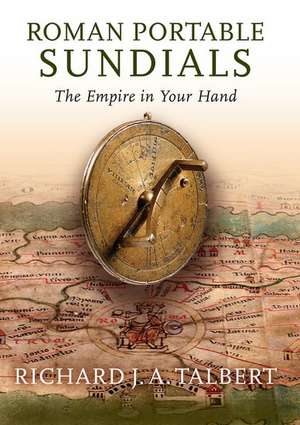
Roman Portable Sundials: The Empire in Your Hand
Autor Richard J.A. Talberten Limba Engleză Paperback – 10 mar 2020
Notăm cu interes atenția deosebită acordată aspectului vizual în această ediție de la Oxford University Press. Roman Portable Sundials impresionează prin calitatea celor 99 de reproduceri alb-negru și a celor 65 de desene tehnice care permit o examinare minuțioasă a acestor „gadgeturi” antice din bronz. Formatul paperback este robust, iar claritatea tipăririi pe hârtie de calitate susține argumentația academică, oferind cititorului o experiență senzorială tactilă și vizuală necesară pentru a înțelege complexitatea unor obiecte atât de mici, dar încărcate de semnificație.
Suntem de părere că această lucrare depășește granițele unui simplu catalog arheologic. Ca și World and Hour in Roman Minds, volumul pune în valoare modul în care romanii percepeau spațiul și timpul, dar cu un accent specific pe cultura materială și pe dispozitivele portabile care permiteau „purtarea imperiului în mână”. Richard J.A. Talbert analizează cele 16 cadrane solare cunoscute până în prezent, demonstrând că acestea nu erau doar instrumente de măsurare a timpului, ci veritabile simboluri ale sofisticării cosmopolite. Deși calculele de latitudine erau adesea eronate, posesia unui astfel de obiect atesta stăpânirea intelectuală asupra geografiei vaste a Romei.
Această cercetare completează organic opera anterioară a autorului, în special Challenges of Mapping the Classical World, continuând explorarea temelor legate de cartografiere și conștiința imperială. Dacă în lucrările trecute Talbert se concentra pe hărți, aici el dezvăluie cum un obiect de mărimea unei palme putea servi drept hartă mentală a lumii romane, de la Britania la Alexandria. Este o incursiune fascinantă în psihologia elitei romane, unde tehnologia și statutul social se intersectau într-un mod surprinzător de modern.
Preț: 297.06 lei
Preț vechi: 372.22 lei
-20%
Carte tipărită la comandă
Livrare economică 19-24 noiembrie
Specificații
ISBN-10: 0197503667
Pagini: 262
Ilustrații: 99 b/w halftones; 65 b/w line
Dimensiuni: 231 x 165 x 15 mm
Greutate: 0.48 kg
Editura: Oxford University Press
Colecția OUP USA
Locul publicării:New York, United States
V-ar putea interesa
-
 NEVERENDING EMPIRE EXAIIE PBAldo CazzulloPreț: 121.06 lei
 -
 Four Points of the CompassJerry BrottonPreț: 91.03 lei
 -
 World and Hour in Roman Minds: Exploratory EssaysRichard J. A. Talbert-32%Preț: 641.94 lei950.37 lei
 -
 -33%Preț: 592.20 lei878.34 lei
 -
 Preț: 196.80 lei
 -
 About TimeDavid Rooney-19%Preț: 63.20 lei77.98 lei
 -
 -13%Preț: 290.14 lei334.07 lei
 -
 SundialsAlbert E. Waugh-19%Preț: 72.57 lei89.10 lei
 -
 MeditationsMarcus AureliusPreț: 33.79 lei
 -
 Sundials: Their Construction and UseR. Newton MayallPreț: 83.76 lei
 -
 Preț: 230.67 lei
 -
 A Brief History of TimekeepingChad OrzelPreț: 85.83 lei
 -
 Roman EmperorsMaxwell CravenPreț: 190.12 lei
 -
 Time TamedNicholas Foulkes-22%Preț: 154.31 lei197.41 lei
 -
 -32%Preț: 93.32 lei138.23 lei
 -
 The Library of Lost MapsJames CheshirePreț: 269.54 lei
 -
 Preț: 394.47 lei
 -
 -19%Preț: 45.82 lei56.82 lei
De ce să citești această carte
Recomandăm această carte pasionaților de istorie antică și tehnologie care doresc să descopere o latură mai puțin explorată a vieții cotidiene romane. Veți câștiga o perspectivă inedită asupra modului în care romanii își vizualizau imperiul prin intermediul obiectelor de lux. Este un studiu riguros, dar accesibil, care transformă niște curiozități muzeale în ferestre către mentalitatea unei civilizații ce dorea să stăpânească timpul și spațiul.
Despre autor
Richard J.A. Talbert este un istoric și clasicist de renume, profesor la University of North Carolina, Chapel Hill, specializat în geografia și cartografierea lumii antice. Expertiza sa este recunoscută la nivel internațional, fiind editorul principal al monumentalului „Barrington Atlas of the Greek and Roman World”. Prin lucrări precum Challenges of Mapping the Classical World, Talbert a redefinit modul în care cercetătorii moderni înțeleg percepția spațială a grecilor și romanilor, combinând rigoarea academică cu o analiză profundă a culturii materiale.
Descriere
Recenzii
[Richard Talbert] is to be congratulated on producing a fine example not only of microhistory, but also of how to investigate the social and cultural history of science and technology, as opposed to the history of science and technology itself.
The objects are fascinating, and Talbert burrows into the data they present to reconstruct a convincing image of the meaning of the empire's geography to Roman intellectuals.
This fascinating text is recommended for students of the classics, world geography and history, archaeology, and astronomy. ... Summing Up: Recommended. Lower-division undergraduates and above; faculty and professionals.
Richard Talbert's loving study...A short and beautifully illustrated cataglogue is at the heart of the book.
This is a fascinating and eminently scholarly book that is the first to focus attention on this important aspect of Roman timekeeping, and Oxford University Press is to be commended for publishing the many photographs with the clarity required to see the fine details commented upon by the author.
If you open this elegant volume, copiously illustrated with black and white photographs, charts, maps and tables, anticipating 'a technical study' aimed at 'chronometric specialists' (p.3), you will not be disappointed...Although displaying some lighter touches, such as the proposal of Trimalchio as the likeliest sort of person to own a geographical portable sundial (pp.169f.), this study remains primarily a book for scholarly specialists.
Without Richard Talbert's important work over the last decades, any attempt at mapping the ancient world would simply be impossible today. In his new work, he leaves the realm of the Tabula Peutingeriana and zooms into a different kind of evidence: portable sundials. Only a scholar with the experience, detailed knowledge, and ardent love for the classical world, which are the author's hallmarks, could explain how these rare, and rarely studied, artifacts can contribute to a better understanding of the Roman Empire and the people in whose hands they lay."-Kai Brodersen, Professor of Ancient Culture, University of Erfurt
It is hard to imagine that such a pathbreaking book might arise from sixteen small objects. To such rebarbative and seemingly unpromising material the author has brought unmatched cartographic, epigraphic, and cultural historical expertise. The result is fascinating and unexpected insight into everyday geographical knowledge. This book will engage anyone who cares about ancient Roman society, the history of maps, or the history of time-reckoning."-Grant Parker, Professor of Classics, Stanford University
A valuable study of surviving Greco-Roman portable sundials, which offers an original geographical analysis, and neatly places them in their broader historical context. A striking demonstration of how much artifact studies can contribute to the analysis of past societies, and a foundation for all future work."-Anthony Turner, author of Mathematical Instruments in Antiquity and the Middle Ages
Notă biografică
Cuprins
- List of Figures and Maps
- Abbreviations
- Chapter 1 Sundials and their Place in the Roman Empire
- Sundial Environment
- Sundial Thinking
- Portable Sundials: Types and Functioning
- Chapter 2 The Geographical Portable Sundials Illustrated and Described
- Presentation Format
- Rome, no. 1
- Kircher Museum, no. 2
- Memphis, no. 3
- Aquileia, no. 4
- Kunsthistorisches Museum, Vienna/Wien, no. 5
- Crêt-Châtelard, no. 6
- Museum of the History of Science, Oxford, no. 7
- Aphrodisias, no. 8
- Samos, no. 9
- Time Museum, no. 10
- Philippi, no. 11
- Science Museum, London, no. 12
- Vignacourt/Berteaucourt-les-Dames, no. 13
- Mérida, no. 14
- British Museum, London, no. 15
- Balkans, no. 16
- Chapter 3 Geographical Awareness and Worldviews
- Names
- Figures: The Concept of Latitude
- Figures: The Concept of Latitude Applied
- Distinguishing Homonymous Cities
- Comparative Frameworks and Orientation
- Latitude and Worldview
- Chapter 4 A Community of Diallers ?
- Time-Telling: Margins of Error
- Table: Time Museum, no. 10, and British Museum, London, no. 15
- Criteria for the Choice of Names
- The Appeal of the Object
- The Spreading of Knowledge and Related Attractions
- Time-Telling Needs
- Conclusion: A Community of Diallers ?
- Chapter 5 Post-Classical Comparisons
- The Astrolabe
- The Navicula and 'Regiomontanus' Types
- Nuremberg Sundials
- Scottish Stone Sundials
- The Twentieth Century and Beyond
- Appendix The Aquincum Fragment: A Sundial-Maker's Manual ?
- Gazetteer
- Table of Latitudes and Locations
- Bibliography
- Ancient and Medieval Texts and Inscriptions
- Modern Scholarship
- Art Credits
- Index