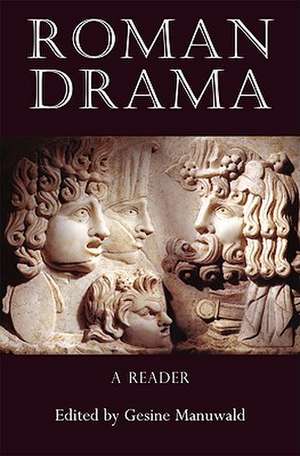
Roman Drama: A Reader: Bristol Classical Press
Editat de Dr. Gesine Manuwalden Limba Engleză Paperback – 17 iun 2010
To make these texts accessible to a wide readership, new English translations (on facing pages) as well as introductions to the individual excerpts and to the general context have been included. A selection of relevant testimonia provides information about the cultural background to Roman drama and ancient views on this literary genre. Paradigmatic extracts from dramas written in England between the sixteenth and twentieth centuries illustrate the continuing influence of Roman plays. Thus this anthology conveniently documents the history of an interesting and exciting literary genre from its beginnings to the modern period.
Preț: 193.48 lei
Puncte Express: 290
Carte tipărită la comandă
Livrare economică 07-21 decembrie
Livrare prin curier în România Termenul estimat este afișat lângă disponibilitate.
Transport gratuit de la 400.00 lei Plată online sau ramburs, în funcție de opțiunile comenzii.
Retur gratuit în 14 zile Comandă securizată și suport în română.
Specificații
ISBN-13: 9780715638699
ISBN-10: 0715638696
Pagini: 234
Dimensiuni: 156 x 234 x 18 mm
Greutate: 0.36 kg
Editura: Bloomsbury Publishing
Colecția Bristol Classical Press
Seria Bristol Classical Press
Locul publicării:London, United Kingdom
ISBN-10: 0715638696
Pagini: 234
Dimensiuni: 156 x 234 x 18 mm
Greutate: 0.36 kg
Editura: Bloomsbury Publishing
Colecția Bristol Classical Press
Seria Bristol Classical Press
Locul publicării:London, United Kingdom
V-ar putea interesa
-
 Ancient Greek LiteratureK. J. Dover-18%Preț: 329.35 lei402.34 lei
 -
 Song of the Distant Dove: Judah Halevi's PilgrimageRaymond P. Scheindlin-27%Preț: 436.54 lei597.18 lei
 -
 -28%Preț: 520.78 lei725.92 lei
 -
 A Commentary on Horace: Odes: Book IR. G. M. Nisbet-28%Preț: 540.96 lei754.08 lei
 -
 -26%Preț: 812.63 lei1091.43 lei
 -
 Eudemian Ethics Books I, II, and VIIIAristotle-29%Preț: 364.10 lei509.25 lei
 -
 Oxford Readings in Greek TragedyErich Segal-34%Preț: 638.31 lei960.57 lei
 -
 Plutarch's Lives: Exploring Virtue and ViceTimothy E. Duff-27%Preț: 524.70 lei719.87 lei
 -
 Preț: 60.88 lei
 -
 Sophocles: ElectraMichael LloydPreț: 180.69 lei
 -
 Classics and the Bible: Hospitality and RecognitionDr John Taylor-11%Preț: 256.34 lei287.29 lei
 -
 Euripides: Suppliant WomenIan C. Storey-17%Preț: 180.85 lei217.03 lei
 -
 Aeschylean TragedyAlan H. SommersteinPreț: 335.66 lei
 -
 Homer: Iliad IHomer-22%Preț: 162.07 lei207.77 lei
 -
 -17%Preț: 165.52 lei198.90 lei
 -
 CiceroDr. Gesine Manuwald-21%Preț: 143.97 lei181.29 lei
 -
 Preț: 143.86 lei
Cuprins
Preface
Notes for the Reader
Introduction: Overview of Roman Drama
I 1 Background and evolution
I 2 Dramatic genres
I 3 Dramatic poets
I 4 Occasions and venues
I 5 Actors and productions
I 6 Audiences
17 Poetry and performance
I 8 Form and style
I 9 Characteristics and developments
I 10 Reception and transmission
Illustrations
Appendix 1 Roman dramatic poets and their plays
Appendix 2 Chronological table
Testimonia on Roman Drama
T 1 On the introduction of drama to Rome (Liv. 7.2; Val. Max. 2.4.4)
T 2 On the introduction of Greek literature to Rome (Hor. Epist. 2.1.145-67)
T 3 On the dates of the early dramatists (Cic. Brut. 71-6; Gell. NA 17.21.42-9)
T 4 On the assessment of comic poets (Volcacius Sedigitus, fr. 1 FPL3, ap. Gell. NA 15.24)
T 5 On the assessment of early Roman dramatists (Hor. Epist. 2.1.50-62)
T 6 On the assessment of Roman dramatists (Quint. Inst. 10.1.97-100)
T 7 On theatre buildings (Vitr. 5.6; Tert. Spect. 10.1-9)
T 8 On the development of theatre buildings (Val. Max. 2.4.1-3, 6)
T 9 On revival performances of 'old' plays (Plaut. Cas. 5-20) (some fragments)
D 2 Ennius, Medea exul (all fragments)
D 3 Pacuvius, Medus (all fragments)
D 4 Pacuvius, on Fortuna (one long fragment)
D 5 Accius, Medea sive Argonautae (some fragments)
D 6 Accius, Brutus (some fragments)
D 7 Plautus, Amphitruo 1-152 (prologue)
D 8 Plautus, Miles gloriosus 1-78 (I 1)
D 9 Caecilius Statius, Plocium (Gellius, NA 2.23)
D 10 Terence, Eunuchus 232-64 (II 2); 771-816 (IV 7)
D 11 Terence, Adelphoe 26-81 (I 1); 81-154 (I 2)
D 12 Afranius, Divortium (all fragments)
D 13 Decimus Laberius and Publilius Syrus (Macrob. Sat. 2.7.1-10)
D 14 Seneca, Medea 150-78; 893-977
D 15 Pseudo-Seneca, Octavia 377-592
Nachleben of Roman Drama
N 1 Nicholas Udall (1552), Roister Doister (Prologue; IV 7-8)
N 2 William Shakespeare (early 1590s), The Comedy of Errors (III 1)
N 3 Matthew Gwinne (1603), Nero (II 3)
N 4 John Dryden (1690), Amphitryon; or The Two Sosias (I 1)
N 5 Tony Harrison (1985), Medea: a sex-war opera (openings of acts 1 and 2)
Bibliography and Further Reading
Notes for the Reader
Introduction: Overview of Roman Drama
I 1 Background and evolution
I 2 Dramatic genres
I 3 Dramatic poets
I 4 Occasions and venues
I 5 Actors and productions
I 6 Audiences
17 Poetry and performance
I 8 Form and style
I 9 Characteristics and developments
I 10 Reception and transmission
Illustrations
Appendix 1 Roman dramatic poets and their plays
Appendix 2 Chronological table
Testimonia on Roman Drama
T 1 On the introduction of drama to Rome (Liv. 7.2; Val. Max. 2.4.4)
T 2 On the introduction of Greek literature to Rome (Hor. Epist. 2.1.145-67)
T 3 On the dates of the early dramatists (Cic. Brut. 71-6; Gell. NA 17.21.42-9)
T 4 On the assessment of comic poets (Volcacius Sedigitus, fr. 1 FPL3, ap. Gell. NA 15.24)
T 5 On the assessment of early Roman dramatists (Hor. Epist. 2.1.50-62)
T 6 On the assessment of Roman dramatists (Quint. Inst. 10.1.97-100)
T 7 On theatre buildings (Vitr. 5.6; Tert. Spect. 10.1-9)
T 8 On the development of theatre buildings (Val. Max. 2.4.1-3, 6)
T 9 On revival performances of 'old' plays (Plaut. Cas. 5-20) (some fragments)
D 2 Ennius, Medea exul (all fragments)
D 3 Pacuvius, Medus (all fragments)
D 4 Pacuvius, on Fortuna (one long fragment)
D 5 Accius, Medea sive Argonautae (some fragments)
D 6 Accius, Brutus (some fragments)
D 7 Plautus, Amphitruo 1-152 (prologue)
D 8 Plautus, Miles gloriosus 1-78 (I 1)
D 9 Caecilius Statius, Plocium (Gellius, NA 2.23)
D 10 Terence, Eunuchus 232-64 (II 2); 771-816 (IV 7)
D 11 Terence, Adelphoe 26-81 (I 1); 81-154 (I 2)
D 12 Afranius, Divortium (all fragments)
D 13 Decimus Laberius and Publilius Syrus (Macrob. Sat. 2.7.1-10)
D 14 Seneca, Medea 150-78; 893-977
D 15 Pseudo-Seneca, Octavia 377-592
Nachleben of Roman Drama
N 1 Nicholas Udall (1552), Roister Doister (Prologue; IV 7-8)
N 2 William Shakespeare (early 1590s), The Comedy of Errors (III 1)
N 3 Matthew Gwinne (1603), Nero (II 3)
N 4 John Dryden (1690), Amphitryon; or The Two Sosias (I 1)
N 5 Tony Harrison (1985), Medea: a sex-war opera (openings of acts 1 and 2)
Bibliography and Further Reading
Recenzii
Manuwald's Reader usefully gathers into one place some of the key testimonia bearing on Roman drama.