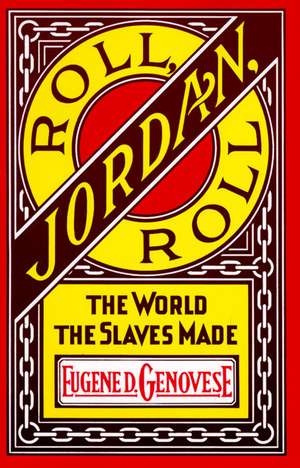
Roll, Jordan, Roll
Autor Eugene D Genoveseen Limba Engleză Paperback – 12 ian 1976
Relevanța lucrării Roll, Jordan, Roll pentru studiile de istorie americană și sociologia opresiunii rămâne incontestabilă la cinci decenii de la publicare, fiind o resursă fundamentală pentru examenele de acreditare în științe umaniste. Găsim în această carte o schimbare de paradigmă: Eugene Genovese nu se limitează la a descrie brutalitatea sistemului, ci investighează modul în care cei înrobiți au forțat recunoașterea propriei umanități. Suntem de părere că forța acestui volum de peste 800 de pagini rezidă în capacitatea de a pătrunde în mintea ambelor tabere, analizând dialectica dintre stăpân și sclav. Structura operei, împărțită în patru secțiuni ample (precum „God is Not Mocked” sau „The Valley of the Shadow”), reflectă importanța religiei ca teren de luptă pentru controlul psihologic. Autorul analizează minuțios elemente de viață cotidiană — de la alimentație și îmbrăcăminte, până la ritualurile funerare — demonstrând cum cultura a devenit un instrument de supraviețuire. Comparabil cu Dark Symbols, Obscure Signs în ceea ce privește analiza manipulării creștinismului, volumul lui Genovese este însă mult mai vast, oferind o perspectivă sistemică asupra întregii societăți sudiste. În contextul operei sale, Roll, Jordan, Roll reprezintă pilonul central care fundamentează cercetările ulterioare din The Sweetness of Life sau A Consuming Fire. Dacă în lucrările mai târzii autorul s-a concentrat pe viziunea creștină a albilor sau pe viața plantatorilor, aici el echilibrează balanța, oferind sclavilor rolul de actori istorici activi. Deși este o lucrare de o rigoare academică extremă, stilul narativ reușește să transforme datele statistice și arhivistice într-o mărturie profundă despre reziliența spiritului uman.
Preț: 132.43 lei
Carte disponibilă
Livrare economică 29 octombrie-12 noiembrie
Specificații
ISBN-10: 0394716523
Pagini: 864
Dimensiuni: 133 x 209 x 39 mm
Greutate: 0.6 kg
Editura: Knopf Doubleday Publishing Group
V-ar putea interesa
-
 Wicked RiverLee SandlinPreț: 102.29 lei
 -
 American Fun: Four Centuries of Joyous RevoltJohn BeckmanPreț: 145.25 lei
 -
 The Mind of the Master ClassElizabeth Fox-GenovesePreț: 390.45 lei
 -
 Slavery in White and BlackElizabeth Fox-GenovesePreț: 248.16 lei
 -
 The Mind of the Master ClassElizabeth Fox-Genovese-11%Preț: 664.70 lei746.85 lei
 -
 Cleopatra's NoseDaniel J. BoorstinPreț: 95.38 lei
 -
 The Heathen SchoolJohn DemosPreț: 135.48 lei
 -
 Civil War SitesCivil War Preservation TrustPreț: 144.00 lei
 -
 Preț: 300.04 lei
 -
 Waters of DiscordRodman L. UnderwoodPreț: 299.72 lei
 -
 From Traveling Show to VaudevilleRobert M. LewisPreț: 317.55 lei
 -
 The World Slaveholders MadeEugene D. GenovesePreț: 191.81 lei
 -
 The Sweetness of LifeEugene D. GenovesePreț: 212.19 lei
 -
 Preț: 101.29 lei
 -
 The Land Records of Prince George's County, Maryland, 1702-1709Elise Greenup JourdanPreț: 69.66 lei
 -
 Cynicism and the Evolution of the American DreamWilber W CaldwellPreț: 81.53 lei
 -
 The Memoirs of General P. H. SheridanPhilip Henry SheridanPreț: 188.09 lei
 -
 The Campaigns of the British Army at Washington and New Orleans 1814-1815R. Gleig G. R. GleigPreț: 128.88 lei
De ce să citești această carte
Recomandăm această carte oricărui cercetător sau student la istorie care dorește să înțeleagă complexitatea sistemului sclavagist dincolo de clișee. Cititorul va câștiga o perspectivă nuanțată asupra modului în care cultura și religia pot servi drept scut împotriva dezumanizării. Este o lectură esențială pentru a înțelege rădăcinile tensiunilor sociale americane și modul în care identitatea colectivă se forjează sub presiune extremă.
Despre autor
Eugene D. Genovese (1930–2012) a fost unul dintre cei mai importanți și controversați istorici ai Americii, cunoscut pentru abordarea sa inițial marxistă asupra sclaviei, pe care a integrat-o ulterior într-o viziune conservatoare complexă. Profesor la universități de prestigiu precum Rochester și Emory, Genovese a revoluționat istoriografia Sudului antebelic prin introducerea conceptului de paternalism ca relație de putere reciprocă. Opera sa, încununată cu prestigiosul premiu Bancroft, rămâne un punct de referință obligatoriu pentru orice analiză a structurilor sociale și de clasă din istoria Statelor Unite.
Cuprins
Part 1. Of the Willing and the Obedient
Part 2. ...and the Children Brought Up
Book Two: The Rock and the Church
Part 1. Of the God of the Living
Part 2. ...and Every Man According as His Work Shall Be
Book Three: The Valley of the Shadow
Part 1. Of the Sons of Jacob
Part 2. ...and the Coat of Many Colors
Book Four: Whom God Hath Hedged In
Descriere scurtă
Rather than emphasizing the cruelty and degradation of slavery, historian Eugene Genovese investigates the ways that slaves forced their owners to acknowledge their humanity through culture, music, and religion. Not merely passive victims, the slaves in this account actively engaged with the paternalism of slaveholding culture in ways that supported their self-respect and aspirations for freedom. Roll, Jordan, Roll covers a vast range of subjects, from slave weddings and funerals, to the language, food, clothing, and labor of slaves, and places particular emphasis on religion as both a major battleground for psychological control and a paradoxical source of spiritual strength. Displaying keen insight into the minds of both slaves and slaveholders, Roll, Jordan, Roll is a testament to the power of the human spirit under conditions of extreme oppression.
Recenzii
"Without modern peer as an historical narrative, as a sensitive functional analysis of a major region and period of American society in general, and the Afro-American community in particular." --The New Republic
"Altogether a first-class historical work, enhanced by a good, forthright style" --The New Yorker
"Genovese has done more than any other American historian to life this tortured subject out of its culture-bound parochialism." --C. Vann Woodward, The New York Review of Books