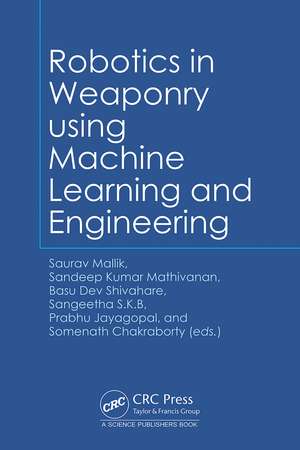
Robotics in Weaponry using Machine Learning and Engineering
Editat de Saurav Mallik, Sandeep Kumar Mathivanan, Basu Dev Shivahare, Sangeetha S.K.B, Prabhu Jayagopal, Somenath Chakrabortyen Limba Engleză Hardback – 11 mai 2026
Mechanical engineers design robots with complex actuators, sensors, and control mechanisms that respond to real-time data processed by machine learning algorithms. The combination of robotics, ML, and mechanical engineering is driving the development of next-generation intelligent systems. These innovations not only improve automation but are also crucial for defence systems, manufacturing, and autonomous vehicle technologies. This synergy promises greater efficiency, adaptability, and autonomy in a range of applications.
Key Features:
- Highlights Real-World Applications
- Explores Advanced AI Techniques
- Addresses Ethical and Security Concerns
- Equips Readers with Hands-On Knowledge
- Forecasts Future Technological Trends
Preț: 1120.13 lei
Preț vechi: 1400.17 lei
-20%
Puncte Express: 1680
Carte tipărită la comandă
Livrare economică 02-16 decembrie
Livrare prin curier în România Termenul estimat este afișat lângă disponibilitate.
Transport gratuit pentru acest produs Plată online sau ramburs, în funcție de opțiunile comenzii.
Retur gratuit în 14 zile Comandă securizată și suport în română.
Specificații
ISBN-13: 9781041074441
ISBN-10: 1041074441
Pagini: 490
Ilustrații: 202
Dimensiuni: 156 x 234 mm
Greutate: 0.86 kg
Ediția:1
Editura: CRC Press
Colecția CRC Press
ISBN-10: 1041074441
Pagini: 490
Ilustrații: 202
Dimensiuni: 156 x 234 mm
Greutate: 0.86 kg
Ediția:1
Editura: CRC Press
Colecția CRC Press
Public țintă
Academic, Postgraduate, and Undergraduate AdvancedCuprins
Preface. 1. ARMSec: A Reinforcement-Learned Autonomous Robotic Monitoring System for High-Threat Defense Zones. 2. Robust Autonomous Navigation in Urban Environments Using ML-Augmented Architectures with Multi-Sensor Fusion. 3. Mechanically Grounded Optimization Framework for Enhanced Robotic Design and Performance. 4. Revolutionizing Combat Strategy: An Intelligent Weapon System Architecture for Next-Generation Warfare. 5. Real-Time Data Processing Framework for Combat-Ready Situational Intelligence using Integrated Sensor Networks. 6. Deep Learning-Driven Target Recognition for Robotic Weaponry Systems: A Neural Network-Based Approach. 7. Reinforcement Learning for Adaptive Weapon Navigation and Control in Autonomous Robotic Systems. 8. Intelligent Robotic Arm Control for Autonomous Weapon Handling Using Deep Reinforcement Learning. 9. Autonomous Combat Drones and UAV Navigation Using Deep Reinforcement Learning for Target Engagement and Mission Execution. 10. Deep Reinforcement Learning for Autonomous Ground Vehicle Control in Warfare and Reconnaissance Operations. 11. DRAGONet: A Deep Reinforcement Learning Framework for Autonomous UAV Navigation in Dynamic and GPS-Denied Environments. 12. Vision-Aware Path Planning Network (VAPP-Net) for Adaptive Autonomous Navigation in Complex UAV Environments. 13. DeepFusion-NavNet: A Deep Learning Framework Combining Semantic Segmentation and Reinforcement Learning for Robust Autonomous UAV Navigation. 14. OptiFlight-Net: A Hybrid Deep Learning and Particle Swarm Optimization Framework for Energy-Efficient and Safe UAV Navigation. 15. Speed-Adaptive Navigation Network for Real-Time High-Velocity UAV Path Planning with Safety Assurance. 16. Unmanned Aerial Vehicles and Autonomous Combat Drones. 17. Machine Learning Fundamentals for Autonomous Systems. 18. Securing the Future: AI-Powered Weapon Systems, Ethics, and Adversarial Defense. 19. Evolution of Weapon Systems and Rise of Intelligent Warfare. 20. Adaptive Control Strategies in Autonomous Vehicles: A Machine Learning Approach. 21. Visual Monitoring Techniques using AI and Deep Learning for Surveillance and Security. 22. SARFALS: A Secure and Robust Framework for AI-Driven Autonomous Weapon Systems. 23. SATNet: A Spatiotemporal Attention-Guided Transformer Network for Robust Surveillance and Real-Time Object Detection. 24. Adversarial-Aware Transformer-Based Threat Mitigation System for Robotic Defense Units in Battlefield Environments. 25. Next-Generation Swarm Threat Neutralization: An Intelligent Sensor Fusion and Behavior Prediction System. 26. An Adversarial-Resilient Multi-Agent AI Framework for Autonomous Robotic Warfare Defense.
Notă biografică
Saurav Mallik is a Research Scientist in the Department of Pharmacology and Toxicology, The University of Arizona, Tucson, Arizona, USA. Prior to this, he was Postdoctoral Fellow in Harvard T H Chan School of Public Health, University of Texas Health Science Center at Houston, and University of Miami Miller School of Medicine, USA. He obtained a PhD degree in the Department of Computer Science & Engineering from Jadavpur University, Kolkata, India in 2017 while his PhD was in Machine Intelligence Unit, Indian Statistical Institute, Kolkata, India as a Junior Research Fellow. He is also a recipient of UGC Research Fellow and CSIR Research Associate, Government of India. He is also recipient of "Emerging Researcher In Bioinformatics" award from Bioclues & BIRD Award steering committee, India in the year 2020. He twice received Travel Grant Award for International Conference on Intelligent Biology and Medicine (ICIBM), 2018 at Los Angeles, CA, USA and 2021 at Philadelphia, PA, USA. Dr Mallik has coauthored more than 235 research papers in various peer-reviewed international journals, proceedings and book chapters. He also has more than 40 authored/edited books with major publishing houses. He attended many conferences in the USA and India. He is currently an active member of Institute of Electrical and Electronics Engineers (IEEE), American Association for Cancer Research (AACR), and Association for Computing Machinery (ACM), USA and life member of BIOCLUES, India. He is associate editors of many journals such as Frontiers in Genetics, PloS One, BMC Bioinformatics, Frontiers in Bioinformatics, Frontiers in Applied Mathematics and Statistics, Archives of Medical Sciences, Mathematics, Electronics, Bioengineered, International Journal of Biomedical Imaging, Chemistry & Biodiversity, International Journal of Molecular Sciences, etc. He is a member of the international advisory committee of many reputed engineering colleges in India. His research areas include data mining, computational biology, bioinformatics, biostatistics and machine learning. Email: sauravmtech2@gmail.com, smallik@arizona.edu
Dr. Sandeep Kumar Mathivanan received the M.S. degree in software engineering and the M.Tech. (by research) degree from Vellore Institute of Technology (VIT), Vellore, India, in 2016 and 2020, respectively, and the Ph.D. degree from the School of Information Technology and Engineering, VIT, in 2023. He is currently an Assistant Professor with the School of Computer Science and Engineering, Galgotias University, Greater Noida, India. He has more than six years of research experience. He is the author of many journals and conferences. He is a reviewer in many reputed Q1 and Q2 journal. His current research interests include machine learning, deep learning, remote sensing, and big data. Email: sandeep.m@galgotiasuniversity.edu.in , sandeepkumarm322@gmail.com
Dr. Basu Dev Shivahare is working as Associate Professor in department of artificial intelligence & data science, school of computer science & engineering at Galgotias University, Greater Noida India. He did PhD (CSE) from Dr. APJ Abdul Kalam Technical University AKTU, Lucknow, Uttar Pradesh, India in 2023, M. Tech (CS) from BIT MESRA, Ranchi, India in 2012 and B.Tech.(CSE) from Uttar Pradesh Technical University (UPTU), Lucknow, (UP) in 2006. He worked more than 10 years as assistant professor in department of Computer Science and Engg, at Amity University, Uttar Pradesh, India. He has published more than 40 research papers in peer review SCIE/Scopus index international journals and conferences. His research area is Image Processing, Medical image analysis, metaheuristic optimization algorithms and machine learning. He is UGC-NET qualified. He has more than 19 years of teaching experience.
Dr. S.K.B. Sangeetha is an Associate Professor at Manipal Institute of Technology Bengaluru, Manipal Academy of Higher Education, Manipal,India, with over 17 years of academic and research experience. She completed her Ph.D. in Computer Science and Engineering from Anna University, Chennai, in 2019. Dr. Sangeetha has authored over 100 publications, including 5 authored books, 2 edited books, 16 book chapters, and 65 peer-reviewed papers in SCI and Scopus indexed journals. She has supervised 3 completed Ph.D. theses and 1 M.Tech thesis, and guided 44 UG students. Her research interests include Machine Learning, Deep Learning, Quantum Computing, and Emotional Intelligence. Dr. Sangeetha has been recognized with several awards, including the Excellence in Research and Publications Award from SNS Innovation Hub (2024) and Best Paper Awards at international conferences. She is an active member of ISTE and IEI and has contributed to organizing multiple events. She has also chaired sessions and delivered invited talks at national and international conferences.
Dr. Prabhu Jayagopal received his Bachelor’s degree in Information Technology from Vellore Engineering College, Vellore, India, in 2004. He earned his Master’s degree in Computer Science and Engineering in 2007 and his Ph.D. in 2015 from Sathyabama University, Chennai, India. With over 19 years of academic experience, he is currently a Professor in the School of Computer Science and Engineering and Information Systems at Vellore Institute of Technology (VIT), Vellore, where he has been serving since 2009. He has published more than 105 research papers in reputed journals and conferences and actively engages in collaborative research projects with national and international organizations and research institutions. His research interests include software testing, machine learning, IoT, deep learning, blockchain, and big data. Email: jprabhuit@gmail.com, j.prabhu@vit.ac.in
Somenath Chakraborty is an Assistant Professor at The West Virginia University Institute of Technology, Beckley, West Virginia, USA. He has experience of 11 years as a Lecturer, Assistant Professor, and Principal. He is a former Principal of Harirampur Government ITI, Nanoor Government ITI and Itahar Government ITI. Prof Chakraborty has significant research expertise in the field of Artificial Intelligence, Medical Image and Data Processing, Machine Learning, Pattern Recognition and Digital Image Processing. He has published many research papers in journals, conference proceedings, and book chapters as the lead author. He is an IEEE Senior Member, IEEE Computer Society, IEEE Computational Intelligence Society (CIS), IEEE Young Professionals, The IEEE Computer Society Bio-inspired Computing Special Technical Community (STC) etc. He also serves as a reviewer for several reputed journals. He is an editor of many journals and a Technical and Organizing Committee Member of several International Conferences. He was the President (2021-2022) and Secretary (2020-2021) of Graduate Student Association for Arts and Sciences (CAS GRADS) at The University of Southern Mississippi. He is passionate about Machine Learning, Data Science, Data Analytics, Pattern Recognition, Computer Vision, Image Processing, Artificial Intelligence, Cloud Computing and Blockchain.
Dr. Sandeep Kumar Mathivanan received the M.S. degree in software engineering and the M.Tech. (by research) degree from Vellore Institute of Technology (VIT), Vellore, India, in 2016 and 2020, respectively, and the Ph.D. degree from the School of Information Technology and Engineering, VIT, in 2023. He is currently an Assistant Professor with the School of Computer Science and Engineering, Galgotias University, Greater Noida, India. He has more than six years of research experience. He is the author of many journals and conferences. He is a reviewer in many reputed Q1 and Q2 journal. His current research interests include machine learning, deep learning, remote sensing, and big data. Email: sandeep.m@galgotiasuniversity.edu.in , sandeepkumarm322@gmail.com
Dr. Basu Dev Shivahare is working as Associate Professor in department of artificial intelligence & data science, school of computer science & engineering at Galgotias University, Greater Noida India. He did PhD (CSE) from Dr. APJ Abdul Kalam Technical University AKTU, Lucknow, Uttar Pradesh, India in 2023, M. Tech (CS) from BIT MESRA, Ranchi, India in 2012 and B.Tech.(CSE) from Uttar Pradesh Technical University (UPTU), Lucknow, (UP) in 2006. He worked more than 10 years as assistant professor in department of Computer Science and Engg, at Amity University, Uttar Pradesh, India. He has published more than 40 research papers in peer review SCIE/Scopus index international journals and conferences. His research area is Image Processing, Medical image analysis, metaheuristic optimization algorithms and machine learning. He is UGC-NET qualified. He has more than 19 years of teaching experience.
Dr. S.K.B. Sangeetha is an Associate Professor at Manipal Institute of Technology Bengaluru, Manipal Academy of Higher Education, Manipal,India, with over 17 years of academic and research experience. She completed her Ph.D. in Computer Science and Engineering from Anna University, Chennai, in 2019. Dr. Sangeetha has authored over 100 publications, including 5 authored books, 2 edited books, 16 book chapters, and 65 peer-reviewed papers in SCI and Scopus indexed journals. She has supervised 3 completed Ph.D. theses and 1 M.Tech thesis, and guided 44 UG students. Her research interests include Machine Learning, Deep Learning, Quantum Computing, and Emotional Intelligence. Dr. Sangeetha has been recognized with several awards, including the Excellence in Research and Publications Award from SNS Innovation Hub (2024) and Best Paper Awards at international conferences. She is an active member of ISTE and IEI and has contributed to organizing multiple events. She has also chaired sessions and delivered invited talks at national and international conferences.
Dr. Prabhu Jayagopal received his Bachelor’s degree in Information Technology from Vellore Engineering College, Vellore, India, in 2004. He earned his Master’s degree in Computer Science and Engineering in 2007 and his Ph.D. in 2015 from Sathyabama University, Chennai, India. With over 19 years of academic experience, he is currently a Professor in the School of Computer Science and Engineering and Information Systems at Vellore Institute of Technology (VIT), Vellore, where he has been serving since 2009. He has published more than 105 research papers in reputed journals and conferences and actively engages in collaborative research projects with national and international organizations and research institutions. His research interests include software testing, machine learning, IoT, deep learning, blockchain, and big data. Email: jprabhuit@gmail.com, j.prabhu@vit.ac.in
Somenath Chakraborty is an Assistant Professor at The West Virginia University Institute of Technology, Beckley, West Virginia, USA. He has experience of 11 years as a Lecturer, Assistant Professor, and Principal. He is a former Principal of Harirampur Government ITI, Nanoor Government ITI and Itahar Government ITI. Prof Chakraborty has significant research expertise in the field of Artificial Intelligence, Medical Image and Data Processing, Machine Learning, Pattern Recognition and Digital Image Processing. He has published many research papers in journals, conference proceedings, and book chapters as the lead author. He is an IEEE Senior Member, IEEE Computer Society, IEEE Computational Intelligence Society (CIS), IEEE Young Professionals, The IEEE Computer Society Bio-inspired Computing Special Technical Community (STC) etc. He also serves as a reviewer for several reputed journals. He is an editor of many journals and a Technical and Organizing Committee Member of several International Conferences. He was the President (2021-2022) and Secretary (2020-2021) of Graduate Student Association for Arts and Sciences (CAS GRADS) at The University of Southern Mississippi. He is passionate about Machine Learning, Data Science, Data Analytics, Pattern Recognition, Computer Vision, Image Processing, Artificial Intelligence, Cloud Computing and Blockchain.
Descriere
This book examines robotics in modern weaponry, surveying engineering design, ethical and legal considerations, and machine learning's role in perception, autonomy, and decision support. It emphasizes system safety, human machine interaction, verification and control, and policy frameworks guiding deployment.