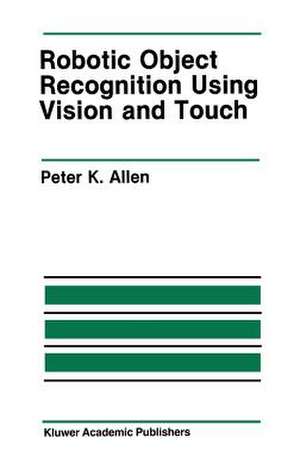
Robotic Object Recognition Using Vision and Touch
Autor Peter K Allenen Limba Engleză Hardback – 30 sep 1987
Preț: 670.90 lei
Preț vechi: 838.62 lei
-20%
Puncte Express: 1006
Carte tipărită la comandă
Livrare economică 28 noiembrie-12 decembrie
Livrare prin curier în România Termenul estimat este afișat lângă disponibilitate.
Transport gratuit pentru acest produs Plată online sau ramburs, în funcție de opțiunile comenzii.
Retur gratuit în 14 zile Comandă securizată și suport în română.
Specificații
ISBN-13: 9780898382457
ISBN-10: 0898382459
Pagini: 172
Ilustrații: XII, 172 p.
Dimensiuni: 160 x 241 x 15 mm
Greutate: 0.45 kg
Ediția:1987 edition
Editura: Springer Us
Locul publicării:New York, NY, United States
ISBN-10: 0898382459
Pagini: 172
Ilustrații: XII, 172 p.
Dimensiuni: 160 x 241 x 15 mm
Greutate: 0.45 kg
Ediția:1987 edition
Editura: Springer Us
Locul publicării:New York, NY, United States
V-ar putea interesa
-
 Arduino Robot BonanzaGordon McComb-38%Preț: 210.57 lei339.85 lei
 -
 Robotics: A Very Short IntroductionAlan Winfield-20%Preț: 57.12 lei71.12 lei
 -
 The Technological SingularityMurray Shanahan-21%Preț: 97.48 lei122.92 lei
 -
 Optimal ControlFrank L Lewis-9%Preț: 992.25 lei1090.39 lei
 -
 The Cambridge ApostlesPeter AllenPreț: 302.16 lei
 -
 THE EASY QUIZ MASTERPeter AllenPreț: 110.17 lei
 -
 Practical Field RoboticsSturges-8%Preț: 636.53 lei691.87 lei
 -
 Human-Robot Interaction in Social RoboticsTakayuki Kanda-18%Preț: 1611.04 lei1964.69 lei
 -
 Parallel Robots: Mechanics and ControlHamid D. Taghirad-20%Preț: 1784.20 lei2230.26 lei
 -
 Process Control: Problems, Techniques and ApplicationsSamuel P. Werther-27%Preț: 1165.46 lei1585.77 lei
 -
 Inspector Beadle's ProgressPeter AllenPreț: 96.23 lei
 -
 The SAGE Handbook of Complexity and ManagementPeter Allen-23%Preț: 1235.15 lei1604.09 lei
Public țintă
ResearchCuprins
1: Introduction.- 1.1 The promise of robotics.- 1.2 Improving robotic system performance.- 1.3 System description.- 1.4 Summary.- 2: Model Database.- 2.1 Object models for recognition.- 2.2 Criteria for a recognition model.- 2.3 A hierarchical model data base.- 2.4 Creating the models.- 2.5 Computing surface attributes.- 2.6 Classifying surfaces.- 2.7 Computing hole and cavity attributes.- 2.8 Example model.- 3: 2-D Vision.- 3.1 Introduction.- 3.2 Image acquisition.- 3.3 Thresholding.- 3.4 Edge detection.- 3.5 Segmentation.- 3.6 Summary.- 4: 3-D Vision.- 4.1 Introduction.- 4.2 Computational stereo.- 4.3 Image acquisition.- 4.4 Camera modeling.- 4.5 Camera calibration.- 4.6 Feature acquisition.- 4.7 Image matching.- 4.8 Depth determination.- 4.9 Interpolation.- 4.10 Summary.- 5: Tactile Sensing.- 5.1 Introduction.- 5.2 Capabilities of tactile sensors.- 5.3 Summary of tactile sensing.- 5.4 Experimental tactile sensor.- 5.5 Organization of tactile processing.- 5.6 Low level tactile processing.- 5.7 Intermediate level tactile processing.- 5.8 Summary.- 6: Integrating Vision and Touch.- 6.1 Introduction.- 6.2 Composite bicubic surfaces.- 6.3 Building level 0 surfaces.- 6.4 Building higher level surfaces.- 6.5 Building hole and cavity descriptions.- 6.6 Summary.- 7: Matching.- 7.1 Introduction.- 7.2 Design of the matcher.- 7.3 Model instantiation.- 7.4 Verification.- 7.5 Summary.- 8: Experimental Results.- 8.1 Introduction.- 8.2 Experiment 1.- 8.3 Experiment 2.- 8.4 Experiment 3.- 8.5 Experiment 4.- 8.6 Experiment 5.- 8.7 Experiment 6.- 8.8 Experiment 7.- 8.9 Summary.- 9: Conclusion.- 9.1 Introduction.- 9.2 Discovering 3-D structure.- 9.3 The multi-sensor approach.- 9.4 Limitations of the system.- 9.5 Future directions.- References.- Appendix: Bicubic Spline Surfaces.- 1. Introduction.- 2. Parametric curves and surfaces.- 3. Coons’ patches.- 3.1 Linearly interpolated patches.- 3.2 Hermite interpolation.- 3.3 Curvature continuous patches.