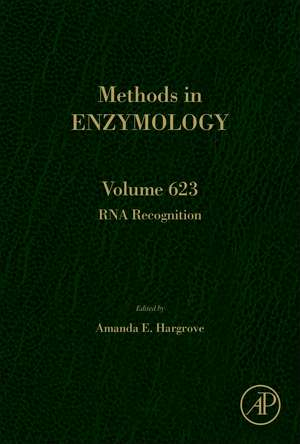
RNA Recognition: Methods in Enzymology, cartea 623
Amanda E. Hargroveen Limba Engleză Hardback – 25 iun 2019
- Provides the authority and expertise of leading contributors from an international board of authors
- Presents the latest release in the Methods in Enzymology series
- Includes the latest information on RNA Recognition
Din seria Methods in Enzymology
- 27%
 Preț: 740.96 lei
 - 27%
 Preț: 744.44 lei
 - 27%
 Preț: 745.82 lei
 - 27%
 Preț: 743.19 lei
 - 5%
 Preț: 970.67 lei
 - 27%
 Preț: 745.50 lei
 - 27%
 Preț: 743.63 lei
 - 27%
 Preț: 739.28 lei
 - 27%
 Preț: 743.51 lei
 - 27%
 Preț: 749.43 lei
 - 27%
 Preț: 745.45 lei
 - 27%
 Preț: 746.70 lei
 - 5%
 Preț: 974.31 lei
 - 27%
 Preț: 741.65 lei
 - 27%
 Preț: 744.14 lei
 - 27%
 Preț: 749.06 lei
 - 27%
 Preț: 745.39 lei
 - 27%
 Preț: 743.27 lei
 - 27%
 Preț: 742.08 lei
 -
 Preț: 464.86 lei
 -
 Preț: 464.24 lei
 - 27%
 Preț: 744.20 lei
 - 27%
 Preț: 741.39 lei
 - 27%
 Preț: 744.44 lei
 - 26%
 Preț: 308.38 lei
 - 27%
 Preț: 746.75 lei
 - 27%
 Preț: 749.06 lei
 - 27%
 Preț: 748.37 lei
 - 27%
 Preț: 744.14 lei
 - 5%
 Preț: 972.54 lei
 - 27%
 Preț: 746.63 lei
 - 27%
 Preț: 741.84 lei
 - 27%
 Preț: 745.39 lei
 - 27%
 Preț: 744.89 lei
 - 25%
 Preț: 316.76 lei
 -
 Preț: 466.82 lei
 - 27%
 Preț: 747.37 lei
 - 27%
 Preț: 747.68 lei
 - 27%
 Preț: 745.69 lei
 - 27%
 Preț: 744.94 lei
 - 27%
 Preț: 748.74 lei
 - 27%
 Preț: 746.19 lei
 - 5%
 Preț: 969.04 lei
 - 27%
 Preț: 742.70 lei
 - 27%
 Preț: 746.31 lei
 - 27%
 Preț: 743.27 lei
 - 27%
 Preț: 747.75 lei
 - 27%
 Preț: 745.08 lei
 - 27%
 Preț: 744.32 lei
 - 27%
 Preț: 740.90 lei
Preț: 915.73 lei
Preț vechi: 1321.80 lei
-31%
Puncte Express: 1374
Carte tipărită la comandă
Livrare economică 20 noiembrie-04 decembrie
Livrare prin curier în România Termenul estimat este afișat lângă disponibilitate.
Transport gratuit pentru acest produs Plată online sau ramburs, în funcție de opțiunile comenzii.
Retur gratuit în 14 zile Comandă securizată și suport în română.
Specificații
ISBN-13: 9780128168318
ISBN-10: 0128168315
Pagini: 468
Dimensiuni: 152 x 229 x 36 mm
Greutate: 0.79 kg
Editura: ELSEVIER SCIENCE
Seria Methods in Enzymology
ISBN-10: 0128168315
Pagini: 468
Dimensiuni: 152 x 229 x 36 mm
Greutate: 0.79 kg
Editura: ELSEVIER SCIENCE
Seria Methods in Enzymology
Public țintă
Biochemists, biophysicists, molecular biologists, analytical chemists, and physiologists.Cuprins
1. Preparation of cooperative RNA recognition complexes for crystallographic structural studies
Chen Qiu, Aaron C. Goldstrohm and Traci M. Tanaka Hall
2. Methods for thermal denaturation studies of nucleic acids in complex with fluorogenic dyes
Lauren M. Aufdembrink, Tanner G. Hoog, Matthew R. Pawlak, Benjamin F. Bachan, Joseph M. Heili and Aaron E. Engelhart
3. Identifying and validating small molecules interacting with RNA (SMIRNAs)
Matthew D. Disney, Sai Pradeep Velagapudi, Yue Li, Matthew G. Costales and Jessica L. Childs-Disney
4. Dynamic combinatorial chemistry as a rapid method for discovering sequence-selective RNA-binding compounds
John D. McAnany and Benjamin L. Miller
5. A click chemistry assay to identify natural product ligands for pre-microRNAs
Amanda L. Garner, Daniel A. Lorenz and Erin E. Gallagher
6. Differentiation and classification of RNA motifs using small molecule-based pattern recognition
Giacomo Padroni, Christopher S. Eubanks and Amanda E. Hargrove
7. Ligand-observed NMR techniques to probe RNA-small molecule interactions
David R. Calabrese, Colleen M. Connelly and John S. Schneekloth Jr.
8. Synthetic bPNAs as allosteric triggers of hammerhead ribozyme catalysis
Yufeng Liang, Jie Mao and Dennis Bong
9. Using Rosetta for RNA homology modeling
Andrew Watkins, Ramya Rangan and Rhiju Das
10. Monitoring co-transcriptional folding of riboswitches through helicase unwinding
Christopher P. Jones, Subrata Panja, Sarah A. Woodson and Adrian R. Ferré-D’Amaré
11. Strategies for understanding RNA recognition by X-ray and NMR methods
Aiai Sun, Kaiyi Huang, Luqian Zheng and Aiming Ren
12. Sensitive detection of structural features and rearrangements in long, structured RNA molecules
Rebecca L. Adams, Nicholas C. Huston, Rafael C.A. Tavares and Anna M. Pyle
13. A fluorescent aminosugar to rapidly screen and study RNA binders
Nihar Ranjan and Dev P. Arya
14. The use of electrospray ionization mass spectrometry to monitor RNA-ligand interactions
Danielle N. Dremann and Christine S. Chow
15. Design of RNA-targeting macrocyclic peptides
Matthew J. Walker and Gabriele Varani
16. Molecular recognition of HIV-1 RNAs with branched peptides
Ashley N. Peralta, Yumin Dai, Chringma Sherpa, Stuart F.J. Le Grice and Webster L. Santos
17. Sequence-specific recognition of structured RNA by triplex-forming peptide nucleic acids
Dziyana Hnedzko and Eriks Rozners
18. Evaluating riboswitch optimality
Hannah Wayment-Steele, Michelle Wu, Michael Gotrik and Rhiju Das
Chen Qiu, Aaron C. Goldstrohm and Traci M. Tanaka Hall
2. Methods for thermal denaturation studies of nucleic acids in complex with fluorogenic dyes
Lauren M. Aufdembrink, Tanner G. Hoog, Matthew R. Pawlak, Benjamin F. Bachan, Joseph M. Heili and Aaron E. Engelhart
3. Identifying and validating small molecules interacting with RNA (SMIRNAs)
Matthew D. Disney, Sai Pradeep Velagapudi, Yue Li, Matthew G. Costales and Jessica L. Childs-Disney
4. Dynamic combinatorial chemistry as a rapid method for discovering sequence-selective RNA-binding compounds
John D. McAnany and Benjamin L. Miller
5. A click chemistry assay to identify natural product ligands for pre-microRNAs
Amanda L. Garner, Daniel A. Lorenz and Erin E. Gallagher
6. Differentiation and classification of RNA motifs using small molecule-based pattern recognition
Giacomo Padroni, Christopher S. Eubanks and Amanda E. Hargrove
7. Ligand-observed NMR techniques to probe RNA-small molecule interactions
David R. Calabrese, Colleen M. Connelly and John S. Schneekloth Jr.
8. Synthetic bPNAs as allosteric triggers of hammerhead ribozyme catalysis
Yufeng Liang, Jie Mao and Dennis Bong
9. Using Rosetta for RNA homology modeling
Andrew Watkins, Ramya Rangan and Rhiju Das
10. Monitoring co-transcriptional folding of riboswitches through helicase unwinding
Christopher P. Jones, Subrata Panja, Sarah A. Woodson and Adrian R. Ferré-D’Amaré
11. Strategies for understanding RNA recognition by X-ray and NMR methods
Aiai Sun, Kaiyi Huang, Luqian Zheng and Aiming Ren
12. Sensitive detection of structural features and rearrangements in long, structured RNA molecules
Rebecca L. Adams, Nicholas C. Huston, Rafael C.A. Tavares and Anna M. Pyle
13. A fluorescent aminosugar to rapidly screen and study RNA binders
Nihar Ranjan and Dev P. Arya
14. The use of electrospray ionization mass spectrometry to monitor RNA-ligand interactions
Danielle N. Dremann and Christine S. Chow
15. Design of RNA-targeting macrocyclic peptides
Matthew J. Walker and Gabriele Varani
16. Molecular recognition of HIV-1 RNAs with branched peptides
Ashley N. Peralta, Yumin Dai, Chringma Sherpa, Stuart F.J. Le Grice and Webster L. Santos
17. Sequence-specific recognition of structured RNA by triplex-forming peptide nucleic acids
Dziyana Hnedzko and Eriks Rozners
18. Evaluating riboswitch optimality
Hannah Wayment-Steele, Michelle Wu, Michael Gotrik and Rhiju Das