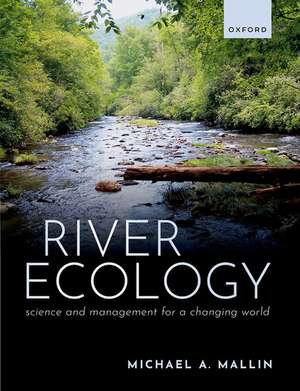
River Ecology
Autor Michael A Mallinen Limba Engleză Hardback – 26 ian 2024
Preț: 656.01 lei
Preț vechi: 1034.30 lei
-37%
Puncte Express: 984
Preț estimativ în valută:
115.97€ • 138.27$ • 100.59£
115.97€ • 138.27$ • 100.59£
Carte tipărită la comandă
Livrare economică 13-24 martie
Specificații
ISBN-13: 9780199549511
ISBN-10: 0199549516
Pagini: 432
Ilustrații: 133 colour line and half tones
Dimensiuni: 203 x 241 x 38 mm
Greutate: 1.09 kg
Editura: Oxford University Press
Locul publicării:Oxford, United Kingdom
ISBN-10: 0199549516
Pagini: 432
Ilustrații: 133 colour line and half tones
Dimensiuni: 203 x 241 x 38 mm
Greutate: 1.09 kg
Editura: Oxford University Press
Locul publicării:Oxford, United Kingdom
Notă biografică
Michael Mallin is Research Professor at the Center for Marine Science, University of North Carolina, Wilmington, USA. His recent research efforts have focused on interrelationships between human landscapes and receiving waters, particularly in terms of microbial contamination and biochemical oxygen demand inputs, and the effectiveness of mitigation strategies to protect stream ecosystems. Professor Mallin is actively involved in science and management boards concerning watershed issues, and his research results have been utilized by the State General Assembly to revise coastal development policies in North Carolina. He was selected as a 2001 Aldo Leopold Environmental Leadership Fellow through the Ecological Society of America.