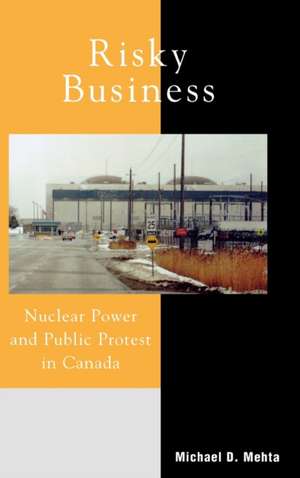
Risky Business: Nuclear Power and Public Protest in Canada
Autor Michael D. Mehtaen Limba Engleză Hardback – 14 dec 2004
Canada about the regulation of nuclear power, Risky Business provides important scholarly attention to nuclear risk assessment and the role of the public in technological and scientific debates.
Preț: 535.15 lei
Preț vechi: 814.31 lei
-34%
Puncte Express: 803
Carte tipărită la comandă
Livrare economică 07-21 decembrie
Livrare prin curier în România Termenul estimat este afișat lângă disponibilitate.
Transport gratuit pentru acest produs Plată online sau ramburs, în funcție de opțiunile comenzii.
Retur gratuit în 14 zile Comandă securizată și suport în română.
Specificații
ISBN-13: 9780739109106
ISBN-10: 0739109103
Pagini: 128
Dimensiuni: 158 x 232 x 16 mm
Greutate: 0.32 kg
Editura: Bloomsbury Publishing
Colecția Lexington Books
Locul publicării:New York, United States
ISBN-10: 0739109103
Pagini: 128
Dimensiuni: 158 x 232 x 16 mm
Greutate: 0.32 kg
Editura: Bloomsbury Publishing
Colecția Lexington Books
Locul publicării:New York, United States
Cuprins
Chapter 1 Introduction: The Democracy-Technocracy Quandary
Chapter 2 Risk Assessment in the Public Policy Domain
Chapter 3 Nuclear Power and Public Protest
Chapter 4 The Canadian Nuclear Industry
Chapter 5 The Battle Over the Pickering Nuclear Generating Station
Chapter 6 David and Goliath Meet on the Shore of Lake Ontario
Chapter 7 The Future of Nuclear Power in Canada
Chapter 2 Risk Assessment in the Public Policy Domain
Chapter 3 Nuclear Power and Public Protest
Chapter 4 The Canadian Nuclear Industry
Chapter 5 The Battle Over the Pickering Nuclear Generating Station
Chapter 6 David and Goliath Meet on the Shore of Lake Ontario
Chapter 7 The Future of Nuclear Power in Canada
Recenzii
Michael Mehta's book Nuclear Power and Public Protest in Canada is a timely and excellent contribution to the role of social movements in shaping risk debates and influencing the trajectory of a technology. Following a strong narrative line, Mehta maps the story of how a small NGO battled a major nuclear power generating station and the Atomic Energy Control Board. The highly readable story is set against the context of risk assessment and public policy. It is rich case studies like this that allow us to probe into, and better understand, the details of the challenges posed by technology in a risk society.