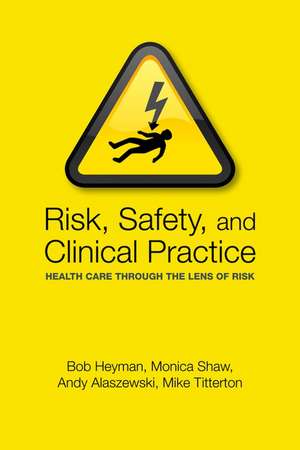
Risk, Safety and Clinical Practice: Health care through the lens of risk
Autor Bob Heyman, Andy Alaszewski, Monica Shaw, Mike Tittertonen Limba Engleză Paperback – 26 noi 2009
În evaluarea oricărui sistem modern de sănătate, implementarea unui algoritm de stratificare a riscului devine fundamentul deciziei clinice. Considerăm că Risk, Safety and Clinical Practice oferă o perspectivă critică esențială asupra modului în care „gândirea bazată pe risc” transformă organizarea serviciilor medicale. Analiza propusă de Bob Heyman și colegii săi pornește de la premisa că avansul tehnologic, în special în domeniul geneticii și al markerilor biomedicali, impune o reevaluare a modului în care gestionăm siguranța pacientului. Nu este doar un manual teoretic; textul examinează cum conștiința socială a riscului — alimentată de controverse precum vaccinul MMR sau crizele de siguranță alimentară — coexistă paradoxal cu o speranță de viață în creștere.
Recomandăm această lucrare pentru rigoarea cu care tratează supravegherea populațională și țintirea grupurilor vulnerabile. Stilul este precis, clinic, evitând abstractizările inutile și concentrându-se pe limitările cadrelor actuale de management. Clinicienii care folosesc Medicine, Risk, Discourse and Power ca referință vor găsi aici instrumentele necesare pentru a trece de la analiza sociologică la aplicarea practică în clinică, beneficiind de o structură axată pe luarea deciziilor. Față de abordările strict tehnice, această ediție publicată de OUP OXFORD integrează dimensiunea umană și politică a incertitudinii, oferind o bază solidă pentru evaluarea critică a noilor tehnologii medicale înainte ca acestea să fie integrate în protocoalele de rutină.
Preț: 499.22 lei
Preț vechi: 722.89 lei
-31%
Carte tipărită la comandă
Livrare economică 18-23 iunie
Specificații
ISBN-10: 0198569009
Pagini: 270
Ilustrații: 1 black and white line drawing
Dimensiuni: 156 x 233 x 15 mm
Greutate: 0.43 kg
Ediția:New.
Editura: OUP OXFORD
Colecția OUP Oxford
Locul publicării:Oxford, United Kingdom
V-ar putea interesa
-
 Introduction to Risk Management and InsuranceMark S Dorfman-15%Preț: 1168.56 lei1374.78 lei
 -
 Ethical Smart Care: Policy, Design, and Everyday UseChristine Hine-28%Preț: 239.66 lei333.24 lei
 -
 Risk: A Very Short IntroductionBaruch Fischhoff-21%Preț: 53.90 lei68.49 lei
 -
 These Strange New MindsChristopher SummerfieldPreț: 136.86 lei
 -
 How Not to Die (Too Soon)Devi SridharPreț: 151.99 lei
 -
 -36%Preț: 176.76 lei275.07 lei
 -
 Sabiston Textbook of Surgery: The Biological Basis of Modern Surgical PracticeDouglas Scott Tyler-31%Preț: 1097.35 lei1580.63 leiRecomandat
 -
 -30%Preț: 274.41 lei393.89 lei
 -
 Kumar and Clark's Clinical MedicineDavid Randall-28%Preț: 458.19 lei632.94 leiRecomandat
 -
 -35%Preț: 156.78 lei240.83 lei
 -
 -5%Preț: 333.69 lei351.25 lei
 -
 -27%Preț: 85.37 lei117.12 lei
 -
 Preț: 369.01 lei
 -
 Safe DangerBen SwirePreț: 138.05 lei
 -
 Reducing Risk in Health and Social CareTerri Salt-5%Preț: 239.05 lei251.63 lei
 -
 -27%Preț: 204.16 lei278.69 lei
 -
 Preț: 328.67 lei
 -
 Running the RiskDavid ReidPreț: 137.28 lei
 -
 -20%Preț: 1239.48 lei1549.35 lei
 -
 -15%Preț: 563.47 lei662.90 lei
De ce să citești această carte
Această carte este esențială pentru managerii de spitale și clinicieni deoarece oferă un cadru de analiză critică a protocoalelor de siguranță. Cititorul câștigă capacitatea de a naviga între presiunea tehnologică și așteptările sociale, învățând să identifice erorile de presupunere în managementul riscului. Este o resursă valoroasă pentru oricine dorește să înțeleagă cum se vor structura sistemele de sănătate în următoarele două decenii.
Despre autor
Echipa de autori este formată din academicieni și practicieni de renume, conduși de Bob Heyman și Andy Alaszewski, experți în sociologia riscului și managementul sănătății. Andy Alaszewski este recunoscut internațional pentru cercetările sale privind modul în care profesioniștii din domeniul sănătății utilizează informația în luarea deciziilor sub presiune. Contribuțiile lui Monica Shaw și Mike Titterton aduc o dimensiune practică asupra politicilor sociale și siguranței, făcând din acest colectiv o autoritate în analiza intersecției dintre medicină, societate și incertitudine.
Descriere
Recenzii
The book is the only one of its kind that really focuses on risk from the inside of healthcare delivery and outside cultural/societal influences.
This is a smart text about a field that has become very popular in recent decades. The authors are all leading thinkers in this area and have written a book that appears to try to appeal to a wide audience of practitioner and academic...There are many more messages to be unearthed in a book packed with different ways of understanding things. So, enjoy the book! It has a great deal to offer the reader.