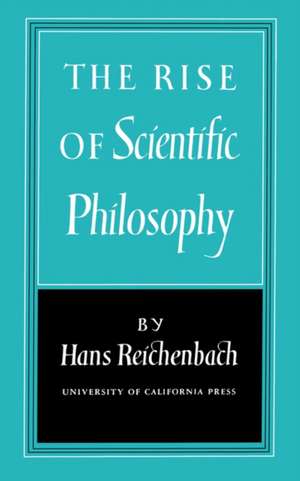
Rise Scientific Philosophy
Autor Reichenbachen Limba Engleză Hardback – 30 iun 1992
În lucrarea Rise Scientific Philosophy, Reichenbach propune o schimbare de paradigmă în studiul filozofiei, tratând disciplina nu ca pe o colecție de sisteme dogmatice, ci ca pe o investigație riguroasă a problemelor fundamentale. Remarcăm cum autorul deconstruiește eșecurile raționalismului clasic — reprezentat de figuri precum Platon sau Kant — argumentând că încercările lor de a oferi soluții morale și fizice absolute au fost dictate de nevoi psihologice, într-o eră în care știința nu deținea încă instrumentele necesare pentru răspunsuri veridice.
Ediția publicată de University of California Press evidențiază modul în care progresele din matematică și fizica modernă au permis filozofiei să părăsească zona speculațiilor metafizice. Reichenbach nu se limitează la o critică a trecutului, ci definește rolul noului filozof ca analist al metodelor și rezultatelor științifice. Structura textului facilitează înțelegerea unor concepte complexe despre atom, univers și cauzalitate, oferind cititorului baza factuală necesară pentru a naviga o lume lipsită de explicații supranaturale. Credem că forța acestui volum rezidă în capacitatea de a transforma filozofia dintr-un câmp de opinii contradictorii într-o știință care descoperă adevărul etapizat.
Ca alternativă la The Science of Philosophy de F. George pentru cursurile de filozofia științei sau epistemologie, acest volum prezintă avantajul unei perspective istorice mai vaste asupra eșecurilor raționalismului. În timp ce F. George se concentrează pe viziunea comportamentală și cibernetică, Reichenbach oferă o sinteză logică ce integrează fizica și matematica în fundamentul gândirii critice moderne. Totodată, spre deosebire de The Failures of Philosophy – A Historical Essay de Stephen Gaukroger, care analizează colapsul disciplinei, lucrarea de față construiește un drum constructiv înainte, validând filozofia ca instrument de cunoaștere activ.
Preț: 242.02 lei
Carte tipărită la comandă
Livrare economică 06-20 iunie
Specificații
ISBN-10: 0520010558
Pagini: 348
Dimensiuni: 125 x 213 x 20 mm
Greutate: 0.38 kg
Editura: University of California Press
V-ar putea interesa
-
 The New GodsE. M. CioranPreț: 181.55 lei
 -
 MetalogicHunterPreț: 254.55 lei
 -
 The Genesis of Heidegger′s Being and TimeTheodore KisielPreț: 318.53 lei
 -
 The Cynics – The Cynic Movement in Antiquity & Its LegacyR Bracht BranhamPreț: 288.77 lei
 -
 The Art of Living – Socratic Reflections from Plato to Foucault (Paper)Alexander NehemasPreț: 219.17 lei
 -
 The Body/Body Problem – Selected EssaysArthur C DantoPreț: 237.54 lei
 -
 Observations on the Feeling of the Beautiful and SublimeImmanuel KantPreț: 196.96 lei
 -
 Preț: 264.60 lei
 -
 Shame and Necessity, Second EditionBernard WilliamsPreț: 203.17 lei
 -
 Preț: 242.75 lei
 -
 Preț: 209.46 lei
 -
 The Punitive SocietyMichel FoucaultPreț: 382.07 lei
 -
 Philosophy of Law: Introducing JurisprudenceProfessor Jeffrey Brand-25%Preț: 194.16 lei259.76 lei
 -
 -46%Preț: 85.34 lei157.63 lei
 -
 The Trouble with Being BornE. M. CioranPreț: 88.03 lei
 -
 To Have or To Be?Erich Fromm-25%Preț: 150.43 lei200.00 lei
 -
 Taking Rights SeriouslyProfessor Ronald Dworkin-26%Preț: 173.48 lei232.94 lei
 -
 The Art of WanderingMerlin CoverleyPreț: 172.46 lei
De ce să citești această carte
Recomandăm această carte celor care doresc să înțeleagă cum știința a redefinit gândirea critică. Cititorul câștigă o perspectivă clară asupra modului în care logica și observația au înlocuit speculația metafizică. Este un titlu esențial pentru studenții la filozofie sau științe umane, oferind o bază solidă pentru interpretarea modernă a spațiului, timpului și cauzalității, fără a necesita o pregătire matematică avansată.