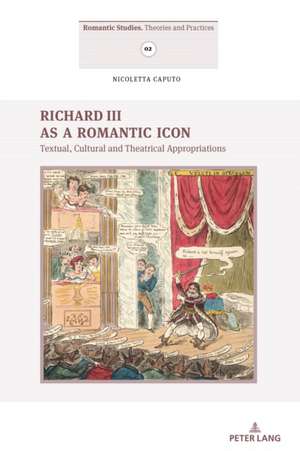
Richard III as a Romantic Icon: Romantic Studies, cartea 2
Autor Nicoletta Caputoen Limba Engleză Paperback – 14 dec 2018
(Keir Elam, University of Bologna)
Preț: 487.21 lei
Preț vechi: 632.74 lei
-23%
Puncte Express: 731
Carte tipărită la comandă
Livrare economică 21 noiembrie-05 decembrie
Livrare prin curier în România Termenul estimat este afișat lângă disponibilitate.
Transport gratuit pentru acest produs Plată online sau ramburs, în funcție de opțiunile comenzii.
Retur gratuit în 14 zile Comandă securizată și suport în română.
Specificații
ISBN-13: 9783034329989
ISBN-10: 3034329989
Pagini: 270
Dimensiuni: 150 x 225 x 15 mm
Greutate: 0.38 kg
Ediția:Nouă
Editura: PETER LANG
Colecția Romantic Studies
Seria Romantic Studies
ISBN-10: 3034329989
Pagini: 270
Dimensiuni: 150 x 225 x 15 mm
Greutate: 0.38 kg
Ediția:Nouă
Editura: PETER LANG
Colecția Romantic Studies
Seria Romantic Studies
Notă biografică
Nicoletta Caputo is a researcher at the University of Pisa. She holds a PhD in English Studies and has been Folger Shakespeare Library Fellow. She has published articles and a volume on Tudor drama (Playing with Power, 1998); essays on nineteenth-century stage history and on contemporary English theatre and fiction, as well as a monograph on Angela Carter's Nights at the Circus (New Wine in Old Bottles, 2010).
Cuprins
Introduction: Richard III as a «Romantic» Icon - Part I: The «True» Richard III - Revising the Tudor Myth in the Eighteenth Century - Richard's Reputation in Romantic Times - A «Romantic» Richard - Part II: King Richard III on the Page - Eighteenth-Century Character Criticism - The Romantic Critics - Two Unhappy Stage Adaptations - Part III: King Richard III on the Stage - A Hybrid Richard - The «Ogreish» Cooke - The «Harlequin» Kean - Conclusion - Bibliography
Descriere
The book investigates the Romantics' fascination with the character of Richard III and explores his iconic centrality from the historical, the textual and the theatrical points of view. The multiplicity of Romantic-period Richards mirrored the age, as it was related to the cultural and ideological multiplicity of the Romantic era itself.