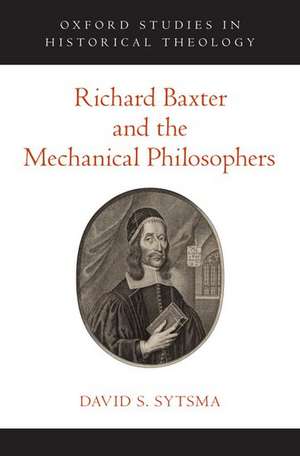
Richard Baxter and the Mechanical Philosophers: Oxford Studies in Historical Theology
Autor David S. Sytsmaen Limba Engleză Hardback – 24 aug 2017
Destinată nivelului de cercetare doctorală și referinței profesionale în istoria ideilor, această monografie semnată de David S. Sytsma recalibrează înțelegerea noastră asupra unuia dintre cei mai influenți puritani ai secolului al XVII-lea. Deși Richard Baxter este recunoscut tradițional pentru literatura sa devoțională, volumul de față dezvăluie un fin cunoscător al teologiei scolastice și un polemist activ în dezbaterile filozofice ale epocii sale. Apreciem modul în care autorul integrează analiza teologică cu istoria științei, plasându-l pe Baxter în centrul controversei împotriva filozofiei mecaniciste promovate de Descartes și Gassendi, imediat după înființarea Royal Society.
Structura este deopotrivă cronologică și tematică, oferind o perspectivă rară asupra modului în care un teolog conservator a răspuns provocărilor modernității timpurii. Credem că valoarea fundamentală a lucrării rezidă în utilizarea unor surse anterior neglijate, cum este tratatul Methodus Theologiae Christianae, pentru a explica viziunea lui Baxter despre creație ca reflexie analogică a atributelor divine (vestigia Trinitatis). Această abordare completează perspectiva oferită de In Pursuit of Purity, Unity, and Liberty de Paul Chang-Ha Lim, care se concentrează pe ecleziologia lui Baxter; în timp ce Lim analizează structurile bisericești și libertatea religioasă, Sytsma adaugă dimensiunea metafizică și fundamentele filozofice care au ghidat interacțiunile lui Baxter cu savanți precum Robert Boyle.
Tonul lucrării este riguros și precis, evitând generalizările și ancorând fiecare argument în corespondența și tratatele de epocă. Este o lectură densă, care demonstrează cum teologia reformată a interacționat, uneori ostil, alteori acomodant, cu emergența științei moderne.
Din seria Oxford Studies in Historical Theology
- 14%
 Preț: 715.28 lei
 - 33%
 Preț: 546.14 lei
 - 33%
 Preț: 537.00 lei
 - 31%
 Preț: 485.59 lei
 - 33%
 Preț: 536.73 lei
 - 27%
 Preț: 484.54 lei
 - 20%
 Preț: 236.10 lei
 - 31%
 Preț: 507.40 lei
 - 31%
 Preț: 383.28 lei
 - 30%
 Preț: 464.05 lei
 - 33%
 Preț: 545.72 lei
 - 33%
 Preț: 608.69 lei
 - 33%
 Preț: 607.87 lei
 - 33%
 Preț: 727.45 lei
 - 14%
 Preț: 677.67 lei
 - 45%
 Preț: 738.18 lei
 - 14%
 Preț: 695.63 lei
 - 14%
 Preț: 629.65 lei
 - 46%
 Preț: 769.96 lei
 -
 Preț: 364.50 lei
 - 14%
 Preț: 597.44 lei
 -
 Preț: 347.69 lei
 - 27%
 Preț: 982.58 lei
 - 21%
 Preț: 371.23 lei
 - 14%
 Preț: 602.65 lei
 - 6%
 Preț: 543.71 lei
 - 6%
 Preț: 834.10 lei
 - 14%
 Preț: 676.41 lei
 -
 Preț: 301.99 lei
 -
 Preț: 313.32 lei
 - 45%
 Preț: 664.30 lei
 - 14%
 Preț: 710.29 lei
 - 24%
 Preț: 514.61 lei
 - 12%
 Preț: 350.72 lei
 - 18%
 Preț: 490.54 lei
 - 14%
 Preț: 685.68 lei
 - 13%
 Preț: 410.09 lei
 - 14%
 Preț: 861.65 lei
 - 7%
 Preț: 578.25 lei
 - 27%
 Preț: 1012.31 lei
 - 9%
 Preț: 743.32 lei
 - 27%
 Preț: 952.08 lei
 - 34%
 Preț: 675.98 lei
 - 14%
 Preț: 756.83 lei
 - 7%
 Preț: 573.28 lei
Preț: 711.08 lei
Preț vechi: 775.18 lei
-8%
Carte tipărită la comandă
Livrare economică 05-16 iunie
Specificații
ISBN-10: 0190274875
Pagini: 354
Dimensiuni: 155 x 236 x 20 mm
Greutate: 0.59 kg
Editura: Oxford University Press
Colecția OUP USA
Seria Oxford Studies in Historical Theology
Locul publicării:New York, United States
V-ar putea interesa
-
 Karl Barth: Against HegemonyTimothy J. Gorringe-15%Preț: 362.99 lei425.93 lei
 -
 Postcolonial Criticism and Biblical InterpretationR. S. Sugirtharajah-8%Preț: 355.47 lei388.11 lei
 -
 The Church in Anglo-Saxon SocietyJohn Blair-13%Preț: 495.76 lei570.61 lei
 -
 -23%Preț: 436.74 lei566.53 lei
 -
 Byzantine Philosophy and its Ancient SourcesKaterina Ierodiakonou-14%Preț: 350.86 lei409.38 lei
 -
 Beliefs and the Dead in Reformation EnglandPeter Marshall-23%Preț: 357.75 lei467.55 lei
 -
 A History of the Churches in AustralasiaIan Breward-33%Preț: 583.69 lei875.58 lei
 -
 Reformation in Britain and IrelandFelicity Heal-23%Preț: 463.52 lei602.73 lei
 -
 Finding Mr. GoldmanDavid RhodesPreț: 81.96 lei
 -
 C. S. Lewis and the Crisis of a ChristianGregory S. CootsonaPreț: 102.02 lei
 -
 JezebelBob LarsonPreț: 151.50 lei
 -
 A Place of HealingJoni Eareckson-TadaPreț: 98.53 lei
 -
 Preț: 425.72 lei
 -
 Qur'an in ConversationMichael BirkelPreț: 265.78 lei
 -
 Face to Face with GodBill JohnsonPreț: 105.35 lei
 -
 Preț: 69.13 lei
De ce să citești această carte
Această lucrare este esențială pentru cercetătorii interesați de intersecția dintre religie și știință în secolul al XVII-lea. Cititorul câștigă o înțelegere profundă a rezistenței teologice față de mecanicism, dincolo de clișeele istorice. Este o recomandare certă pentru cei care doresc să exploreze cum concepte precum legile mișcării sau natura sufletului au fost dezbătute într-un cadru care îmbina rigoarea scolastică cu noile descoperiri experimentale.
Despre autor
David S. Sytsma este un cercetător specializat în istoria teologiei și a filozofiei din perioada modernă timpurie. Prin această contribuție publicată de Oxford University Press, el se afirmă ca un expert în opera lui Richard Baxter și în scolastica reformată. Activitatea sa academică se concentrează pe recuperarea nuanțelor intelectuale ale puritanismului englez, demonstrând complexitatea dialogului dintre dogmatica creștină și curentele filozofice emergente ale secolului al XVII-lea, precum epicureismul și cartezianismul.
Descriere
Recenzii
It is fairly obvious that Sytsma's book will set both the standard and the agenda for Baxter scholarship for many years to come. But its importance lies in more than that. It can be profitably read not just by those antecedently interested in Baxter. Scholars concerned with Margaret Cavendish, Anne Conway, Ralph Cudworth, Descartes, Gassendi, Hobbes, Gottfried Leibniz, John Locke, More, or any number of other figures will surely benefit from learning about Baxter and comparing and contrasting him with their philosopher of special interest. More generally, the book is valuable because it provides us with the opportunity to challenge some widely held preconceptions and to see and think about early modern philosophy in a different way. For this, as much as anything, we should be grateful to Sytsma.
The author has done a great job in showing that Baxter was a philosophical theologian with a deep understanding of the developments in natural philosophy of his day.
The centrality of the celebrated polemicist Richard Baxter to the debates over science and religion in seventeenth-century England has often been asserted but never seriously investigated. Now, thanks to David Sytsma's detailed and thoughtful analysis of the entire corpus of Baxter's works, we can fully appreciate the complex manner in which a Puritan polymath sought to engage with key constituents of the new science, in a heroic effort to safeguard the old faith.
A distinguished work of scholarship that restores Richard Baxter to a fitting place of influence as a Philosopher-theologian who engaged head on with the rise of mechanical philosophy, even as he remained open to new ways of thinking. Sytsma's book sheds welcome light not just on Baxter's engagement but on vital developments in early modern European philosophy and the rise of science.
Richard Baxter has long been known as an important Puritan theologian, but the significance of his conversations with the philosophers of his day has not yet been fully appreciated. In this excellent analysis of Baxter's evaluation of mechanical philosophies, David Sytsma makes a major contribution to filling the lacuna by showing, from a wide range of sources, how theological concerns guided Baxter in his response to the new philosophical ideas.
this book is far more than a study of Baxter, impressive (and unprecedented) though it is in that role: it is also an extraordinarily wide-ranging history of seventeenth-century ideas ... Baxterians will delight that the thought of their man has been accorded such respect, but this study can be read with hardly less profit for its clear exposition not only of the thinking of individuals but of the period's debates about the nature of the soul, the Trinity, Aristotelianism, Epicureanism, natural law, and a host of other topics. And, it should be added, all this is done with organizational confidence and fine stylistic lucidity. It is a remarkable achievement, to be warmly welcomed and applauded.
in this important book Sytsma has clearly achieved what he set out to accomplish, that is question the prevailing image of Richard Baxter as a minister mainly concerned with pastoral theology.
This book is a distinguished work of scholarship, and Sytsma's discussion and contextualization of Baxter's philosophical theology is remarkable. Sytsma's work is a welcome addition to the scholarship of Baxter and Reformed and Puritan theologians in the early modern period, and Sytsma makes a major contribution by analyzing a wide range of Baxter's unexamined theoretical works. I highly recommend it.